Identification and location
The pyramid of Pepi I, a ruler of the 6th Dynasty also called Meryra, lies at South Saqqara. His royal complex comprises the pyramid, the funerary apartments and a cult temple to the east. The surrounding necropolis was enriched with queens’ pyramids and tombs of dignitaries. The chronology of the reign varies according to historical conventions; a date around 2330–2280 BC serves as an approximate reference point, not as a precise date for each part of the necropolis. The name Men-nefer, attached to the pyramid, contributed to the later name of Memphis.
General presentation
The site is essential for the study of the Pyramid Texts, of which the inscribed walls of Pepi I form, according to the Orient Méditerranée research team, the largest group currently known. The documentation also concerns the development of the mortuary temple, the formation of the queens’ necropolis and the links between royal power, family and cult staff. These levels must not be confused: the king’s pyramid and the neighbouring monuments have distinct owners, programmes and sometimes phases.
Monuments and remains
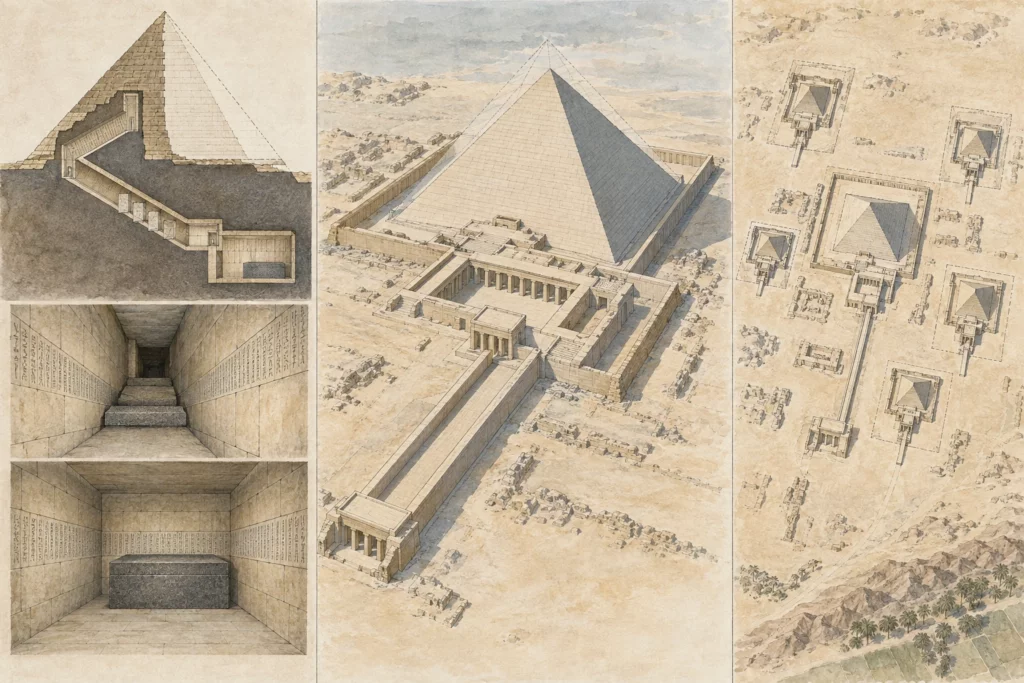
The pyramid has lost a large part of its elevation. Beneath the mass of masonry, the funerary arrangement comprises a descending entrance, passages controlled by portcullises and chambers with inscribed walls. The antechamber and the king’s chamber were part of the internal route. To the east lay the mortuary temple, cleared and studied by the mission. The discoveries of blocks and carved fragments show the extent of the destruction and displacement. To the south and west, research has revealed several queens’ complexes; the Institut français d’archéologie orientale (IFAO, French Institute of Oriental Archaeology) presents a summary map of them. It would be misleading to draw on a single image a complete and certain plan of all the monuments and all their phases.
Chronology and building phases
The core of the complex belongs to the reign of Pepi I. The modern excavations, begun in the 1960s for the pyramid and the temple, were followed by campaigns to study and restore the funerary apartments. From the late 1980s, exploration of the surroundings brought to light a true royal necropolis of queens. The dates and parentage proposed for each queen require separate examination; some burials in the area belong to later generations. The presence of the tomb of a priest of the pyramid named Meryra-ankh is also a reminder of the continuity of the cult staff.
History and functions
The pyramid and its temple served the cult of the dead king. The spells carved in the chambers were intended to favour his access to an eternal existence and to organise his divine future. The placing of queens’ monuments near the royal tomb expressed dynastic ties and gave each owner a funerary space of her own. The tombs of cult officials and other dignitaries bear witness to a society organised around the complex. Neither spatial proximity nor a shared general period is enough to prove an identical function for all the structures.
Excavations and the history of research
The Pyramid Texts of Pepi I have been studied from the inscriptions in place and from thousands of fragments. The mission put some blocks back in their original position where a reconstruction was well founded. The IFAO’s publications give surveys, facsimiles and analyses. University College London reports an inscribed fragment from the antechamber in the Petrie Museum: its present place of keeping must be distinguished from its original context. The builders’ marks studied by Vassil Dobrev provide another type of evidence, linked to the work gangs and the building site, without replacing the funerary inscriptions.
State of preservation and research questions
Preservation is uneven: the exterior is badly degraded, while the texts, sometimes fragmentary, can be reconstructed by comparison and joins. Any reconstruction must show what is still in place, what has been put back and what remains hypothetical.
Sources
Main sources: University of Geneva, French-Swiss Archaeological Mission at Saqqara, ‘Textes des Pyramides’ (in French), https://www.unige.ch/mafssaqqara/textes-des-pyramides; IFAO, ‘Saqqara’ (in French), https://www.ifao.egnet.net/recherche/archeologie/saqqara/; IFAO, ‘Les textes de la pyramide de Pépy Ier’ (in French), https://www.ifao.egnet.net/uploads/publications/sommaires/IF858.pdf; UCL, ‘King Pepy I’, https://www.ucl.ac.uk/museums-static/digitalegypt/chronology/kingpepyI.html; UCL, ‘Memphis: The development in the Old Kingdom’, https://www.ucl.ac.uk/museums-static/digitalegypt/memphis/ok.html; V. Dobrev, ‘Les marques de la pyramide de Pépy Ier’ (in French), https://www.ifao.egnet.net/bifao/098/08 (consulted on 27 September 2026).