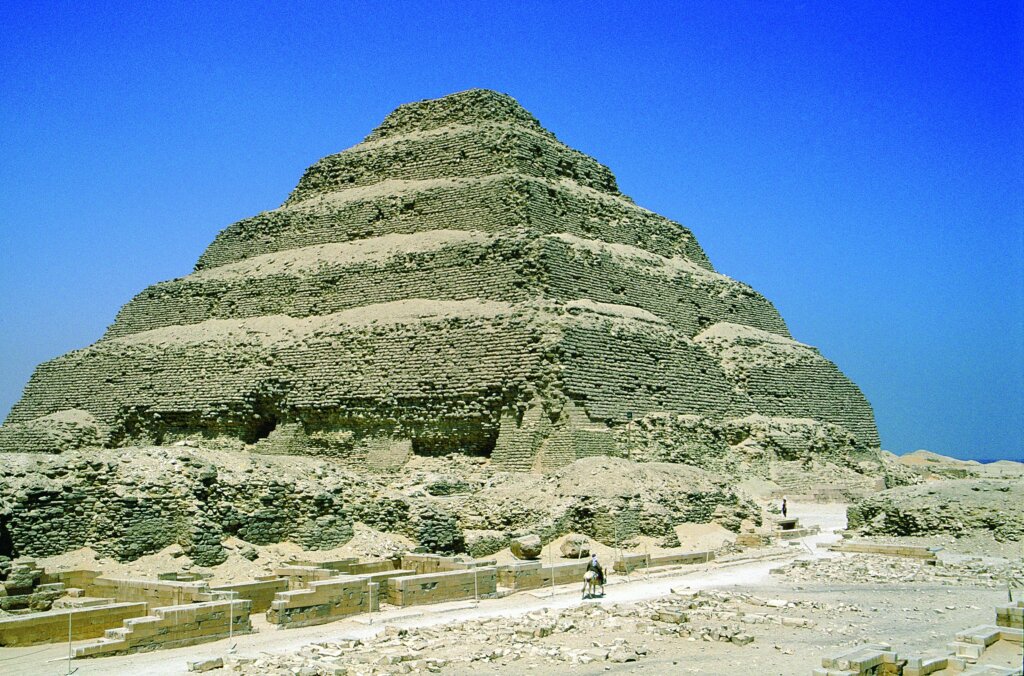
Saqqara is a vast necropolis in the Memphis region. Its monuments belong to different periods and practices; the Step Pyramid of Djoser is only its most famous landmark. Two sub-groups, north and south, organise the articles here.
In brief
Saqqara stretches across the desert plateau overlooking the valley, south-west of Cairo. It was one of the main cemeteries of Memphis, the great capital of the Old Kingdom. Its name probably comes from Sokar, a god of the necropolis. Kings and nobles of the first two dynasties were buried there, then Djoser had his Step Pyramid raised there, which UNESCO presents as the first stone building and the first pyramid ever constructed. The site is part of the property ‘Memphis and its Necropolis’, inscribed on the World Heritage List in 1979.
What you discover
The necropolis reads like an open-air museum. The great mastabas of the first dynasties precede the complex of Djoser. Then come the pyramids of the 5th and 6th Dynasties, those of Userkaf, Unas and Teti and, further south, of Pepi I, Merenre and Pepi II, surrounded by the richly decorated tombs of dignitaries. UNESCO counts more than nine thousand rock-cut tombs across the whole Memphite necropolis, from the 1st to the 30th Dynasty and down to the Graeco-Roman period.
Saqqara does not stop with the Old Kingdom. The general Horemheb had a tomb built there before becoming king; he was finally buried in the Valley of the Kings. The galleries of the Serapeum received the Apis bulls, regarded as an incarnation of the god Ptah, from the 18th Dynasty to the Ptolemaic period. Finally, the monastery of Apa Jeremias recalls Coptic Egypt, down to the 8th century.
What to look at
In the pyramid of Unas (c. 2375–2345 BC), the burial chamber is the earliest in a pyramid to bear texts. These columns of hieroglyphs, the Pyramid Texts, were meant to guide the dead king into the afterlife. They show that a royal tomb could also be a book carved in stone.
Its history
Within a single area, Saqqara makes it possible to follow the transformation of funerary forms: from the mastaba to the step pyramid, then to smooth-sided pyramids and the decorated tombs of the elite. It also shows that the history of a necropolis continues long after its most visible monuments were built, with the cults of sacred animals and Christian foundations. The Imhotep Museum, at the entrance to the site, displays objects from all these periods. Excavations continue and regularly bring new tombs to light.
How to explore the articles
North and central Saqqara brings together the first great necropolises, the complex of Djoser, several Old Kingdom pyramids and the later complexes. South Saqqara follows the royal projects of the 6th Dynasty. These divisions are for navigating the articles; they are not absolute archaeological boundaries.
Sources
UNESCO, Memphis and its Necropolis: https://whc.unesco.org/en/list/86
Egyptian ministry, Saqqara: https://egymonuments.gov.eg/archaeological-sites/saqqara/