In brief
At Saqqara, about thirty kilometres south of Cairo, the New Kingdom necropolis extends south of the causeway of the pyramid of Unas. Horemheb had his tomb built there when he was commander-in-chief, under Tutankhamun and then under Ay. Once king, the last of the 18th Dynasty, he had a new tomb cut in the Valley of the Kings, KV57. The Memphite monument is therefore that of a dignitary, showing how a man who had risen to the top of the state wished to be seen before he reigned.
What you discover
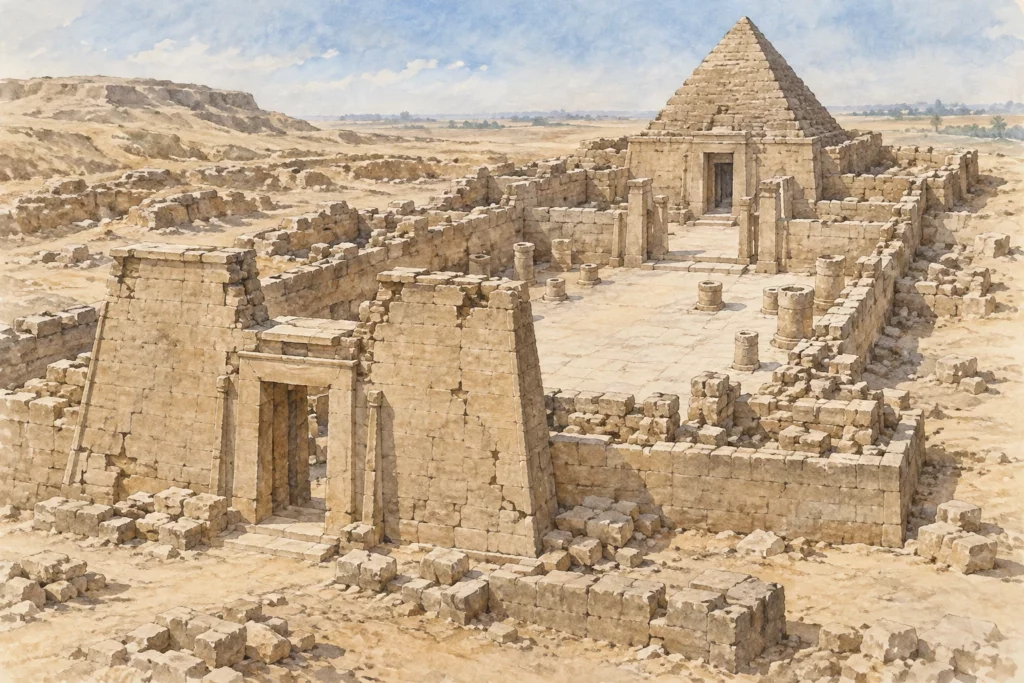
The tomb is built above ground rather than cut into the rock. Egyptologists class it among the ‘temple-tombs’, because its plan takes up that of the great temples of the period: an entrance pylon, two open courts, then the inner rooms of the chapel. The central room was topped by a small pyramid, a solar symbol of rebirth. The tomb proper is underground: a vertical shaft, cut into the floor of the inner court, descends to the burial chamber. The surviving parts are also the result of ancient stone robbing, excavations and restorations.
The tomb is not isolated. Around it are other tombs of high-ranking figures of the same period, including that of Maya, Tutankhamun’s treasurer, and that of Tia, the brother-in-law of Ramses II. The sector thus forms a funerary quarter of the court, close to Memphis, then one of the main cities of the country.
What to look at
The scene to look for is that of the gold of honour. Horemheb, followed by rows of foreign prisoners, is publicly rewarded by Tutankhamun himself. A block from this composition, kept in the Rijksmuseum van Oudheden in Leiden and coming from the second court, shows the general receiving gold collars for his victories, while Egyptian soldiers bring in Asiatic captives. The limestone relief measures 86 × 109 cm. The image speaks of military glory, but it remains a staging chosen by the owner of the tomb.
The other masterpiece is in the British Museum. A large round-topped limestone stele, 1.95 m high, found in the tomb, shows a winged sun disc at the top; below, Horemheb raises his arms before falcon-headed Ra-Horakhty, ibis-headed Thoth and Maat. Twenty-five carved lines form a prayer to Ra. The top of the stele is damaged, but the text is well preserved and traces of red, yellow and blue survive.
Its history
The tomb was located at the beginning of the 19th century, when robbers and antiquities dealers were exploiting this sector of Saqqara. The British Museum stele was thus bought in 1839 from Giovanni Anastasi. The reliefs were dispersed among European collections, and then the location of the monument was forgotten. In 1975, the Anglo-Dutch mission of the Egypt Exploration Society and the Leiden museum, led by Geoffrey Martin, found it again. This rediscovery changed the way New Kingdom Memphis was seen, long overshadowed by Thebes.
The tomb did not remain empty after its owner came to the throne. A female skeleton and the bones of a foetus have been found there; the identification of the woman with Mutnedjmet, Horemheb’s wife, remains a hypothesis. The mission, joined by Leiden University and then by the Museo Egizio in Turin, continues to study the sector and to match the dispersed blocks with their original walls.
Sources
Consulted on 30 September 2026: Tomb of Horemheb, Egyptian Ministry of Tourism and Antiquities; Stele of Horemheb (EA 551), British Museum; Saqqara, Rijksmuseum van Oudheden.