Identification and location
The pyramid of Unas, the last king of the 5th Dynasty, lies south of the complex of Djoser at Saqqara. The chronology of this collection places his reign c. 2375–2345 BC. Its ancient name is given by University College London’s Digital Egypt as Nefer-isut-Unas. The complex comprises the pyramid, a mortuary temple, a long causeway and a valley temple. Its place in the history of Egyptology lies above all in the funerary spells carved in the internal chambers: this is the first surviving attestation of Pyramid Texts in a royal pyramid.
General presentation
The exterior, now very ruined, does not on its own reveal the importance of the monument. The internal inscriptions inaugurate a practice of textual decoration of royal chambers that was taken up by the following kings of the 6th Dynasty and by some queens. A first surviving attestation must not be confused with the birth of all the spells: some of the recitations must have existed earlier in ritual forms that have not come down to us. The surface complex remains important for understanding movement between valley, temple and tomb.
Monuments and remains
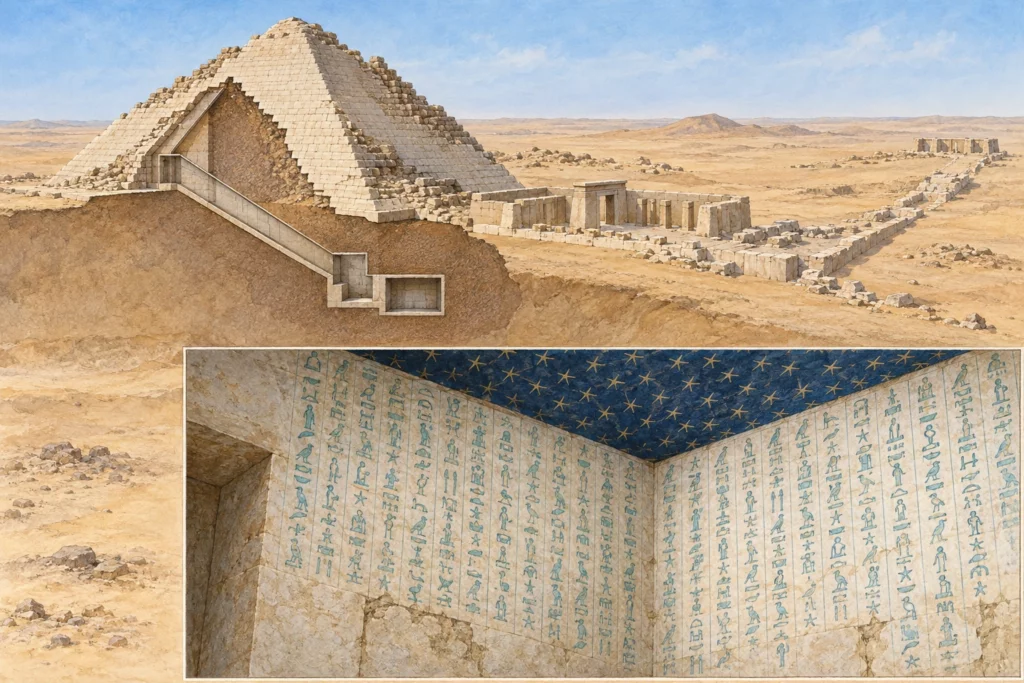
The pyramid has lost most of its casing and part of its volume. To the east are the remains of the mortuary temple. A decorated causeway ran down to the valley temple, whose remains are reported by the Egyptian ministry near the modern entrance to the site. Only part of the causeway survives; blocks were removed and reused. Inside, a passage leads to the underground spaces, including the antechamber and the burial chamber. The walls bear columns of hieroglyphs corresponding to the spells known as the Pyramid Texts. The overall picture must keep the external architectural route and the internal textual programme distinct.
Chronology and building phases
The project was built under Unas at the end of the 5th Dynasty. The inscriptions in his chambers represent an innovation among the surviving royal monuments: before this, the known pyramids do not carry this textual programme in their burial chambers. During the 6th Dynasty, the texts were adapted, expanded and placed in other royal pyramids; some queens’ pyramids received them too. The later history of the monument includes erosion, the dismantling of blocks and their reuse. Modern surveys have made it possible to reconstruct part of the decoration of the causeway, but the full set of original scenes can no longer be seen on site.
History and functions
The Pyramid Texts are ritual recitations intended to help the dead king receive offerings, overcome dangers and attain a divine state. They do not form a single continuous narrative or a manual written in one piece. The spells combine images of ascent to the sky, relations with the gods and the maintenance of the cult. Their interpretation depends on the variants known from several pyramids. They are often linked to the Coffin Texts of the Middle Kingdom and then to certain compositions of the Book of the Dead, but these groups are neither identical nor the necessary stages of a single book. The upper temple and the valley temple, for their part, housed the practices of the funerary cult within the royal complex.
Excavations and the history of research
Nineteenth-century travellers and excavators explored the pyramids of Saqqara and identified the royal inscriptions. The first copies and editions of the Pyramid Texts opened up a major field in the study of Egyptian religion. The architectural research and publications of the team of Jean-Philippe Lauer and Audran Labrousse then clarified the temples of Unas, as the bibliography of UCL Digital Egypt recalls. Modern studies compare the spells of Unas with those of other kings and queens to follow their movements, their variants and their uses. A single translation is not enough to resolve all the allusions of a very ancient ritual text.
State of preservation and research questions
The pyramid is badly degraded on the outside, while the internal texts preserve an essential part of the documentation. The causeway and the temples are fragmentary, and some decorated blocks have been moved. The ‘first’ status of the Pyramid Texts concerns the surviving monumental attestation in this type of tomb, not the first Egyptian religious writing. Reconstructions of the internal layout and of the causeway scenes must be checked against the surveys.
Sources
Main sources: Egyptian Ministry of Tourism and Antiquities, ‘Pyramid of Unas’, https://egymonuments.gov.eg/monuments/pyramid-of-unas/; Egyptian ministry, ‘Old Kingdom’, https://egymonuments.gov.eg/historical-periods/old-kingdom/; University College London, Digital Egypt, ‘King Unas’, https://www.ucl.ac.uk/museums-static/digitalegypt/chronology/kingunas.html; UCL, ‘Evolution of Pyramids’, https://www.ucl.ac.uk/museums-static/digitalegypt/pyramids/shape.html; UCL Petrie Museum, ‘A pyramid text’, https://www.ucl.ac.uk/engage/museums-collections/petrie-museum-egyptian-and-sudanese-archaeology/top-objects-petrie-museum/pyramid-text (online sources consulted on 27 September 2026).