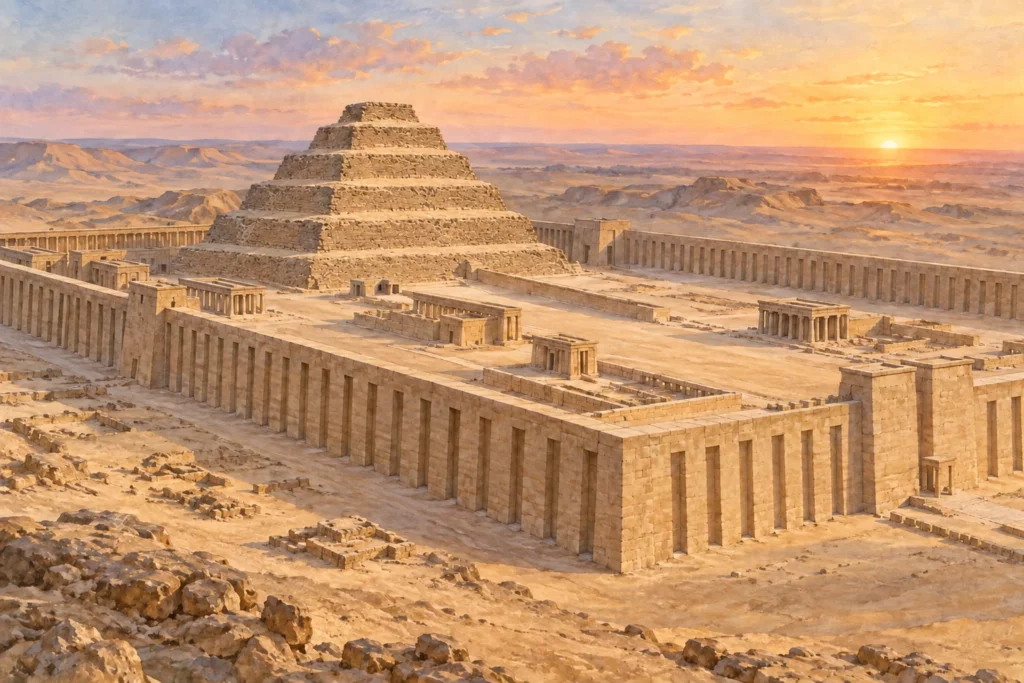
North and central Saqqara brings together articles ranging from the first great mastabas to the cults of the Late Period. The closeness of the monuments on today’s route does not mean that they were contemporary. This article helps to read the main stages without confusing the functions of tombs, pyramids and underground galleries.
In brief
This sector is the historic heart of the Memphis necropolis. It holds the tombs of the kings and nobles of the first two dynasties, the complex of Djoser, several pyramids of the 5th and 6th Dynasties and monuments of the New Kingdom and later periods. The Imhotep Museum, at the entrance to the site, helps to place these periods, so far apart from one another.
What you discover
The mastabas of the first dynasties precede the complex of Djoser (c. 2686–2667 BC). The Step Pyramid marks a major transformation of stone architecture, while the unfinished project of Sekhemkhet makes it possible to compare two royal initiatives close in time.
Userkaf, Unas and Teti each have their own pyramid complex. Beside the royal monuments, the tombs of Userefre and Mereruka document the elites and the way they had themselves represented for eternity. These finely decorated mastabas, which UNESCO cites among the treasures of the Memphite necropolis, complement the testimony of the royal tombs and are a reminder that the court lived, and died, in the shadow of the pyramids.
Other articles concern much later periods. Horemheb had his tomb cut at Saqqara while he was still a general; once king, he was buried in the Valley of the Kings. The Bubasteion and the Serapeum carry the history of the cults of sacred animals: in the galleries of the Serapeum lay the Apis bulls, held to be an incarnation of Ptah, only one of them living at any one time.
What to look at
The burial chamber of the pyramid of Unas, the last king of the 5th Dynasty, is the earliest in a pyramid to be covered with texts. These Pyramid Texts, spells intended to accompany the king into the afterlife, are a different kind of evidence from built walls: they give a voice to the funerary beliefs of the Old Kingdom.
Its history
For UNESCO, the funerary complex of Saqqara is a masterpiece of architectural design, because it contains the first stone building and the first pyramid ever constructed. The archaic necropolis that surrounds it goes back to the origins of pharaonic civilisation. The following centuries added tombs, galleries and sanctuaries, so that every excavation is a reminder that the site was in use for more than three millennia.
How to explore the articles
Start with the great mastabas and then the complex of Djoser, before moving on to the pyramids of Userkaf, Unas and Teti. The tombs of Userefre and Mereruka show the elites. The tomb of Horemheb, the Bubasteion and the Serapeum end the route with the later uses of the necropolis.
Sources
Egyptian ministry, Saqqara: https://egymonuments.gov.eg/archaeological-sites/saqqara/
UNESCO, Memphis and its Necropolis – the Pyramid Fields from Giza to Dahshur: https://whc.unesco.org/en/list/86