Identification and location
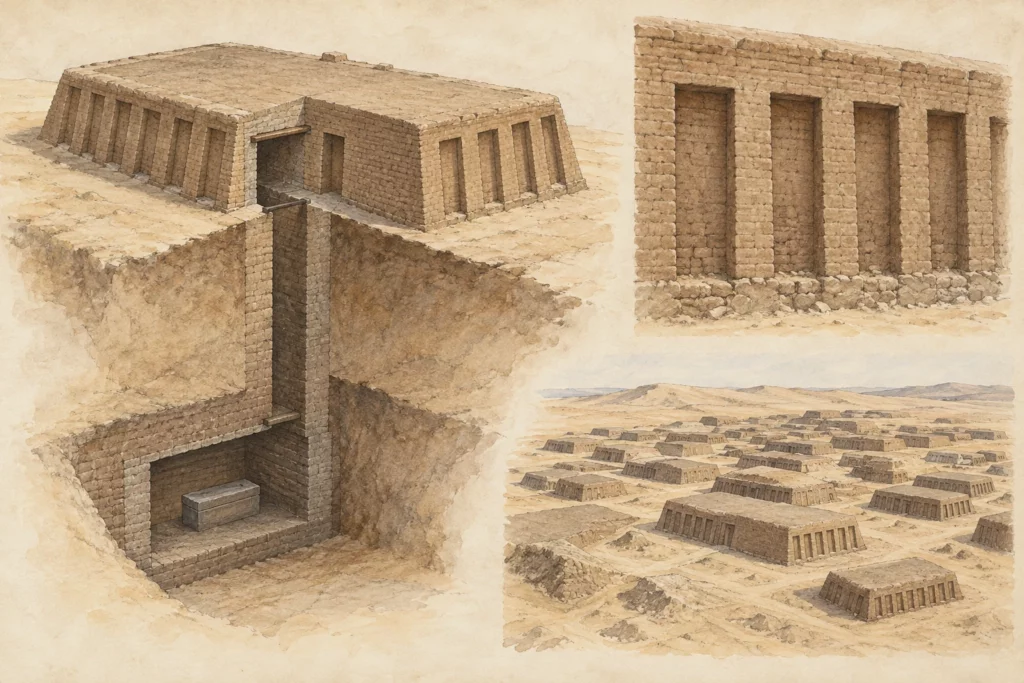
The northern sector of Saqqara occupies a desert plateau west of ancient Memphis. During the 1st and 2nd Dynasties, it served as a cemetery for an elite established near the political centre of the kingdom. Its great mastabas are mudbrick funerary structures, mainly rectangular, raised above underground chambers. The word ‘mastaba’ now describes their bench-like silhouette. The general chronology runs from the beginning of the dynastic period, c. 3100 BC, to the end of the 2nd Dynasty, c. 2700 BC. Later tombs exist on the plateau, but they must not be confused with those of the archaic group. The site is not just a few giant monuments: many smaller structures make up a much denser cemetery.
General presentation
North Saqqara gives access to the strategies of display and burial of the Memphite elites before the great pyramid complexes. The site overlooking the cultivated landscape, the quantity of bricks and the care given to the façades show a considerable investment. The mastabas of the 1st Dynasty often have niched architectural decoration, sometimes called a palace façade. In the 2nd Dynasty, several façades become simpler and the arrangements for offerings evolve. These trends must not be applied mechanically to every tomb. The spectacular size of some monuments had led to their attribution to rulers; the royal tombs identified at Abydos have made this reading less convincing. The question of the occupants is dealt with on the basis of the inscriptions, the grave goods and the context of each group.
Monuments and remains
The superstructure, built of mudbrick, forms a rectangular mass above the burial arrangement. The recessed and niched façades repeat a prestigious architectural motif, without necessarily being usable doors. The burial chamber lies below, sometimes with storerooms and access arrangements whose layout varies from tomb to tomb. The grave goods may include pottery, vessels, personal objects and seal impressions; robbery has often scattered the deposits, however. The surviving elevations are uneven, because mudbrick erodes easily. The excavations did not cover all the sectors with the same precision, and the mastabas of the 2nd Dynasty long received less attention than the largest monuments of the 1st. The plans must therefore be compared with caution.
Chronology and building phases
The first great mastabas of North Saqqara belong to the beginning of the dynastic period. They precede the complex of Djoser, built in the 3rd Dynasty further south on the plateau, and are not pyramids in miniature. Over the 1st and 2nd Dynasties, the superstructures, façades and underground installations show variants and transformations. Strongly niched forms are particularly associated with the beginning of the series; simpler façades appear later. The cemetery continued to grow denser beyond the archaic period. A project re-examining the archives has stressed that it is misleading to see here only scattered tombs of the 1st Dynasty. More than a hundred and sixty excavated structures had remained little studied or unpublished. The reconstructed plan indicates dense occupation until around the end of the 3rd Dynasty.
History and functions
The mastabas are monuments of status and places of memory. Building a large brick mass, organising funerary storerooms and depositing goods required access to labour and resources. The proximity of Memphis links this cemetery to the formation of the royal administration, without proving the exact office of each person buried. The niches of the façades created visible points for memory and offerings; their number and arrangement change. The objects found in the chambers show funerary choices, but they do not give a complete picture of daily life. The more modest tombs, long less well published, are needed to understand the internal hierarchy of the cemetery. The plateau must be read as a social and chronological whole, not as a simple gallery of isolated monuments.
Excavations and the history of research
The first modern excavations on the plateau were carried out by several generations of researchers, including Auguste Mariette, James Quibell, Cecil Firth and Walter Emery. From the 1950s, the Egypt Exploration Society resumed work under Emery, Geoffrey Martin and Harry Smith. The great mastabas, which might be associated with royal names, received disproportionate attention. A recent project led by Sergio Alarcón Robledo brings together archive data, photographs, surveys and the results of geomagnetic prospection to reconstruct the cemetery beyond these monuments. The EES stresses that no complete plan of the necropolis exists yet; the reconstruction can only be partial. This documentary review helps to reassess the density of the sector and the place of the tombs of the 2nd Dynasty. It shows the scientific value of old archives when the remains are now eroded or difficult to re-examine.
State of preservation and research questions
The identity of many occupants remains uncertain. A seal bearing a king’s name may date a context or attest an administrative relationship without making the buried individual that king. The old debates about ‘royal tombs at Saqqara’ cannot be resolved by size alone. The mudbrick architecture is often reduced, and reconstructions of height or roofing are hypothetical. The plans of tombs excavated at different dates do not always offer the same quality of survey. The mastabas of the 3rd Dynasty and the decorated chapels of the Old Kingdom must not be projected onto these older buildings.
Sources
Egypt Exploration Society, ‘North Saqqara’, archive re-examination project, 2022. https://www.ees.ac.uk/resource/north-saqqara.html (consulted on 26 September 2026).
University College London, Digital Egypt for Universities, ‘Mastabas’. https://www.ucl.ac.uk/museums-static/digitalegypt/burialcustoms/mastaba.html (consulted on 26 September 2026).
University College London, Digital Egypt for Universities, ‘Early Dynastic burial customs’. https://www.ucl.ac.uk/museums-static/digitalegypt/burialcustoms/earlydynastic.html (consulted on 26 September 2026).
University College London, Digital Egypt for Universities, ‘Saqqara’. https://www.ucl.ac.uk/museums-static/digitalegypt/saqqara/index.html (consulted on 26 September 2026).