In brief
At the southern tip of Roda Island, opposite old Fustat, a pavilion with a conical roof shelters one of the oldest instruments for measuring the Nile still in place. The Nilometer was used to follow the rise of the flood: on its height depended the preparation of dykes and canals, the harvests and therefore the level of taxation. The present building dates from AH 247 (AD 861), under the Abbasid caliph al-Mutawakkil. For the Egyptian Ministry of Tourism and Antiquities, it is the oldest building from after the Arab conquest (AD 640) that survives in its original form.
What you discover
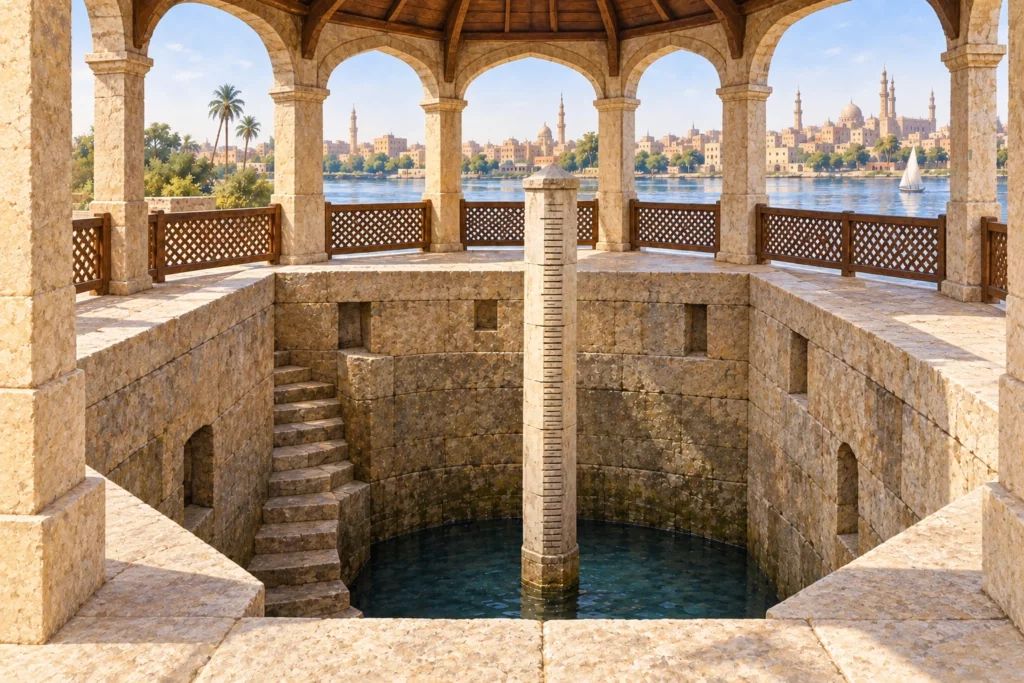
Beneath the roof, the floor opens onto a deep stone-lined shaft, rectangular in its upper part and circular at its base. A staircase runs down along the walls to the bottom. In the centre stands an octagonal marble column, graduated in cubits: as the river water entered the shaft through conduits, its level could be read on these marks. The whole looks neither like a mosque nor like a palace; it is a technical structure, whose beauty lies in the rigour of its construction.
What to look at
Look at the walls of the shaft. They bear verses of the Qur’an about water, vegetation and prosperity, carved in Kufic script. According to the entry in the virtual museum Discover Islamic Art, these form the oldest dated Arabic inscription known in Egypt. An account reported by the biographer Ibn Khallikan and studied by the historian Gaston Wiet attributes the choice of verses to the builder himself, on the orders of the caliph, who also wanted his own name to appear there. On the east side, look too at the three pointed-arched openings through which the water arrived from the tunnels.
Its history
The monument of 861 is not the first Nilometer on the island. Gaston Wiet recalls that a Nilometer was founded there in AH 96 (AD 714), repaired a century later, then restored twice under al-Mutawakkil; the surviving structure corresponds to the second intervention. In AH 259 (AD 873), Ahmad ibn Tulun, the builder of the great mosque of al-Qatai, had it restored in his turn. The Fatimids, Mamluks and Ottomans then maintained it. The reading of the flood gave rise each year to a seven-day festival, celebrated from the Middle Ages to the end of the 19th century in the presence of the ruler and his dignitaries.
The Mamluk dome that covered the shaft was replaced in 1925 by the present lead-covered conical roof. The monument has long since stopped measuring anything, and several points are still debated, in particular the exact identity of the engineer of 861 and the value of the cubit used to graduate the column.
Sources
Sources (consulted on 30 September 2026): Rawda Island Nilometer, Egyptian Ministry of Tourism and Antiquities; Tarek Torky, ‘Nilometer’, Discover Islamic Art, Museum With No Frontiers; Gaston Wiet, ‘Une restauration du Nilomètre de l’île de Rawda sous Mutawakkil (247/861)’, Comptes rendus de l’Académie des inscriptions et belles-lettres, 1924, Persée (in French).