In brief
The Citadel of Cairo occupies a spur of the Muqattam hills, east of the city, from which it overlooks historic Cairo. The Egyptian Ministry of Tourism and Antiquities dates the start of the building work to AH 572, that is AD 1176, on the orders of Saladin (Salah al-Din al-Ayyubi). The fortress was completed in AH 604 (AD 1207) by the sultan al-Kamil ibn al-Adil. The present complex is therefore not the work of a single period: it is a place of power remodelled over centuries.
What you discover
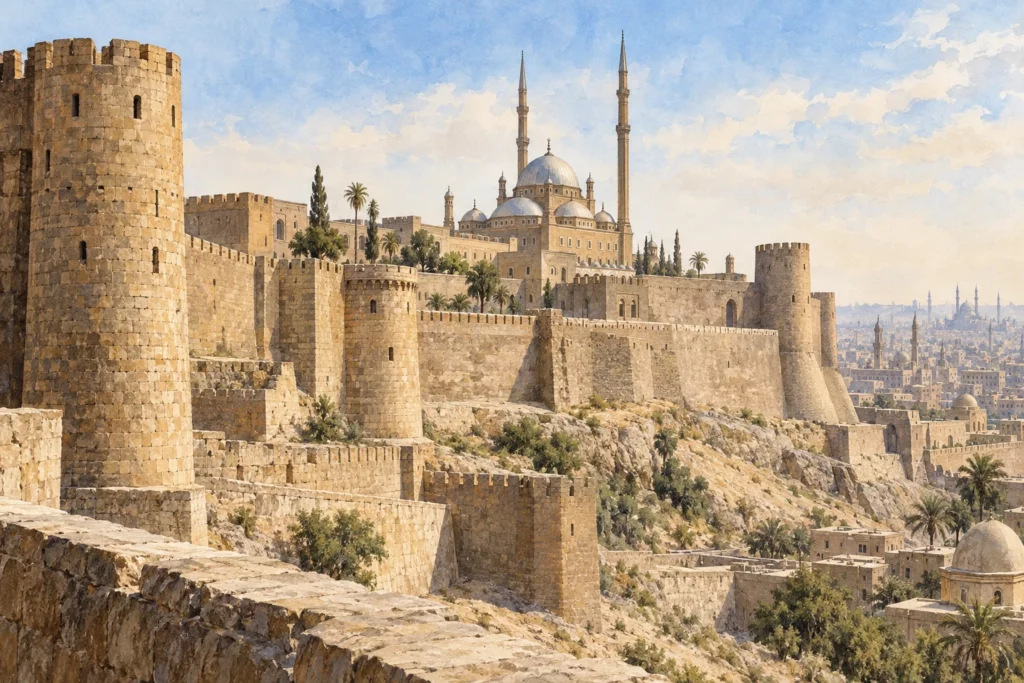
On arrival, the eye is first caught by the mass of the mosque of Muhammad Ali Pasha, which dominates the whole. It belongs to a late phase in the history of the site and must not be taken for a building of Saladin. Inside the enclosure are also the mosque of the Mamluk sultan al-Nasir Muhammad ibn Qalawun, the Ottoman mosque of Sulayman Pasha al-Khadim, the al-Gawhara Palace, the Police Museum and the Military Museum. These buildings, of different ages and styles, bear witness to the long role of the place as the seat of government.
What to look at
Rather than the most famous domes and minarets, observe how the buildings are distributed over the hill. The walls and towers are a reminder that the Citadel was first a defensive stronghold, designed to control the capital and its approaches. The mosques, for their part, correspond to commissions by successive sultans or governors: that of al-Nasir Muhammad recalls Mamluk power, that of Sulayman Pasha the Ottoman presence, that of Muhammad Ali the reorganisation of the 19th century. Reading these layers, by comparing materials, volumes and silhouettes, is the best way to understand that the site cannot be reduced to an Ayyubid foundation.
Its elevated position also matters. From the terraces, the view takes in the city and conveys the logic of surveillance that governed the choice of site, away from the plain but within reach of the capital.
Its history
According to the Egyptian ministry, the Citadel remained the official residence of the rulers of Egypt for centuries. The seat of government was moved to the Abdin Palace in the middle of the 19th century, under the Khedive Ismail. The ministry’s entry also mentions the revolution of 1952 as a landmark in the recent history of the monument. This continuity explains the accumulation of buildings, but it also makes it difficult to reconstruct the original state: each period built, repaired or replaced.
The site is part of the property ‘Historic Cairo’, inscribed on the World Heritage List. UNESCO mentions, in connection with the southern part of the city, the colossal fortress built by Saladin, famous for the battles fought against the Crusaders. What can be seen today nevertheless remains the result of successive remodellings, and the exact share of the first Ayyubid enclosures in the present layout calls for precise surveys that the official entries do not detail.
Sources
Sources (consulted on 30 September 2026): Egyptian Ministry of Tourism and Antiquities, Cairo Citadel; UNESCO, Historic Cairo.