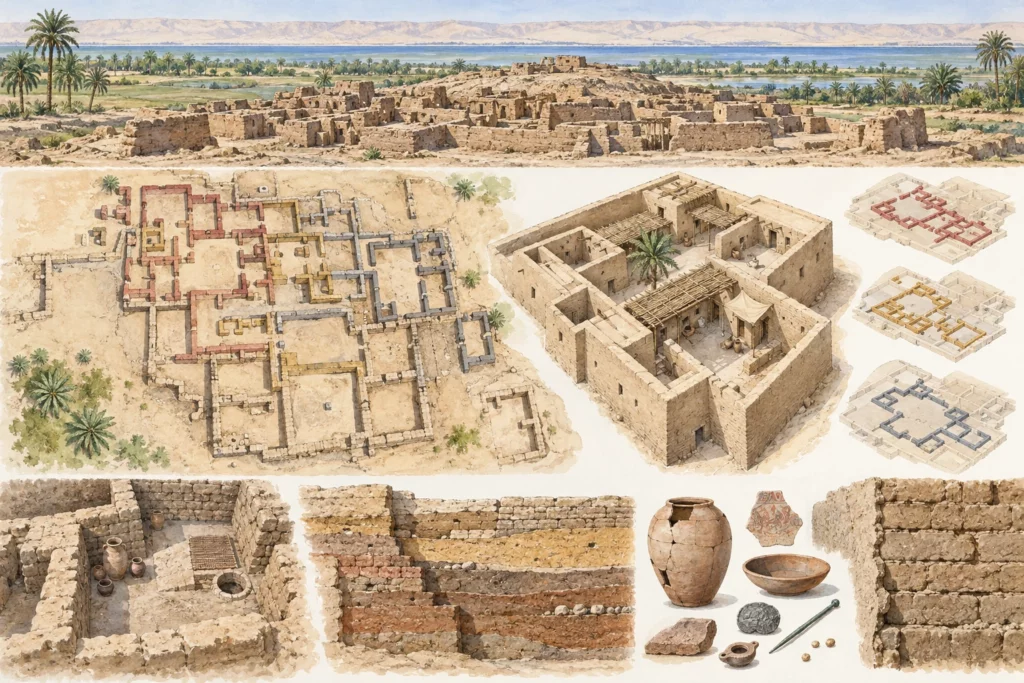
Identification and location
Karanis corresponds to the mound of Kom Aushim, on the limestone ridge forming the north-eastern edge of the Faiyum, some 80 kilometres south-west of Cairo. The mound rises twelve metres above the plain, between the road from Cairo and an ancient irrigation canal. The identification of the site with Karanis was established in 1895 by Bernard P. Grenfell and Arthur S. Hunt from the papyri they collected there.
Seven centuries of an agricultural settlement
The town was founded around 250 BC, when the lowering of Lake Moeris allowed the Ptolemies to bring the land of the northern shore under cultivation; it was meant to house the farmers of this reclaimed land. After the Roman conquest, Augustus had the army clean the canals and rebuild the dykes, and the settlement spread northwards. Prosperity lasted until the 2nd century AD; recessions struck at the end of that century and in the second quarter of the 3rd, before an irreversible decline in the 4th century. The tax grain, received in the public granaries against a receipt from the sitologos, the granary official, was shipped to Alexandria and then to Rome.
Temples of Pnepheros, Petesouchos and Soknopaios
The town had two stone temples. The crocodile god Souchos (Sobek) was worshipped there in three forms, Pnepheros, Petesouchos and Soknopaios. At the south temple, a Greek inscription above the main gate names Pnepheros and Petesouchos; a paved avenue leads to a colonnaded court, then through ever smaller rooms to the sanctuary and its altar platform. A banqueting hall was built within the enclosure under Vespasian (AD 69–79). In both temples, deep niches in the vestibules probably held crocodile mummies, and each altar contains a small chamber reached through a low opening, perhaps intended for the delivery of oracles. At the north temple, a crocodile mummy was found in the sanctuary, and a marble torso of Isis with two images of the falcon-headed Soknopaios in the inner court. Some twenty-seven deities are attested at Karanis, half of them Egyptian and half Greek.
Houses, granaries and dovecotes
The mudbrick houses combined vaulted underground rooms, a courtyard and upper floors linked by a continuous staircase; the floors were made of branches. Ten large granaries and seven smaller ones, built on the model of Roman military storehouses, have been identified; their vaulted chambers were divided into four or six compartments. Remains of six dovecotes have been recognised, two of which could house at least 250 birds.
The Michigan excavation, 1924–1935
Since the end of the 19th century, the sebbakhin had dug into the mound for fertiliser and destroyed its centre. On the initiative of Francis W. Kelsey, with funding from Horace H. Rackham, the University of Michigan opened an excavation there in 1924–1925, directed by J. L. Starkey and then by Enoch E. Peterson (1926–1935). The mound was divided into seven sectors gridded in 35-metre squares; five levels of occupation, labelled A to E, were distinguished, and each object was recorded by level, house and room. The Egyptian government allotted nearly 45,000 objects to the university; the Antiquities Service kept 2,462 lots of finds, shared between the Egyptian Museum in Cairo, the Coptic Museum, the Agricultural Museum and provincial museums.
The end of Karanis under debate
The dated documents stop in the middle of the 5th century, long taken as the date of abandonment; archaeological and textual evidence nevertheless suggests occupation in the 6th and perhaps the 7th century, with abandonment complete by the 8th. A papyrus of AD 439 mentions Christian priests, but no church has been identified. Current research uses the excavation registers and films to put papyri and objects back into their contexts.
Sources
Main sources (consulted on 30 September 2026): Elaine K. Gazda (ed.), Karanis, An Egyptian Town in Roman Times, Kelsey Museum of Archaeology, University of Michigan, 2004; T. G. Wilfong (ed.), Karanis Revealed, Kelsey Museum of Archaeology, 2014; Karanis, Egypt, Kelsey Museum of Archaeology, University of Michigan.