In brief
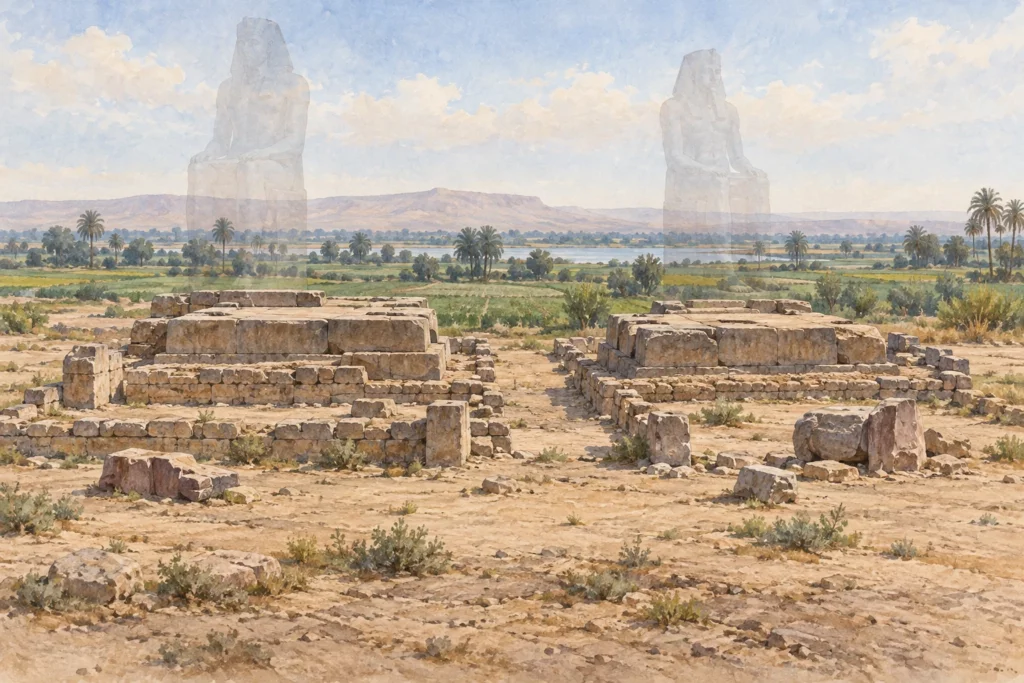
Biahmu lies in the cultivated plain of the Faiyum, about six kilometres north of Medinet el-Faiyum, ancient Shedet. Two ruined masses of masonry there were long taken for pyramids; the inhabitants called them, according to Petrie, Kursi Faraun, ‘the throne of Pharaoh’. The excavations carried out by Flinders Petrie in 1888 showed that they were the pedestals of two colossal statues of Amenemhat III, a king of the 12th Dynasty, each carved from a monolith of quartzite and set in the centre of a court closed by a wall.
What you discover
The two pedestals, about sixty metres apart, face the same direction. They are built of brownish limestone, with dressed faces on all sides, which proves that they did not belong to a larger building. Around each, remains of the court wall survive and, on the ground, chips of fine white limestone that probably come from the destroyed paving. Between the two monuments ran, in 1888 as in antiquity according to Petrie, the road leading from the shores of the lake to the provincial capital: the colossi guarded this approach, like the statues that frame the entrance to a temple.
What to look at
The interest of Biahmu lies in its fragments. Most have remained on site; a few are kept in the Ashmolean Museum in Oxford. Petrie examined them one by one to reconstruct the statues. The nose of the western colossus, found on the surface, proves that it was a human figure and not a sphinx; pieces of drapery and of the throne show a seated king. The sides of the throne bore the motif of the union of the Two Lands and figures of Nile spirits, and the base was decorated with a procession of personifications of the provinces bringing offerings, facing north. Fragments of red granite probably belonged to the gateway of one of the courts, and a fragment of inscription in the name of Amenemhat III mentions the restoration of damaged works.
On the basis of these elements, Petrie estimated that each seated statue reached about 10.7 metres and that the whole, including the pedestal, rose to nearly 18 metres. These figures are reconstructions calculated by comparison with other statues, not measurements.
Its history
In the 5th century BC, Herodotus described two pyramids emerging from the water, each bearing a stone statue seated on a throne. Petrie explained this image by a visit during the flood and an observation from afar, from the provincial capital. He also thought that the colossi stood at the corner of a dyke overlooking the lake, but that the water had never reached them: no trace of silt marked the upper stones. This reading of the ancient landscape is still debated, because the level of the lake varied greatly.
The colossi belong to the work of Amenemhat III in the Faiyum, which also includes his pyramid at Hawara, the temple of Medinet Madi and works at Shedet. It is not known when the statues were brought down; Petrie observed only, at the foot of the eastern pedestal, two pits dug during their destruction and filled with quartzite debris.
Sources
Consulted on 30 September 2026: W. M. Flinders Petrie, Hawara, Biahmu, and Arsinoe, London, Field and Tuer, 1889 (Internet Archive digitisation); Site index: Biahmu, Digital Egypt for Universities, University College London; Amenemhat III, Digital Egypt for Universities, University College London.