In brief
Karanis, near the present-day village of Kom Aushim, was founded around 250 BC to house the farmers of land newly reclaimed from the Faiyum lake. A farming village of no particular standing, it has nonetheless become one of the most eloquent sites of Graeco-Roman Egypt: houses, granaries, temples and papyri were found there together, so that the written documents can be read in the very setting in which they were drawn up.
What you discover
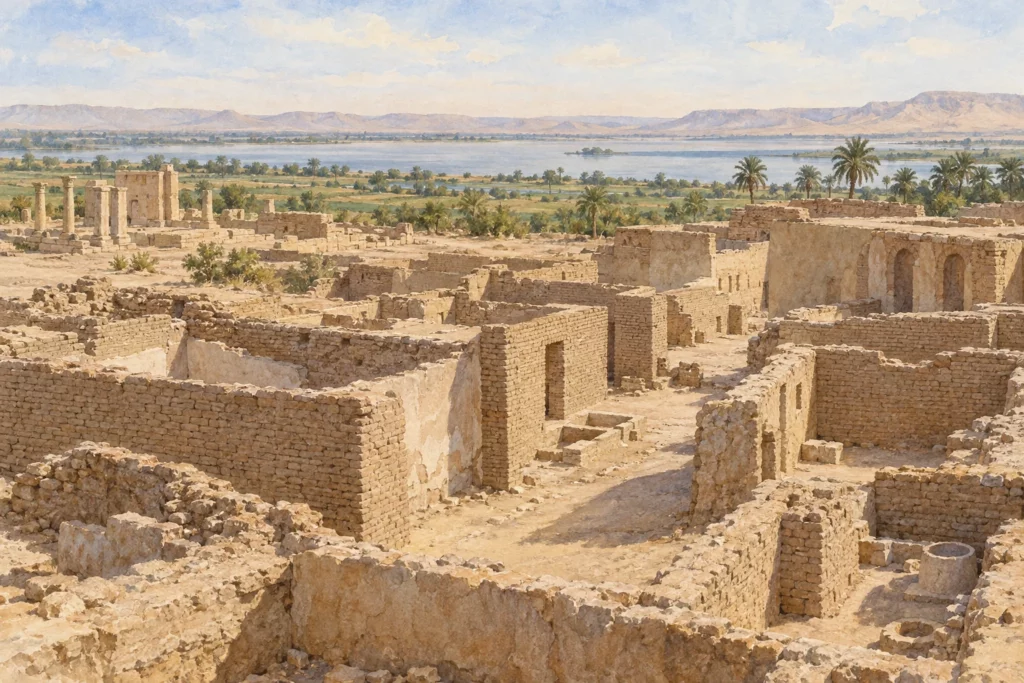
The site forms a large mound rising twelve metres above the cultivated plain, on the limestone ridge that borders the Faiyum to the north-east, between the old road from Cairo and an ancient irrigation canal. The centre of the mound is missing: between the end of the 19th century and the 1920s, farmers removed the earth rich in organic debris, the sebakh, to fertilise their fields. Around this void survive quarters of mudbrick houses, packed tightly along lanes that often ended in a dead end, crossed by two wide north–south streets.
The houses followed a very consistent plan: vaulted underground rooms for provisions, an open courtyard where most of the household work was done, and upper floors served by a continuous staircase. Floors and roofs rested on barely trimmed tree branches.
What to look at
Two stone temples stand out from this expanse of brick. Above the main gate of the south temple, a Greek inscription names the two crocodile gods of the place, Pnepheros and Petesouchos. Inside, the rooms narrow towards the sanctuary, where a high altar platform stands. A curious detail: this altar, like that of the north temple, contains a small chamber reached through a low opening. A priest may have hidden there to deliver oracles in the name of the god, a hypothesis the excavators put forward without being able to prove it.
The granaries also deserve attention. Ten large and seven small ones have been identified; their vaulted chambers, divided into compartments about one metre deep, received the tax grain before it left for Alexandria, and then for Rome.
Its history
The town flourished above all under the Roman Empire, after Augustus had the army clear the canals. Recessions marked the end of the 2nd century and then the second quarter of the 3rd, before a decline that became irreversible in the 4th century. The dated documents stop in the middle of the 5th century, but the final abandonment of Karanis is now placed later, perhaps between the 6th and the 8th century.
From 1924 to 1935 the University of Michigan carried out there one of the first excavations of a Graeco-Roman town to record the position of every object. A large share of the finds is now kept at the Kelsey Museum in Ann Arbor, far from the houses they once furnished; the excavation archives therefore remain essential for understanding what can be seen on the ground.
Sources
Consulted on 30 September 2026: Elaine K. Gazda (ed.), Karanis, An Egyptian Town in Roman Times, Kelsey Museum of Archaeology, University of Michigan, 2004; T. G. Wilfong (ed.), Karanis Revealed, Kelsey Museum of Archaeology, 2014.