In brief
El-Lahun lies at the entrance to the Faiyum, where the Bahr Yusuf leaves the Nile valley to turn west and run into the depression. On the edge of the low desert plateau, Senusret II, a king of the 12th Dynasty, had his pyramid raised and, below it, near the valley temple, a planned town intended for the staff attached to his cult. Flinders Petrie called this town ‘Kahun’; its ancient name was probably Hetep-Senusret. The site thus brings together the tomb of a king, the burials of his family and one of the best-documented settlements of the Middle Kingdom.
What you discover
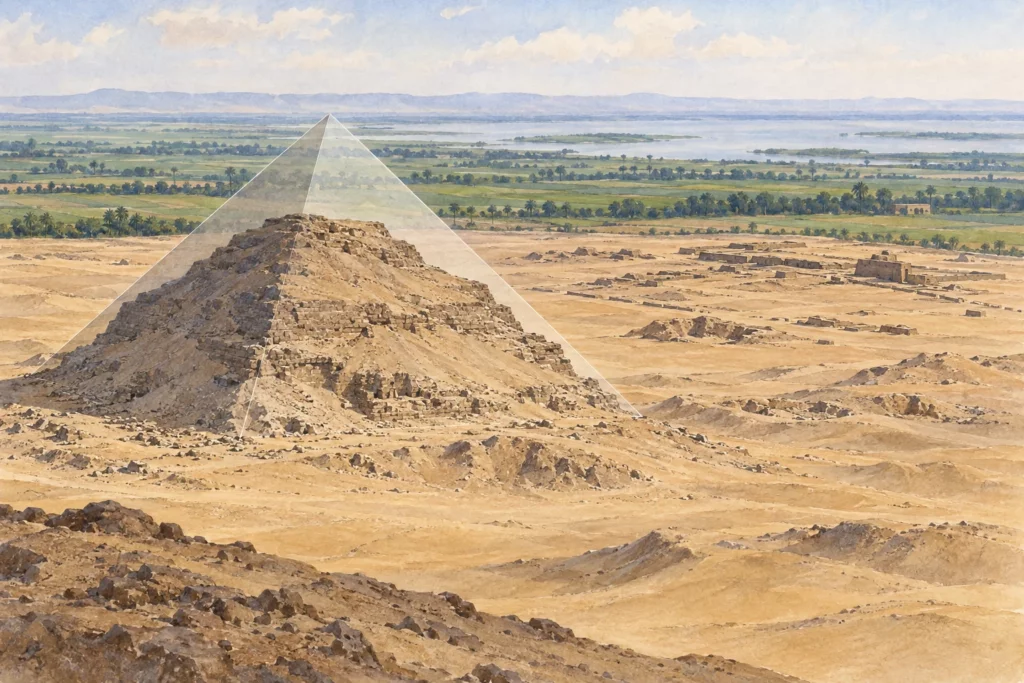
The pyramid now appears as a dark mass of mudbrick, stripped of its limestone facing. Its construction is unusual. Petrie found that it rests on a core of natural rock, cut to a height of about twelve metres. Above rises masonry held together by a framework of walls. Walls of stone in the lower part, then of brick, follow the diagonals up to the summit and branch off at right angles towards the faces. The compartments thus formed are filled with mudbrick. Around the monument, the royal enclosure contained tombs of members of the king’s family, mastabas and, at the north-east corner, a small pyramid of which Petrie found only the base cut into the rock.
The town covered about 13 hectares inside an enclosure wall. Its orthogonal plan lines up hundreds of houses, from about 40 to 2,400 m²; an internal wall separates a large eastern sector, bordered on the north by spacious residences, from a more densely built western sector. The highest point carried a large dwelling that Petrie named the ‘acropolis’.
What to look at
First, the entrance to the pyramid. Whereas the pyramids Petrie knew opened on the north, this one remained untraceable for months. The passage was finally reached through a shaft dug to the south, at some distance from the monument and concealed beneath the paving; it was opened in 1889–1890 by Fraser, Petrie’s colleague. According to Petrie, graffiti recorded on the blocks indicate that the temple and the casing were dismantled under Ramses II to serve as a quarry.
In the town, two modest details say a great deal. Petrie recorded in the middle of several streets a slightly hollowed stone channel that carried away rainwater and waste water; he saw it as the earliest known example of urban drainage. Florence Doyen observes, moreover, that the most common house plan at Kahun is generally accompanied by an entrance door on the north, an arrangement that brings the coolness of the northern breezes to the back of the dwelling.
Its history
Petrie cleared the town and explored the pyramid from 1889. He returned to El-Lahun in 1913–1914 with the British School of Archaeology in Egypt: in 1914, Guy Brunton discovered in the tomb of Princess Sithathoriunet, near the pyramid of Senusret II, a niche containing her jewellery. Among the pieces is a gold pectoral inlaid with semi-precious stones, composed around the throne name of Senusret II and now kept in the Metropolitan Museum of Art in New York.
The town lived on well beyond the reign of its founder. The accounts of the royal cult discovered near the valley temple date mainly from Senusret III and Amenemhat III, and the papyri found in the houses cover the end of the 12th and the beginning of the 13th Dynasty. Much nevertheless remains uncertain: the objects were rarely recorded at their exact find spot, and Petrie’s idea of a western quarter reserved for workers is now debated, since this sector brings together houses of very varied types and sizes.
Sources
Consulted on 30 September 2026: Florence Doyen, ‘La résidence d’élite : un type de structure dans l’organisation spatiale urbaine du Moyen Empire’, Austrian Academy of Sciences (in French); W. M. Flinders Petrie, Illahun, Kahun and Gurob, 1889–1890, London, D. Nutt, 1891 (Internet Archive digitisation); Pectoral and Necklace of Sithathoryunet with the Name of Senwosret II, Metropolitan Museum of Art.