In 1858, Auguste Mariette uncovered at Karnak an alabaster statue of rare delicacy. A standing woman, wearing a wig with a vulture headdress, holds a fly whisk. Her name is Amenirdis. The daughter of a king of Napata, in Sudan, she governed Thebes in the name of the god Amun, without husband or child. She is now in the Cairo museum.
Identification and location
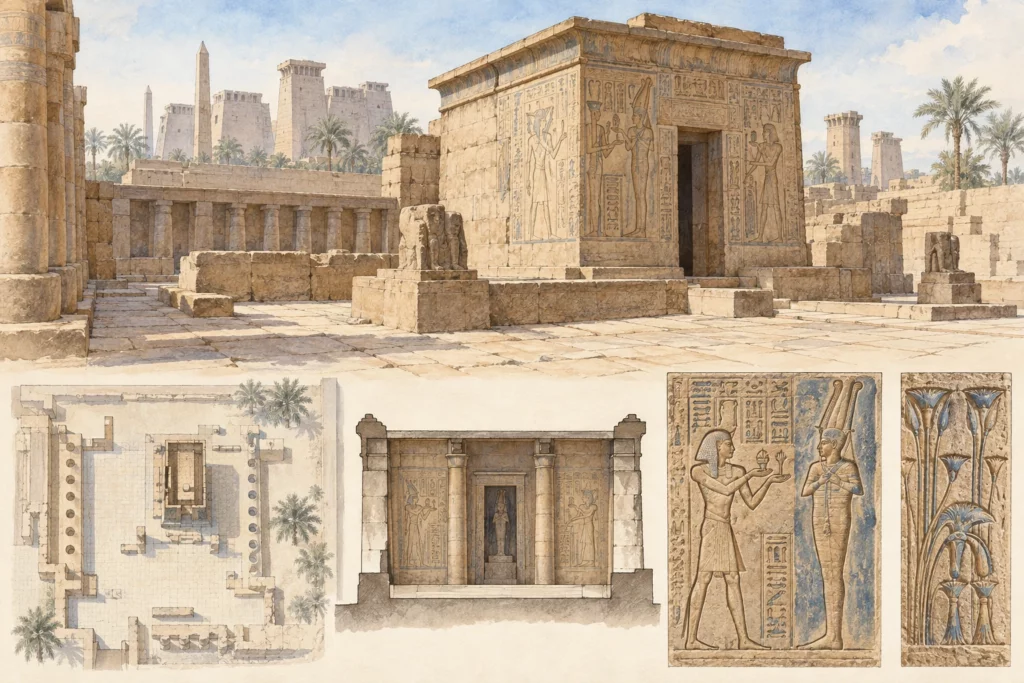
Within the enclosure of Amun-Ra at Karnak, mainly in its northern and north-eastern sectors, stand several small chapels dedicated to particular forms of Osiris. They often go unnoticed beside the pylons and the great hypostyle hall. They can be found by walking a little away from the crowds.
Yet they tell an important chapter in the history of Thebes: the time when the city was held by women, the Divine Adoratrices of Amun.
Architecture and decoration
These buildings are small: a doorway, sometimes a court or a columned hall, then one or two inner rooms. Their decoration associates Osiris, under various names, ‘ruler of eternity’, ‘lord of life’, with the kings and the Divine Adoratrices who had them built.
On the walls, the Divine Adoratrice performs the rites like a king. She presents the offering, consecrates the temple, receives life from the hands of the god. Her name is written in a cartouche.
Chronology and functions
Most of these chapels date from the 8th and 7th centuries BC, from the end of the Third Intermediate Period to the 25th and 26th Dynasties. The chapel of Osiris Heqa-djet was built under Osorkon III and Takelot III, with the Divine Adoratrice Shepenupet I, daughter of Osorkon.
The office was passed on by adoption. When the Kushite kings took Egypt, Shepenupet adopted Amenirdis I, daughter of the Kushite king Kashta and sister of Piye. Amenirdis in turn adopted Shepenupet II. Then, in 656 BC, Psamtik I had his own daughter Nitocris adopted. Each change of dynasty went through this door.
These women did not marry. They had considerable estates, a steward and an administration. Their funerary chapels are at Medinet Habu, on the other bank.
Excavations and the history of research
The Centre franco-égyptien d’étude des temples de Karnak (CFEETK, Franco-Egyptian Centre for the Study of the Temples of Karnak), founded in 1967, studies these chapels as part of its programmes on cults and places of worship. Its photographic archives and epigraphic records document their condition and their decoration, which is sometimes badly damaged.
State of preservation and research questions
Several chapels were partly dismantled in Antiquity, others restored in modern times. Research focuses on their precise chronology, their place in the processional routes of Karnak, and the way in which Osiris took up more and more space in the domain of Amun.
The real power of these women also remains to be better understood: the texts show them both as wives of the god and as representatives of the king.
Sources
Main sources (consulted on 28 September 2026): CFEETK, cults and places of worship at Karnak (in French); UNESCO, Ancient Thebes with its Necropolis; Mariam F. Ayad, God’s Wife, God’s Servant: The God’s Wife of Amun (c. 740–525 BC), London, Routledge, 2009.