In brief
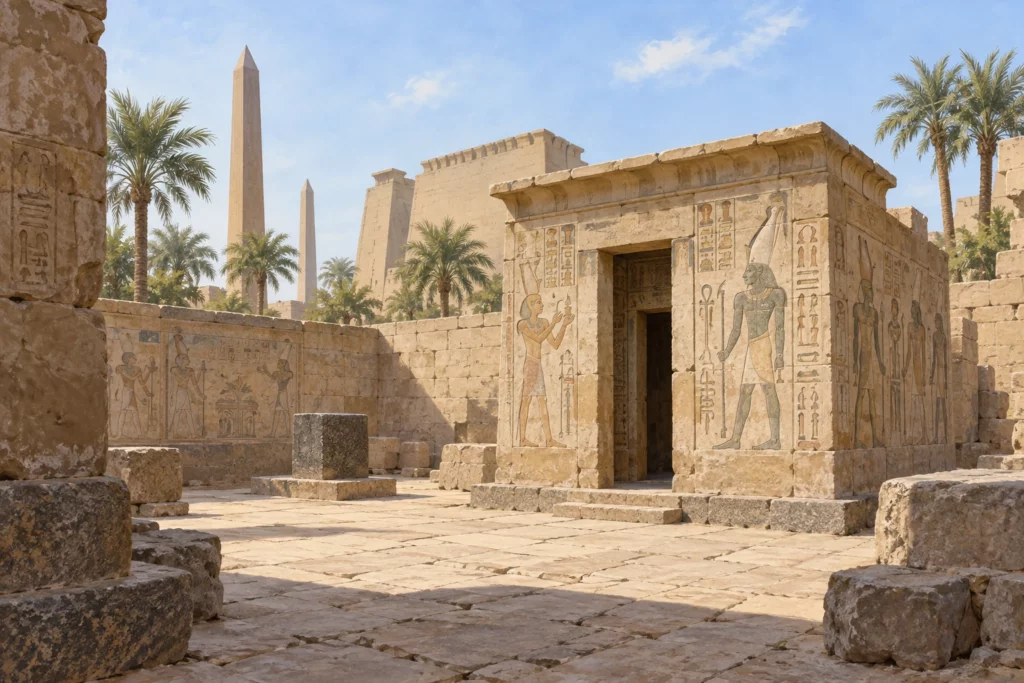
At Karnak, several sanctuaries dedicated to Osiris are scattered through the northern and north-eastern sectors of the domain of Amun, with a few examples to the south. The research programme distinguishes the surface chapels, the Osirian cemetery, the temple of Osiris of Coptos and the sector known as the tomb of Osiris. These sanctuaries bear witness to a major phenomenon in Egyptian religious history in the 1st millennium BC: the rise of Osiris to the rank of a major god in all the temples. These are separate building projects, not a single Osirian temple.
What you discover
Three chapels line the paved way leading to the temple of Ptah: Osiris Neb-ankh, the oldest, Osiris Wennefer Neb-djefau, the intermediate one, and Osiris Wennefer, the most recent. Next to them stands the temple of Osiris of Coptos, partly visible in the 19th century. Other buildings occupy the north and north-east of the domain, and a chapel of Osiris Ptah-Neb-ankh lies to the south. According to the Institut français d’archéologie orientale (IFAO, French Institute of Oriental Archaeology), these buildings range in date from the beginning of the Third Intermediate Period to the Saite period, in the 6th century BC.
What to look at
The chapel of Osiris Wennefer Neb-djefau, ‘lord of food’, is associated with the Divine Adoratrice Ankhnesneferibre. The IFAO excavations at Karnak have yielded bronze figurines, including a winged Nephthys and statuettes of Osiris, as well as a statuette of Isis suckling Horus 9.5 cm high and foundation deposits of bronze and vessels. In the north-west sector, buildings are linked to the Divine Adoratrice Nitocris. The mudbricks of some structures bear the name of the high priest Menkheperre, of the 21st Dynasty.
Its history
The research programme is itself long-standing. Born of early work by the Centre franco-égyptien d’étude des temples de Karnak (CFEETK, Franco-Egyptian Centre for the Study of the Temples of Karnak) from 1993, it developed with the IFAO from 2000: excavation, documentation and epigraphy of the Osirian chapels and necropolis. At the time of the CFEETK’s presentation, the excavations of the cemetery and of the temple of Osiris of Coptos were complete; test trenches were still to document the setting of the Neb-djefau chapel and the structure of its enclosures, and the restoration of its brick walls and paving was planned. The chapels of North Karnak, already published in Karnak-Nord III, were to receive a new photographic and epigraphic record. The programme also includes Osirian catacombs, among them those of Ptolemy IV, with richly painted decoration, which must be studied separately from the surface chapels.
Publications are following: a series, Temples et cultes osiriens de Karnak, is appearing with the IFAO, with the chapel of Osiris Wennefer Neb-djefau and the temple of Osiris of Coptos as its first volumes. The iconography of the figures depicted in the chapels is the subject of a separate study. This work does not yet make it possible to reconstruct a single calendar of Osirian festivals.
Sources
Consulted on 30 September 2026: Les sanctuaires osiriens de Karnak, Centre franco-égyptien d’étude des temples de Karnak, CNRS (in French); Karnak, sanctuaires osiriens, Institut français d’archéologie orientale (in French).