In brief
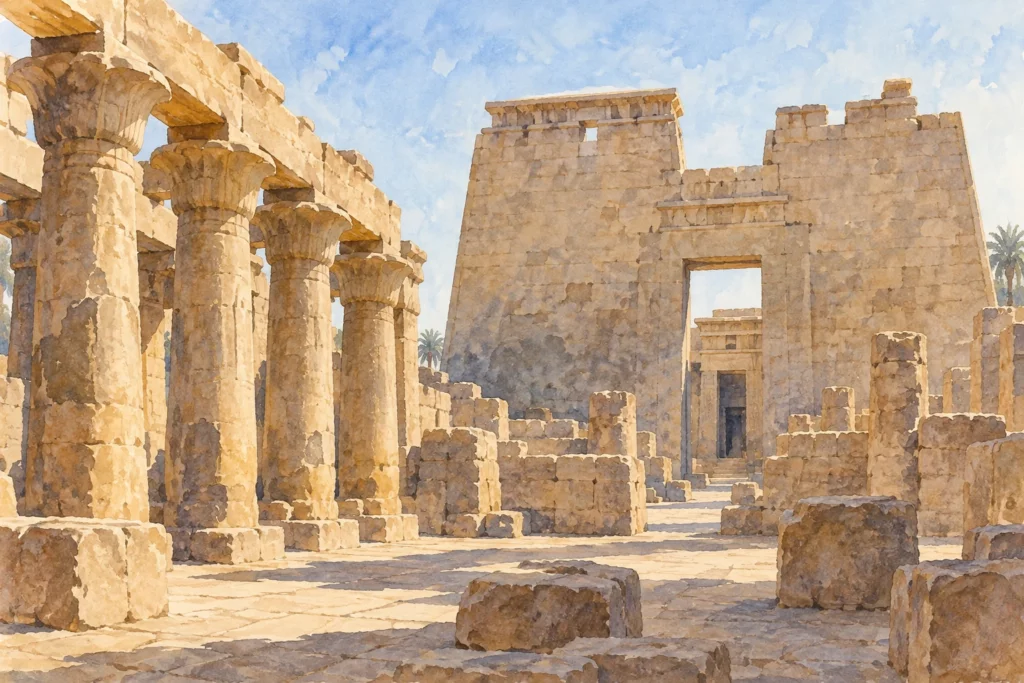
The temple of Khonsu occupies the south-west corner of the great complex of Karnak. The Egyptian Ministry of Tourism and Antiquities gives it a length of about 73 m and a width of 29 m. It was rebuilt in the 20th Dynasty by Ramses III (Ramesses III) for Khonsu, the divine child of Amun and Mut, on the site of an 18th Dynasty temple.
What you discover
The route is clear. A pylon opens onto an avenue lined with sphinxes, attributed to Nectanebo I, then comes a first square court with papyrus-bud columns. Next is a hypostyle hall of eight columns in two rows, with alternately closed and open capitals. Beyond lie the rectangular sanctuary and the chapel of the sacred barque, with four columns and its barque stand. The Ptolemaic rulers extensively renovated and enlarged the building, and Nectanebo II rebuilt the doorways of the hypostyle hall.
What to look at
The most instructive detail can be read in the stone itself. The blocks of the floors and foundations come from the mortuary temples of Amenhotep III, Ay and Horemheb, as well as other blocks from the time of Thutmose III and Seti I. The royal names they bear cover Thutmose III, Amenhotep II, Amenhotep III, Thutmose IV, Ay, Horemheb, Seti I, Ramses II and Seti II; blocks from a Middle Kingdom temple have also been identified. On several blocks of Thutmose III and on one block of Horemheb, reliefs were recarved under Ramses II. In all, the Chicago House team recorded 765 blocks in five campaigns, from 2008 to 2013, including scenes of offerings presented to Khonsu.
Its history
This reuse shows that the temple is a building of salvage, in which the stone of predecessors, royal or not, was reused without scruple. The present temple is therefore not the product of a single building project: to the Ramesside base are added, according to the ministry, a contribution by Seti I to the hypostyle hall, the works of Nectanebo I and II and the Ptolemaic renovations. As Seti I is earlier than Ramses III, this attribution calls for closer examination.
The recarvings under Ramses II indicate, according to ARCE, that appropriating an older monument was a common practice among the pharaohs. Khonsu, the lunar god of the Theban triad, gives the temple its function: to house the barque and the rites of a child god, the son of Amun and Mut. A sandstone statue of Khonsu dated to the reign of Tutankhamun was discovered in the sanctuary: it is earlier than the Ramesside temple.
Sources
Consulted on 30 September 2026: Khonsu Temple, Egyptian Ministry of Tourism and Antiquities; Epigraphy of the Khonsu Temple, American Research Center in Egypt.