In brief
At Zawyet el-Aryan, between Giza and Saqqara, an unfinished pyramid recalls the architectural experiments of the 3rd Dynasty, at the beginning of the Old Kingdom. It is called the ‘Layer Pyramid’ because its core was raised in successive layers leaning inwards. It is often associated with King Khaba, but no royal name has been found in the pyramid itself. These remains invite us to look at a building in progress rather than at a finished silhouette.
What you discover
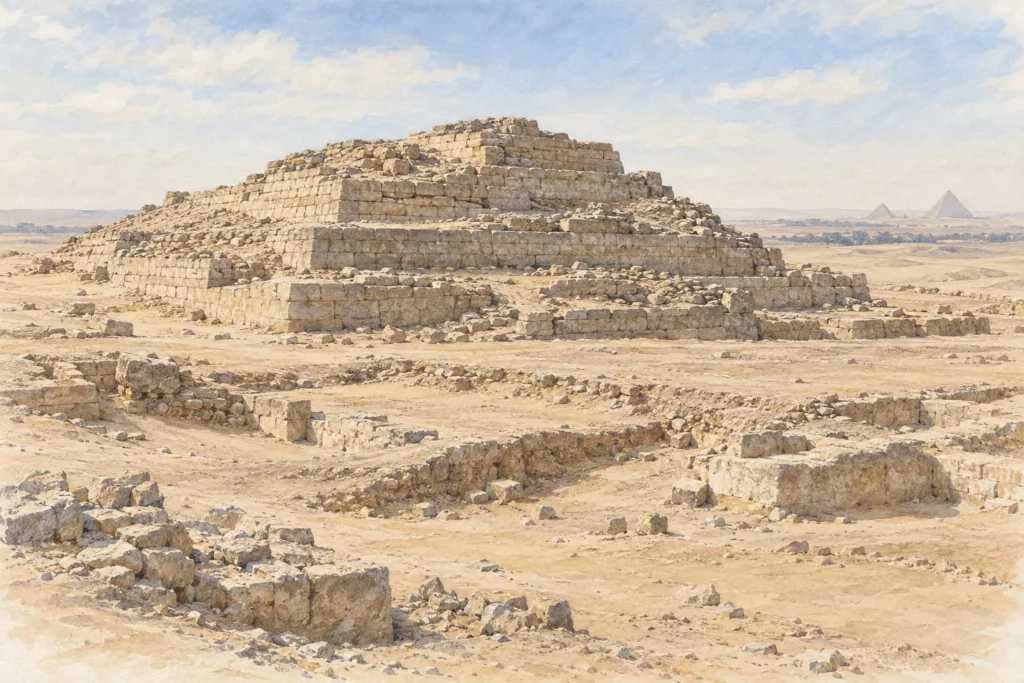
Today the monument appears as a low, ruined mass, far removed from the image of a great complete pyramid. Its masonry allows you to recognise the principle of layers leaning against a central core. Early explorations also described an underground substructure with an entrance and internal spaces; the published plans do not agree on every detail. Nearby lies mastaba Z500, a rectangular tomb distinct from the pyramid. Vessels bearing the name of the Horus Khaba were discovered there. They shed light on the history of the area, without proving on their own that Khaba was buried in the pyramid.
Its history
The pyramid probably belongs to the 3rd Dynasty, after the first great step pyramids of Saqqara. Its construction never reached the planned height. The precise date, the patron and the reason for the halt remain uncertain. Travellers and archaeologists described the place in the 19th century; more detailed excavations were carried out at the beginning of the 20th century, notably by Alessandro Barsanti, then by George Reisner and Clarence Fisher. The site is distinct from another unfinished pyramid, further north in the same necropolis, often called the ‘Great Pit’.
Why this place matters
The site shows that the history of the pyramids is not just a succession of finished monuments. The arrangement of the layers reveals a way of building, and the low surviving height makes the unfinished state visible. The attribution to Khaba rests mainly on evidence from the surroundings and on architectural comparisons: it remains a hypothesis.