In brief
At Abu Rawash, north-west of Giza, King Djedefre, a son of Cheops, established his funerary complex in the 4th Dynasty. All that remains today is a very ruined core, set against a large rocky outcrop. This appearance long led people to believe in a pyramid abandoned before the work was finished. Recent excavations suggest instead that destruction and stone robbing were far more extensive than had been imagined.
What you discover
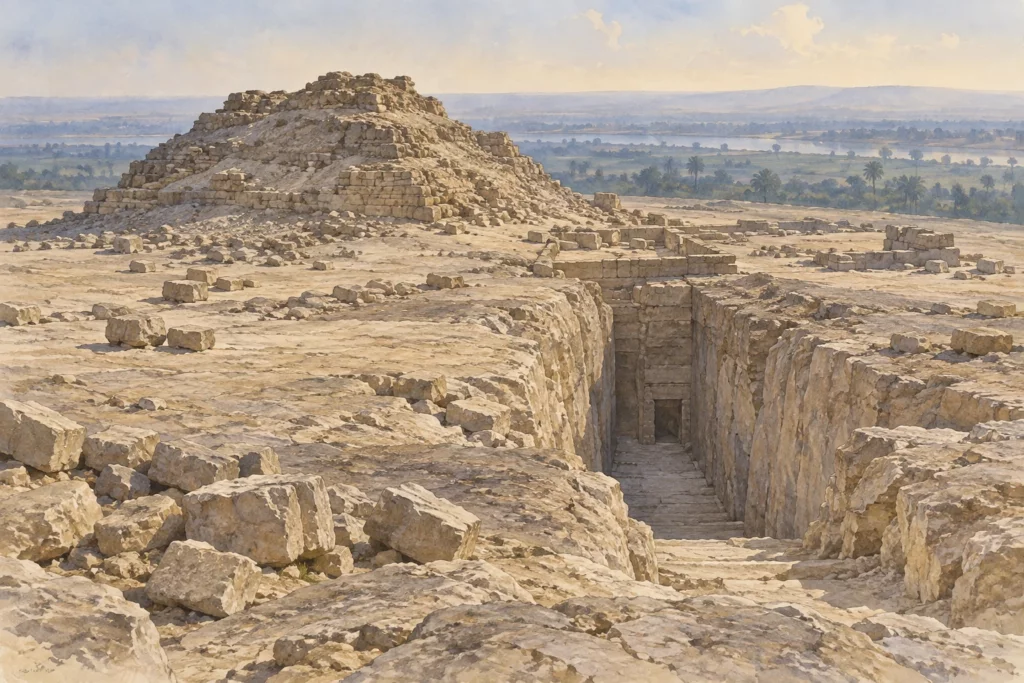
The site preserves the central rock around which the pyramid was raised, low masonry and a great descending passage leading to the underground spaces. Research has also identified the enclosures, the mortuary temple, the causeway and a small satellite pyramid. Fragments of quartzite statues, some bearing the name of Djedefre, have made it possible to attribute the complex to the king with certainty. The present monument is not just an isolated heap of ruins: the remains outline a royal complex organised on the plateau.
Its history
Djedefre had this complex built after the reign of Cheops. The finished form of the pyramid can no longer be seen. The Institut français d’archéologie orientale (IFAO, French Institute of Oriental Archaeology) and the University of Geneva re-examined the site and concluded that the building was probably completed, before being very largely dismantled and exploited as a quarry, notably in the Roman period. The burial chamber and other parts have been destroyed. This conclusion rests on the excavations and on the reading of the complex; it does not reveal every detail of its elevation.
Why this place matters
Abu Rawash is a reminder that a ruin can look like an interrupted building site when it is mainly the result of later demolition. The great rock core also shows how the builders used the topography to reduce the amount of masonry to be laid. The enclosures and cult buildings place the king within a funerary tradition comparable to that of Giza. The separate images in this article are non-metric interpretive evocations, not exact surveys.