In brief
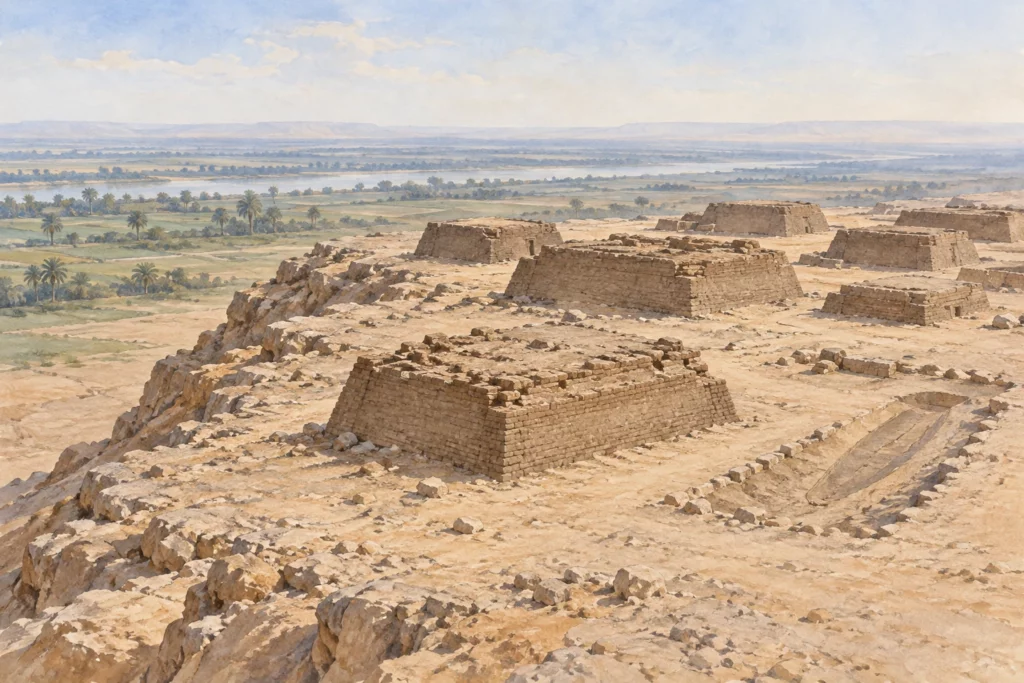
North-west of Giza, Abu Rawash is often associated with the pyramid of King Djedefre. Cemetery M, however, belongs to a much earlier time: the middle of the 1st Dynasty, around 3000 BC, at the turn of the 4th and 3rd millennia. It occupies a rocky spur overlooking the plain. Excavations there have identified twenty-five mudbrick tombs, mainly large elite mastabas. They shed light on funerary practices in the Memphis region before the pyramids.
What you discover
The brick masses have suffered badly, but their foundations, niches and buried chambers preserve precise evidence. In mastaba M02, a slab of the stone portcullis that closed the entrance to the burial chamber was still in place. Near mastaba M06, archaeologists found the remains of a wooden funerary boat. Smaller burials accompany some of the large monuments. The grave goods include jars, stone vessels and seal impressions; one bears the name of King Den. These finds make it possible to place the tombs in his reign, without making Den the occupant of a mastaba.
Its history
Cemetery M was excavated by Pierre Montet in 1913–1914, then studied again in the 20th century. From 2009 to 2014, a team from the Institut français d’archéologie orientale (IFAO, French Institute of Oriental Archaeology) re-examined fifteen mastabas and their associated tombs. The pottery, the building techniques and radiocarbon dates refine the history of the place. The study of the skeletons found in subsidiary tombs revealed no traces of violence; it leads the excavators to rule out the idea of human sacrifice for these individuals. Each context must nevertheless be examined separately.
Why this place matters
Abu Rawash M shows the place of a Lower Egyptian elite in the young Egyptian state. The mastabas, the foundation deposits and the boat bear witness to a major investment in funerals. The site is to be confused neither with the pyramid of Djedefre, built several centuries later, nor with the royal burials of Abydos. Recent excavations have given this long-neglected cemetery back its place in the study of the architecture and funerary practices of the 1st Dynasty.