Identification and location
The Layer Pyramid lies in the necropolis of Zawyet el-Aryan, in the Memphite region, between Giza and Saqqara. It is an unfinished royal pyramid of the 3rd Dynasty, generally placed in the period following Sekhemkhet. It is frequently attributed to Khaba, a ruler known by his Horus name. As no king’s name has been recorded in the monument, this plausible attribution must be distinguished from a direct identification. The ancient name of the complex and the king’s actual place of burial remain unknown. This monument must not be confused with the other unfinished pyramid project at Zawyet el-Aryan, further north, referred to in the literature as the Great Pit or the northern pyramid.
General presentation
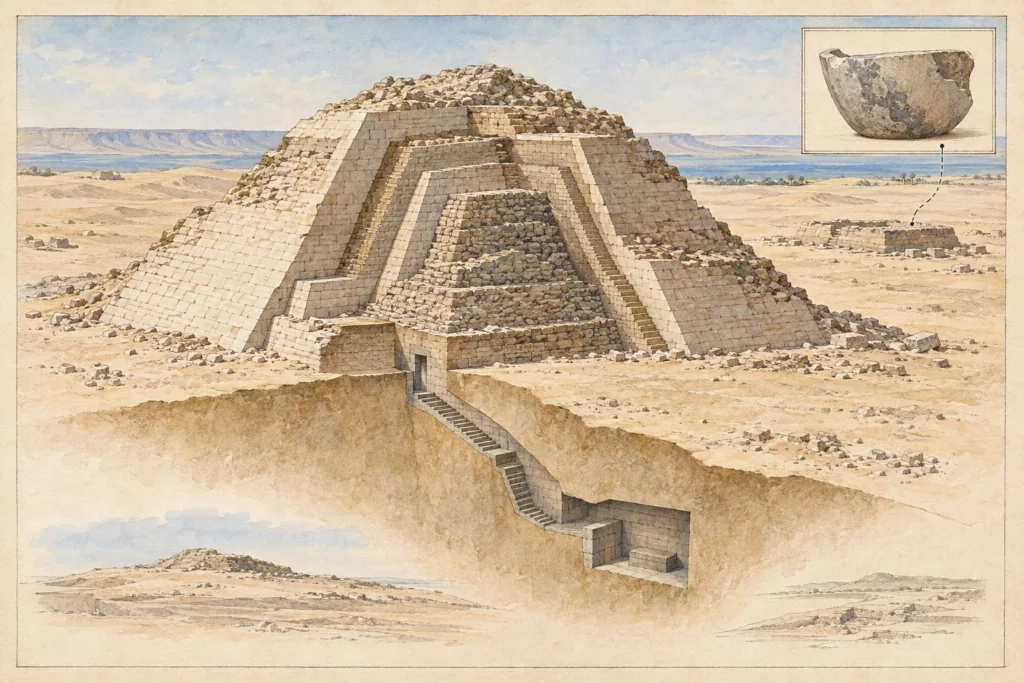
Its interest lies in the visibility of an interrupted building site. Where a finished envelope would have hidden the stages of construction, the remains reveal a core and successive layers of masonry. The name ‘layer’ reflects the principle of accretion layers leaning inwards. The whole belongs to the experiments of the 3rd Dynasty with the pyramid form and the organisation of underground spaces. Its low degree of completion does not allow the intended final elevation to be drawn with certainty. The pyramid, mastaba Z500 and the other, northern project are three distinct entities within the same funerary landscape.
Monuments and remains
The surviving superstructure is low, ruined and made up of beds of stone forming several envelopes around a core. Comparison with the monument of Sekhemkhet helps to understand the method, without demonstrating that the two projects had exactly the same design. Accounts of the early excavations mention a descending entrance and an underground substructure, with spaces interpreted as corridors or storerooms. The published plans differ on their number, dimensions and layout: a precise reconstruction must therefore refer to an identified survey rather than to a composite diagram presented as certain. Mastaba Z500 lies some 250 metres to the north. Stone vessels bearing Khaba’s serekh were found there; this provenance is crucial. None of these vessels comes from the Layer Pyramid. The limits of the enclosure and any cult installations of the complex are less certain than the main structure.
Chronology and building phases
The general dating to the 3rd Dynasty rests on the building technique and on comparisons with the step pyramids of Saqqara. The project is often placed after that of Sekhemkhet, but the detailed chronology of the reigns and projects is still debated. The presence of Khaba’s name in Z500 establishes this ruler’s activity in the vicinity; it does not directly date each phase of the pyramid and does not name its occupant. The successive layers suggest a planned enlargement of the superstructure, halted before completion. The state of the remains does not allow the number of steps of the complete monument to be fixed. The causes of the interruption are not documented. A short reign is sometimes suggested, but it is not a proven explanation for this particular project.
History and functions
The hypothesis of a royal funerary complex is consistent with the monument’s place in the pyramid tradition of the 3rd Dynasty and with its underground spaces. It does not mean that a burial is attested there. The question of Khaba’s tomb remains open: one scholarly proposal has even favoured the large mastaba Z500, where his name is actually documented. These scenarios respond to different kinds of evidence: the monumental form of the pyramid on one side, the inscribed material of the mastaba on the other. The necropolis of Zawyet el-Aryan belongs to the funerary occupation of the Memphite region, close to royal power and its resources. The masonry shows the mobilisation of collective skill, but it reveals neither a detailed administrative organisation of the building site nor an annual work schedule.
Excavations and the history of research
The pyramid was noted and described by several travellers and researchers in the 19th century, among them John Shae Perring and Karl Richard Lepsius. Alessandro Barsanti worked there at the turn of the 20th century; George Reisner and Clarence Fisher then undertook more systematic explorations. Their documents remain essential, because access conditions and the state of the remains limit present-day verification. Their plans, however, do not always agree on the substructure. The excavations of Z500 produced the vessels bearing Khaba’s name, a major element in the attribution debate. Recent overviews therefore return to the early reports, to architectural comparisons and to the provenance of the objects, instead of treating all the remains of the necropolis as a single whole. The Griffith Institute’s Topographical Bibliography lists the pyramid attributed to Khaba and the other unfinished pyramid of Zawyet el-Aryan separately.
State of preservation and research questions
Erosion, losses of masonry and the early halt of the building work explain the present low profile. An image of a finished pyramid would be a hypothetical reconstruction. The proximity of a military installation, noted in the research literature, has also restricted the possibilities of re-examining the site; conditions of access may change. Three questions must be kept separate: who commissioned the pyramid, who used Z500, and where Khaba was actually buried. The inscribed vessels answer the second directly, and the other two only indirectly. The comparison with Sekhemkhet supports a place in the sequence of the 3rd Dynasty, without providing an absolute date. The discrepancies in the early plans and the absence of a royal inscription in the pyramid set the limit of any reconstruction. The two images supplied with the articles are visual creations: the discovery image is a landscape evocation.
Sources
Main sources: UCL Digital Egypt, ‘King Khaba’, https://www.ucl.ac.uk/museums-static/digitalegypt/chronology/kingkhaba.html; Griffith Institute, Topographical Bibliography of Ancient Egyptian Hieroglyphic Texts, Statues, Reliefs and Paintings, vol. III/1, section ‘Zawyet el-Aryan’, https://www.griffith.ox.ac.uk/topbib/pdf/pm3-1.pdf; Dickinson, doctoral research, section 7.3 ‘Khaba’, University College London, https://discovery.ucl.ac.uk/1448710/7/DICKINSON%20PHD%20V1.pdf; UCL Digital Egypt, ‘Evolution of Pyramids’, https://www.ucl.ac.uk/museums-static/digitalegypt/pyramids/shape.html.