Identification and location
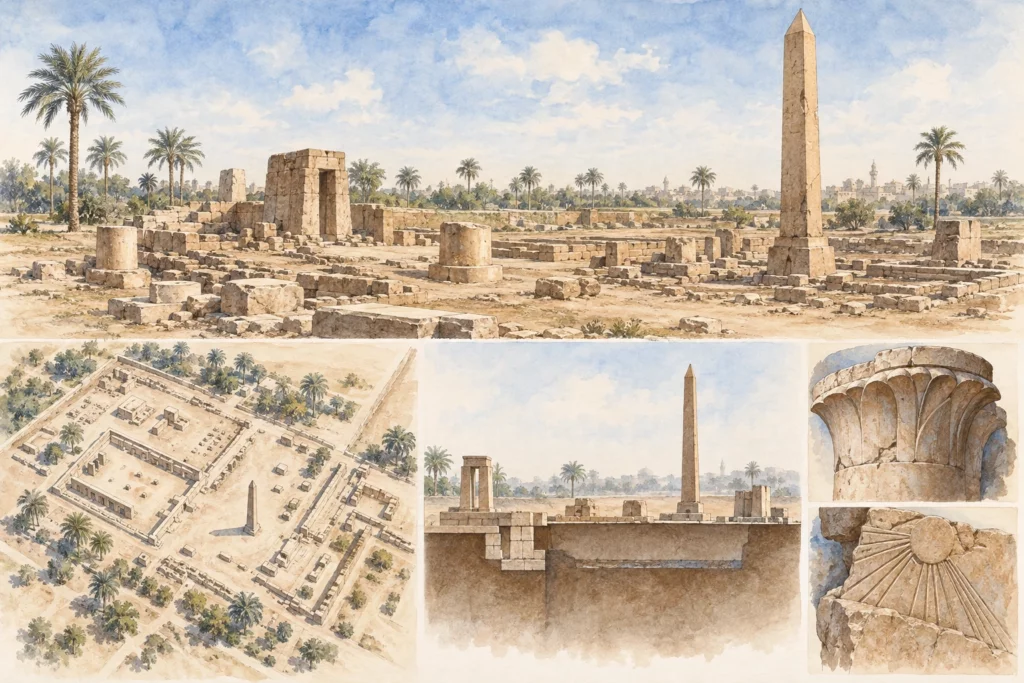
Heliopolis, the Greek name of the city the Egyptians called Iunu, corresponds to the districts of Ain Shams, Matariya and Tell el-Hisn, in the Cairo conurbation. The city occupied a crossroads: the east–west routes coming from Asia and Sinai met the north–south axis of the Nile there, and a canal probably linked it quickly to the Memphite region. The sacred complex covered about one square kilometre, surrounded by walls up to 17 metres thick and 10 metres high; the area currently open for excavation measures about 300 by 400 metres.
An occupation older than the pharaohs
Drilling and geophysical survey have located pottery of the Buto-Maadi culture 300 to 400 metres west of the obelisk, on a sandy ridge of Pleistocene age that formed an island about 5.5 metres high. North-west of Gebel el-Ahmar, a necropolis of 63 tombs of the Naqada II period was published by Fernand Debono and Étienne Drioton.
Atum, Ra and the question of origins
The antiquity of the solar cult often rests on the limestone fragments of a naos bearing the name of Netjerykhet (Djoser), found in 1903 by Ernesto Schiaparelli and kept in the Museo Egizio in Turin (S 2671). They show the gods Geb and Seth enthroned, as well as the end of the royal name written in the serekh. Their find context remains poorly known. The oldest object that directly attests the solar cult is a fragment of a quartzite obelisk bearing the full titulary of Teti, found with a lintel in the name of the same king. For Wolfgang Helck, followed by Dietrich Raue, the site seems linked to Atum and the Ennead for most of the Old Kingdom; the explicit relationship between Ra and Heliopolis appears only at the turn of the 5th and 6th Dynasties.
The temenos and the obelisk of Senusret I
The major topographical feature is a vast mudbrick temenos, doubled by a great enclosure wall. Its date is debated: the first dynasties, the beginning of the 12th Dynasty (Quirke), the Hyksos period (Petrie), the Saite period (Baud), the late Saite period to the 30th Dynasty (Raue); as things stand, nothing allows it to be placed before the Saite period. The obelisk of Senusret I, 20.41 metres high, was erected for the king’s sed festival, probably as one of a pair and together with a temple of Ra-Horakhty; the modern ground surface lies about 3.3 metres above its base. Dieter Arnold deduced from this that the temple was set into an already existing mound (kom).
From Schiaparelli to the Egyptian-German mission
After some work in the 19th century, the mission of the Turin museum led by Schiaparelli worked on the site from 1903 to 1906. William Flinders Petrie drew up the first reliable plan in 1912, and Herbert Ricke studied the temenos. In the early 1990s, the Antiquities Service cleared, north-east of the obelisk, the base of the temenos, lined with a limestone wall built with blocks from destroyed mastabas. Since 2012, the Heliopolis Project, directed by Dietrich Raue (Leipzig University) and Aiman Ashmawy (Ministry of Tourism and Antiquities), with i3mainz and the support of the Deutsche Forschungsgemeinschaft, has been excavating the temple: seasons from 2012 to 2019, then from 2021 to 2023, and a programme for 2024–2026. In March 2017, the mission uncovered the head and bust of an inscribed colossal statue of Psamtik I, followed by several thousand fragments.
A sanctuary beneath the city
Research focuses on the phase of the 4th century BC, on the decline of the temple, whose royal patronage ended in the 3rd century BC, and on the reuse of its monuments. The rising water table, rubbish dumps and urban growth, including illegal occupation of land, threaten the layers still in place.
Sources
Sources (consulted on 30 September 2026): Massimiliano Nuzzolo and Jaromír Krejčí, ‘Heliopolis and the Solar Cult in the Third Millennium BC’, Ägypten und Levante 27, 2017; Ausgrabungen in Heliopolis, Institute of Egyptology, Leipzig University (in German); The cult center of the sun god in Heliopolis, i3mainz, Hochschule Mainz.