In brief
Off Aboukir, the sea has covered a gateway to Egypt. Some 6.5 kilometres from the present shore, under about ten metres of water, Thonis-Heracleion preserves the traces of a world where the Nile met the Mediterranean. Ships entered there, goods were taxed there, gods travelled there by barque. For a long time, two names kept the mystery alive: Thonis for the Egyptians, Heracleion for the Greeks. A stela found in 2000 restored the city’s unity.
What you discover
Nothing breaks the surface today. To find the city, one must follow the patient drawing of the underwater surveys. The prospection of the European Institute for Underwater Archaeology (IEASM) reveals islands and islets, houses, sanctuaries and vast basins linked by canals. Water already crossed the city before swallowing it. It organised its routes, its trade and its horizons.
Before the foundation of Alexandria in 331 BC, this port controlled the entry into Egypt of ships from the Greek world. More than 700 ancient anchors and many wrecks bear witness to this activity. At the bottom of the basins, each hull, each anchor is a trace of passage: that of a ship that stopped at the threshold of the Delta, between sea navigation and the routes of the river. Coins and pottery make it possible to find the trade behind the monumental stones.
On the central island, the sanctuary of Amun-Gereb occupied more than three hectares. Its enclosure was built of limestone blocks, not of bricks. A red granite naos, the shelter of the divine image, made it possible to identify the god to whom it was dedicated. The Ptolemaic sovereigns came here to have their power legitimised: the port was also a place where kingship was affirmed.
The finds restore some of this sanctuary’s wealth: silver ritual instruments, gold jewellery, fragile alabaster vessels for perfumes and ointments. These delicate objects, preserved among the debris, answer the masses of stone. A galley moored near the temple met a singular fate: carried down in their fall, the blocks pinned it to the bottom of the canal, helping to preserve its remains beneath the clay.
What to look at
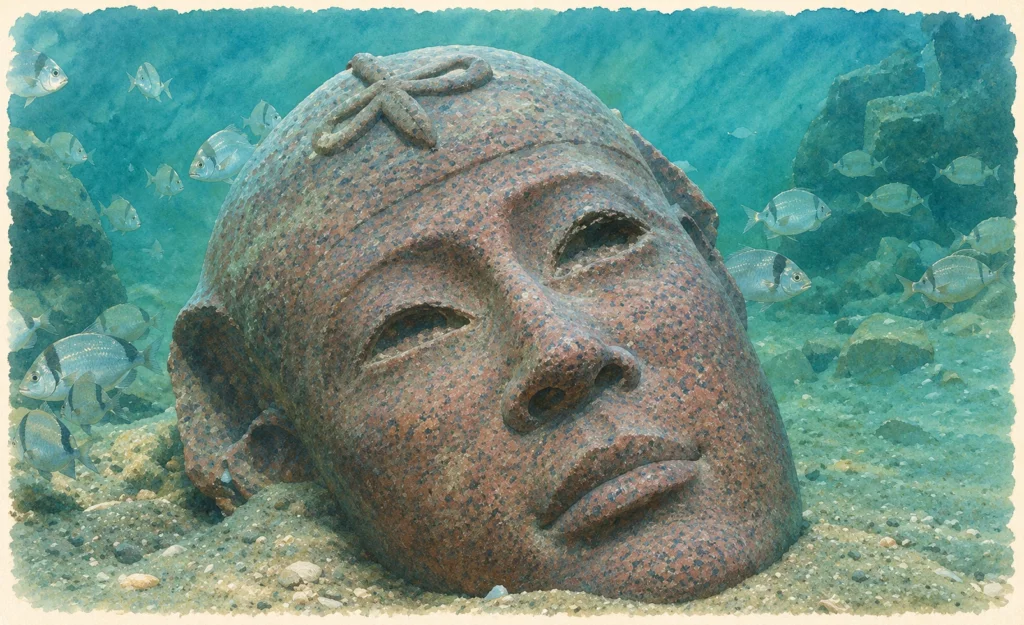
The face of Hapy gives a presence to this vanished city. In the photograph that inspired our watercolour, the head rests among the fish, half caught in the sediment. The red granite still bears the features of the god of the flood and of abundance. On his head, the papyrus evokes Lower Egypt. The monument, found broken, belonged to a group of three colossi with a royal couple; 5.4 metres high, the figure of Hapy is, according to the IEASM, the largest representation of this god known in Egypt.
Another encounter takes place at the level of the signs. The black granodiorite stela of Nectanebo I, 1.99 metres high and dated to around 380 BC, bears the so-called decree of Sais. In it the king reserves for the temple of Neith a share of the revenue from trade. An almost identical copy had been discovered at Naucratis in 1899. Here, the instruction about where to set up the stone names Thonis, ‘at the mouth of the Sea of the Greeks’: a few words were enough to bring the names together and solve the riddle of the city.
The canals also had their sacred calendar. During the Mysteries of Osiris, a nautical procession took the god from Heracleion to his sanctuary at Canopus. The Canopus decree, promulgated in 238 BC, refers to this annual journey. On the waters of the Delta, the return to life of Osiris joined the expectation of the flood and the renewal of the land. Hapy, personification of the fertile waters, belongs to the same religious landscape.
Its history
Probably founded around the 8th century BC, Thonis-Heracleion reached its peak between the 6th and the 4th century BC. Herodotus places there the temple built where Heracles was said to have first set foot on Egyptian soil; he also has Helen and Paris pass through it. These stories tell of the city’s place in the Greek imagination, at the threshold of a country as ancient as it was prestigious.
Its disappearance did not, however, happen in a single legendary night. The temple of Amun-Gereb was destroyed around the middle of the 2nd century BC. The city suffered several natural disasters before being entirely covered by the sea in the 8th century AD. The precise sequence of events is still being studied. Beneath the sediment, archaeologists are also looking for the chronology of this disappearance.
The research of Franck Goddio and the IEASM, carried out with the Egyptian authorities and supported by the Hilti Foundation since 1996, made it possible to find the city in 2000. The Oxford Centre for Maritime Archaeology has taken part in the work since 2011. In 2026 the excavations are continuing: a large part of Thonis-Heracleion remains buried. Each season adds a few landmarks to a city whose map remains open.
From the seabed to the Grand Egyptian Museum
The exhibition Osiris: Egypt’s Sunken Mysteries, shown in Paris in 2015–2016, had opened a window on these discoveries.
The opening of the Grand Egyptian Museum at Giza on 1 November 2025 now gives them another dimension. Near the pyramids, the remains of the sunken cities take their place in the vast story of Egyptian civilisation. The Delta thus regains a presence equal to the role it played: a land of welcome, trade and sanctuaries, open to the Mediterranean.
According to the review published by Hilti in May 2026, 132 objects from the excavations of Thonis-Heracleion, Canopus and Alexandria are now displayed in the museum, including three colossal statues. Bringing them together makes it possible to leave behind the fascinating image of discovery underwater and look at the works themselves: to feel the size of the sculptures, follow the carved signs, recognise behind an object the hand that shaped it and the use for which it was intended.
The passage from the seabed to the museum galleries makes these encounters possible. It owes as much to the divers as to the patient work of conservation, restoration and study. The stones raised from the mud regain outlines, names and a history; they bring us closer to the inhabitants and gods of these vanished ports.
In 2026, while the public discovers these works at Giza, Franck Goddio and the IEASM are continuing their research in Aboukir Bay. The museum shows part of the recovered city. Under the sea, other fragments of its history are still waiting.
Sources
Opening of the Grand Egyptian Museum: Grand Egyptian Museum, Museum Story, official chronology, consulted on 4 November 2026.
Illustrations: watercolour drawn from a photograph of the IEASM excavations; reference photograph: Christoph Gerigk © Franck Goddio / Hilti Foundation.
Consulted on 30 September 2026: Sunken Civilizations: Thonis-Heracleion, Franck Goddio / European Institute for Underwater Archaeology; Stele of Thonis-Heracleion, Franck Goddio / IEASM; Anne-Sophie von Bomhard, Le décret de Saïs. Les stèles de Thônis-Héracléion et de Naucratis, Institut français d’archéologie orientale (IFAO, French Institute for Oriental Archaeology), 2025 (in French).
Further sources consulted on 4 November 2026: Hilti Foundation, support for the research since 1996; Hilti Foundation, ‘A Breakthrough Year for Underwater Archaeology’, May 2026: objects displayed in the Grand Egyptian Museum; Franck Goddio / IEASM, exhibition Osiris: Egypt’s Sunken Mysteries; Franck Goddio and David Fabre, Osiris, mystères engloutis d’Égypte, exhibition catalogue, Paris, Flammarion / Institut du monde arabe, 2015 (bibliographic record of the Mucem (in French)).
For the sanctuary, its objects and its destruction: Franck Goddio / IEASM, Temple of Amun-Gereb. For Hapy and the Osirian processions: Franck Goddio / IEASM, Colossal Statue: God Hapy. Records consulted on 4 November 2026.