In brief
Canopus lay on the coast, west of Thonis-Heracleion and of the Canopic mouth of the Nile, 120 stades from Alexandria by road according to Strabo, about twenty kilometres. Part of the town is now under the sea: the remains known as East Canopus lie about two kilometres east of the modern harbour of Aboukir. The oldest mention of the place is found in a poem by Solon, in the first half of the 6th century BC. Greek tradition derived its name from Canopus, the helmsman of Menelaus, who died there on the way back from Troy.
What you discover
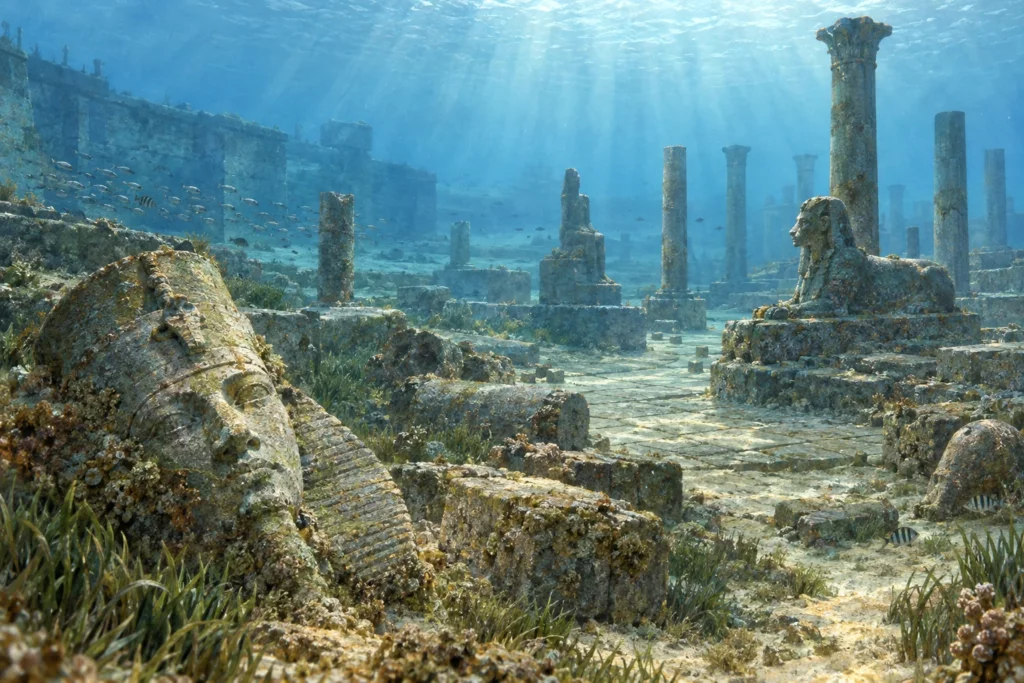
As at Thonis-Heracleion, nothing emerges. The divers of the European Institute for Underwater Archaeology (IEASM) have located a line of ruins 150 metres long: granite columns, limestone blocks, statues. Among the pieces raised are a marble head of Sarapis of the 2nd century BC, a larger-than-life black diorite statue that may represent Arsinoe II, a Byzantine gold ring topped by a tiny oil lamp, and Byzantine (7th century AD) and Islamic (8th century) gold coins. These objects span nearly a millennium: the site was occupied well beyond the Ptolemaic period, but the areas explored represent only part of the town.
What to look at
The most telling monument was found in pieces, over more than two centuries. The Naos of the Decades, a monolithic chapel of black stone dated to the reign of Nectanebo I (379–361 BC according to the Louvre) and dedicated to the god Shu, bears on its upper part a winged sun disc, the sign of the sky and the figures of the decans, accompanied by astronomical texts. Its upper part, found at Aboukir on 13 November 1777, is kept in the Louvre, which bought it in 1818 at the sale of the Choiseul-Gouffier collection. Two fragments were taken from the sea by Prince Omar Toussoun in 1940 (Alexandria museum). Four others were found by Franck Goddio’s team in 1998–1999. The Louvre gives Saft el-Henna, in the eastern Delta, as its original provenance: the naos therefore travelled before ending up on the Canopic coast.
Its history
The town was famous for its sanctuaries of Osiris and Sarapis. Strabo (Geography, XVII, 1, 17) describes the temple of Sarapis, where men of repute came to sleep in order to obtain a cure, and the crowd of revellers who came down from Alexandria by the canal, day and night, to the sound of flutes. Every year, processions linked to the Mysteries of Osiris connected Thonis-Heracleion with Canopus. The fame of the place was such that the emperor Hadrian had part of it reproduced in his villa near Rome. After the destruction of the temples, an important monastery was established on the site.
The coastline has since changed profoundly, and several points remain open: the exact location of each sanctuary, the route of the processions and the boundary between the sunken town and the part that remained under dry land.
Sources
Consulted on 30 September 2026: Sunken Civilizations: Canopus, Franck Goddio / European Institute for Underwater Archaeology; Naos of the Decades, Musée du Louvre; Strabo, Geography, book XVII, trans. H. L. Jones, LacusCurtius, University of Chicago.