With John Garstang’s team · 1902–1904. A story adapted from the excavation report.
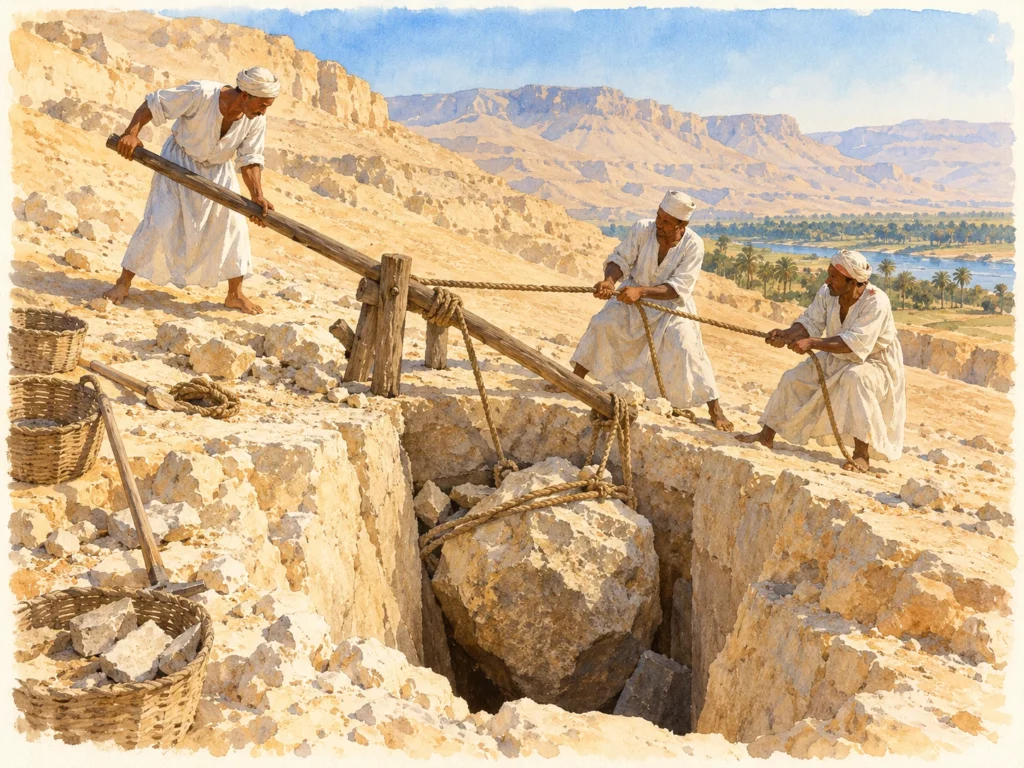
This time, our lifting gear is not enough. The block is too wide, too firmly wedged between the walls of the shaft. It stopped the plunderers. It may well stop us too.
The route of the first visitors
The tomb bears the number 186. Its shaft is narrow, roughly square. At a depth of four metres, a chamber opens that intruders visited long ago.
They had found the great stone a little higher up, in the way of their descent. To get round it, they had dug a passage at the side, just wide enough to squeeze through. In this way they had reached the upper chamber and turned its contents upside down. But below, the shaft continued.
Did they know that another burial remained? We cannot say. What is certain is that the block did not let them go any further. We in turn try to raise it. It does not move enough. Persisting in the same way gets us nowhere.
Lowering what cannot be raised
The workmen carefully clear the space beneath the stone. Little by little it drops to the level of the upper chamber. That chamber has been emptied of its debris; we are going to put the obstacle blocking our way inside it.
Ropes take as much of the weight as possible from the surface. With levers, the men push the block into the chamber. In the end it fits, filling almost all the space. The shaft is free at last.
We can carry on down to seven metres. A second doorway appears. It is still closed with stones, like that of the physician’s tomb. Behind it lies Nefwa, also called Mehti-em-hat, a senior official of the treasury of the province.
The boats of Nefwa
On the lid of the coffin, near the entrance, several boats have been placed. Further on are a miniature workshop and a granary. A woman bearing provisions rests against the wall; a fourth boat takes up a little of the remaining space.
The granary contains wheat and barley. Its compartments are open, its porters stopped in the middle of their work. In the neighbouring group, a figure with his jar has been placed among the others, although he has his own base. The chamber was already full.
Inside the two nested coffins, the body is wrapped in linen. A painted mask covers the head. Opposite the face, eyes have been drawn on the walls of the coffins.
Above us, the great stone remains in the chamber into which the workmen pushed it. We can now come and go in the shaft. The discovery depended on the place they managed to find for it.