With John Garstang’s team · 1902–1904. A story adapted from the excavation report.
The shaft is small. The stones filling it are much less so. For several days, the workmen labour to tie them up and haul them out. Those who had tried to plunder the tomb had stopped at this obstacle.
Four metres down
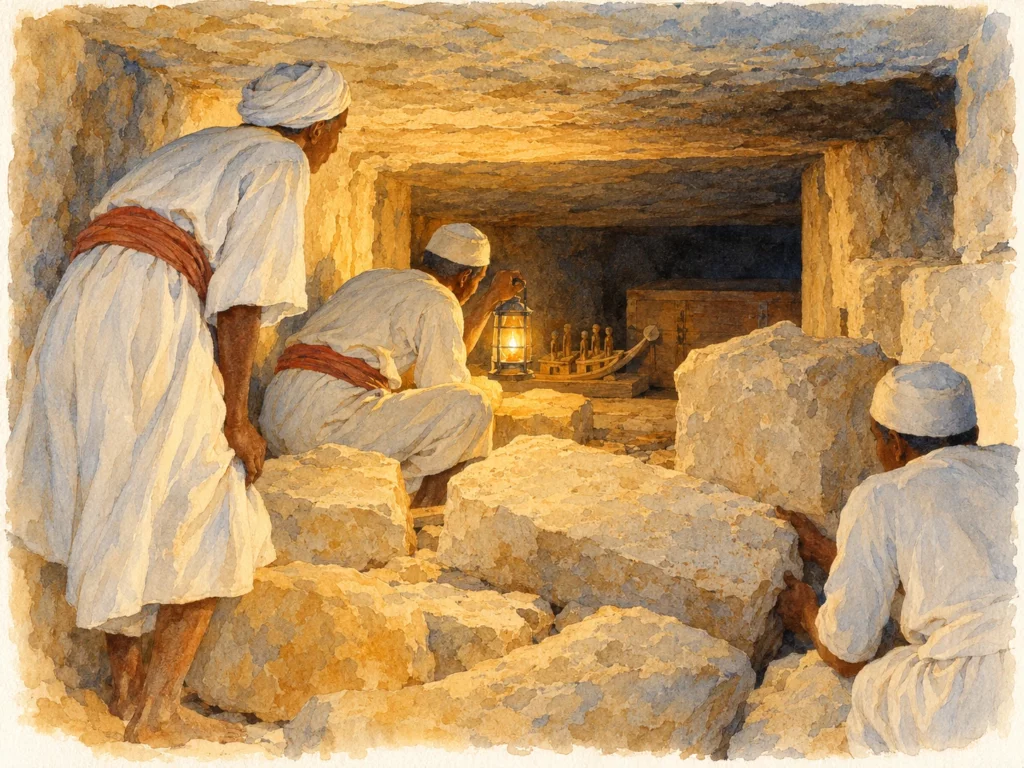
We are at the southern end of the necropolis, near a ravine that breaks the line of the cliff. The mouth of the shaft had already been cleared. It goes down into the limestone; small footholds, cut into two opposite walls, once made it possible to climb up and down.
The bottom finally appears at a depth of four metres. A chamber opens on the south side, closed by irregular stones packed into the entrance. We remove them. The space is just large enough for the wooden coffin and the objects around it.
Before moving them, we take photographs. A little dust and chips of limestone have come in through the joints of the blocking. They whiten the end of the coffin nearest to it. We lightly remove this deposit to make the objects visible; most of them remain where they were placed.
A small door that works
On the right, the men immediately recognise a house. It is a granary in miniature. Its door really turns in its sockets, and behind the walls a staircase leads to the roof. The wooden figures are busy at their work.
Next to it is a pair of sandals; further on, a rowing boat. Another boat lies beside the coffin. As the photographs become clearer, we make out a man leading a bull, a woman carrying a basket and birds, and figures busy preparing food.
The objects do not form a collection arranged for the pleasure of looking at them. They surround a dead man who had to be provided with supplies, journeys and services. The granary has its door, the boat its crew, the bearer her load. The gestures are easy to recognise, even when the sculptor’s work remains rough.
The name of Antef
The signs painted on the coffin give a name and a title: Antef, a man of the court. When we are able to examine the inside, we find the body lying on its left side, the face turned towards the east, wrapped in linen cloths.
In front of the head is a wooden headrest. Behind the knees, another, in alabaster. At the feet, a second pair of sandals. The first had been left on top of the lid.
We can now take up the objects one by one and note their dimensions and colours. But the first photographs keep something else: the open door, and the coffin still surrounded by everything that had been prepared for Antef.