In the footsteps of Jean-François Champollion · late October–early November 1828. A story adapted from his travel letters; it is not a quotation.
I thought I would deal with Beni Hasan in a day. Its tombs have now kept us busy for a fortnight. I should already be in Thebes; I do not regret the delay in the least. Every morning, we climb back up to the same rooms, and there is still drawing to be done.
The first verdict was a poor one
We arrived around midnight, driven by a squall. At dawn, a few of the young men go off to reconnoitre. They come back with a discouraging conclusion: the paintings are almost effaced, and there will not be much to do.
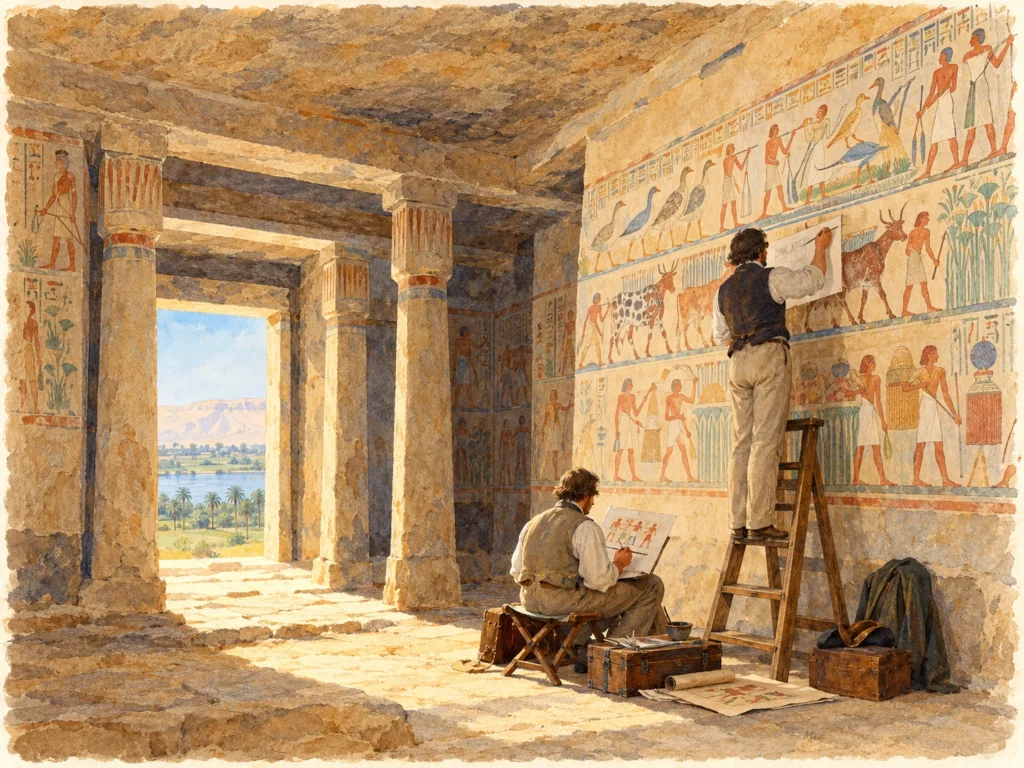
I go up all the same at sunrise. The fine dust covering the walls has misled my companions. We remove it, we pass a damp sponge over the surface, and the details reappear. The scenes become clear enough to occupy the whole team. The ladders are set up; the quick visit has just changed its programme.
In the northern tombs, the porticoes cut into the rock also hold us up. Beyond the columns, we find the painted rooms. Each new wall adds reasons to extend the stop.
Days that are almost identical
Our life is regulated by the sun. From the morning onwards, we draw, we record the colours, we copy the inscriptions. The meal comes from the boats. We eat it in a large hall, sitting on the sand; through the columns stretch the cultivated plains.
An hour is enough for the meal. We then go back to work until sunset. That alone gives the signal to leave. We go back down to the boat, have supper and go to bed. The next day, we climb up again.
This regularity might seem monotonous. The images we are copying are much less so. They move from craftsmen to herds, from fishermen to games, from houses to boats. The animals are rendered with a precision that reminds me of the coloured plates in our natural history books.
Everything worth copying
Little by little, I organise the drawings by subject. The crafts have their series, navigation its own, exercises and entertainments another. Even the utensils are recorded with their colours, because these can help to identify the materials.
I want to bring back these gestures with as much care as the great scenes of the rulers. A craftsman’s work, the way of catching a fish or carrying a dish, also feed the history we are trying to write.
Our drawings can now be counted in hundreds. Thebes is still waiting upstream. When I take up my letter again, I can at least explain the delay: the day planned at Beni Hasan has filled a fortnight of work.