With John Garstang’s team · 1902–1904. A story adapted from the excavation report.
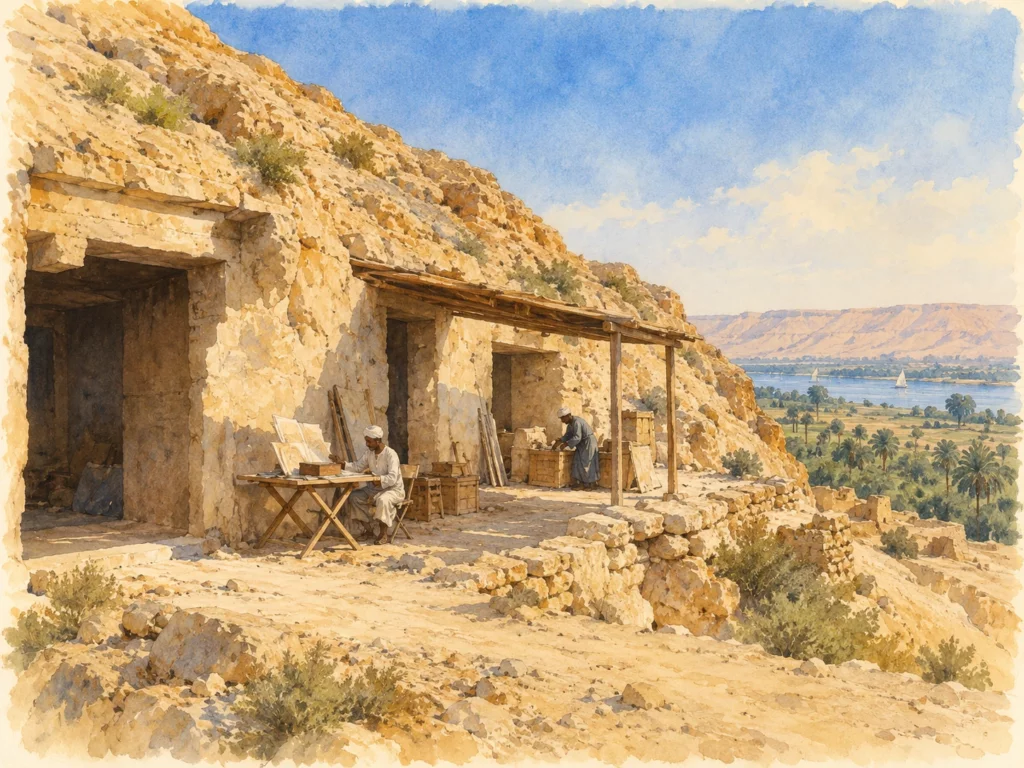
A veranda in front of the entrance, rooms cut into the cliff and the Nile below: our quarters are ready. With the permission of the Antiquities Service, we shall live in an ancient tomb for the two seasons of excavation.
Above the fields
From the river, the openings lined up in the limestone can be seen from afar. The great tombs of Beni Hasan occupy a terrace halfway up the cliff. Lower down, the cultivated land forms a narrow strip before the desert. The valley stretches out before us; you only have to look up from your work to find it again.
The best-known rooms belonged to the governors of the province. Their paintings show fields, workshops, boats and wrestlers. We are looking for the burials of those who lived in their circle. At other sites, the great men do not lie alone: why should it be any different here?
A few openings are already visible beneath the gallery of the monumental tombs. As they clear the debris, the workmen bring others to light. By the end of the two seasons, we shall have explored eight hundred and eighty-eight. For the moment, each one has to be located and opened, and a record kept of what it contains.
A thousand negatives underground
An underground room, reached by a sloping passage from a neighbouring chamber, serves as our photographic laboratory. Mahmoud abd el Gelêl, a young Egyptian, develops more than a thousand negatives there. Part of the images of the dig therefore pass through this small room before they can be shown in a book.
The darkroom is close to the discoveries. The inside of a burial can be photographed, with the objects still in place, and then each of them separately. A model boat will change its meaning depending on whether it is shown on its own or resting on the coffin where it was placed. Both views must be kept.
Ours is not the only dwelling on the terrace. The workmen occupy other chambers a little further on. Several have already worked with us on another site. They know the difficulties of a shaft, the weight of a block, the precautions that ancient wood requires.
Saleh abd El Nebi leads the men. His skill in dealing with the unexpected counts as much as his knowledge of the team; Garstang will mention it in his report. When an obstacle halts the work, it is also his resourcefulness that we are waiting for.
The veranda added to our entrance gives this ancient facade a temporarily domestic air. A few steps away, one chamber is used for sleeping; lower down, another is used for developing photographs. Outside, the shafts are beginning to outline a second necropolis beneath the first.