With John Garstang’s team · 1902–1904. A story adapted from the excavation report.
The two upper chambers have been plundered. Lower down, a huge stone made the intruders believe they had reached the bottom. We haul it up with difficulty. Eight metres below the surface, a third chamber is still sealed.
The boat on the lid
A few pieces of limestone are enough to block its entrance. They have held back most of the debris; only a light dust veils the colours. On the lid of the large coffin, the first thing that catches the eye is a rowing boat.
Twenty oarsmen are at work on it, standing. Their bodies are painted dark red, their clothes white; in places, the small pieces of linen that dressed them even survive. The mast, lowered for lack of space, rests among them. Two figures seated in the middle of the crew raise their hands, as if beating time.
Garstang thinks of the boatmen he has seen on the Nile, and above all of those who take visitors to Philae. In front of these small ancient figures, he recognises a movement still seen on his travels. The model is more than a metre long: in this narrow chamber, it takes up a considerable amount of space.
Behind the oarsmen
A granary stands further on, also placed on the coffin. In its courtyard, the porters are knee-deep in grain. The staircase leads to the roof; a man there watches over the work, a tablet on his knees and a reed in his hand. The miniature doors can be closed, and their pegs would allow them to be tied.
At the back of the chamber, other figures are making bread and beer. A man carries a jar, a woman a basket and a bird. On the floor, a sailing boat accompanies the rowing boat. This small world already filled the chamber before we had even opened the coffin.
The inscriptions tell us that the dead man was a physician. His title appears in the funerary formulas. We still have to lean over an object placed behind the baking scene to discover what will give this visit its most familiar detail.
The ink is still there
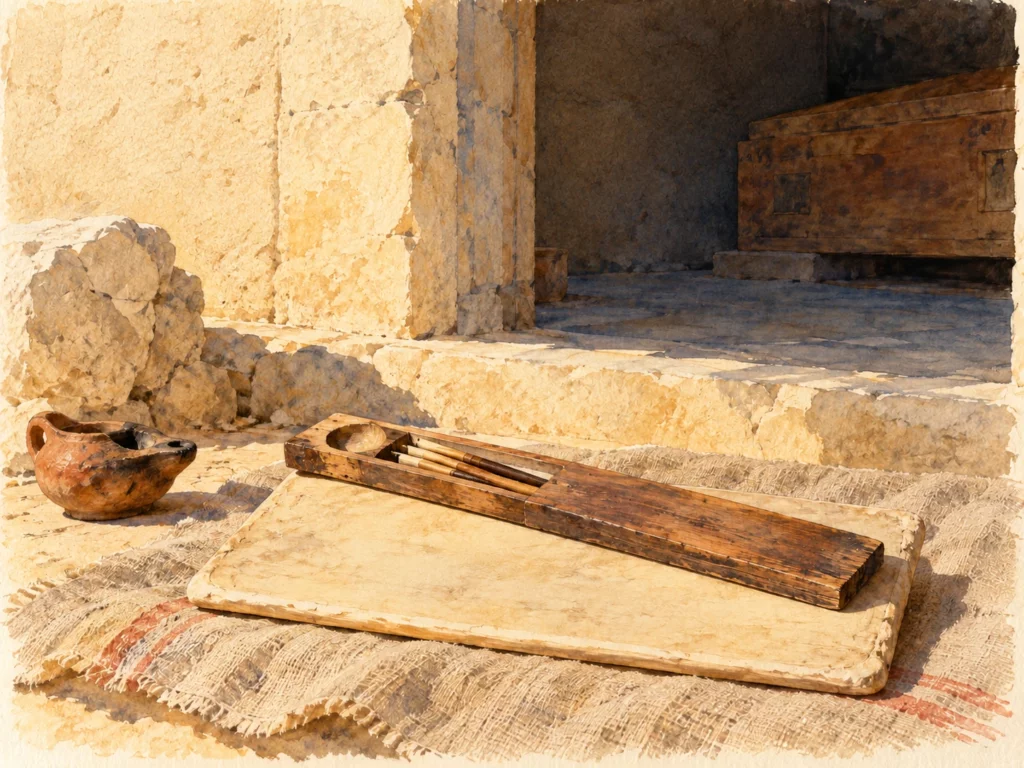
It is a wooden tablet, smoothed with a coating and paint. A writing set rests on it. Reeds stick out of their slot; at each end, the wells still hold the remains of red and dark ink.
The tablet seems smooth enough to have been wiped clean and used again. We cannot read the physician’s notes on it. Nothing allows us to make it a collection of remedies, and the small tools found in a nearby bag belong to woodworking.
Yet this arrangement remains: the reeds in their box, the box on the tablet, the whole laid near the wooden servants. We photograph the group before separating the pieces.