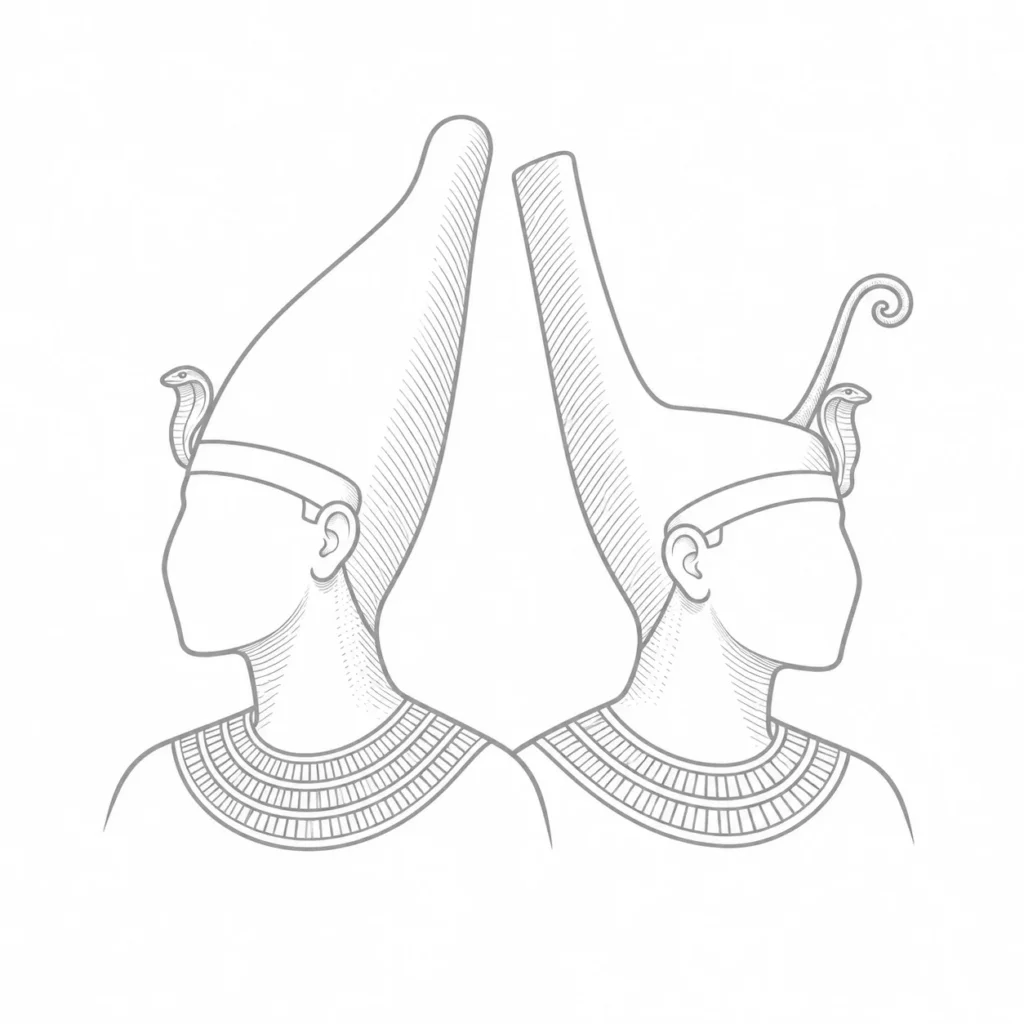
A reign at the end of the 4th Dynasty
Shepseskaf generally succeeds Mycerinus and is among the last kings of the 4th Dynasty. The exact length of his reign and the details of the succession are still debated, as is often the case for the Old Kingdom. He is known from a monumental tomb at Saqqara, from inscriptions and from a decree linked to his predecessor’s complex. These sources make it possible to study concrete decisions without turning the gaps into a dynastic novel. His funerary choice draws particular attention: after the great pyramids of Giza, he adopted a rectangular building for his own burial. This peculiarity makes his reign an important moment for understanding the real diversity of royal monuments. In the chronology of Ian Shaw (Oxford, 2000), his reign falls c. 2503–2498 BC.
A monument unlike the pyramids
At South Saqqara, the tomb of Shepseskaf is known by the modern name of Mastabat el-Faraun, the ‘mastaba of the pharaoh’. Its long, massive superstructure contrasts with the pyramidal silhouette of the tombs of his immediate predecessors. The choice of a different form is certain; its motivation is not. A break with the solar cult, a constraint of time or an architectural preference have been proposed, but no contemporary text directly explains the king’s decision. The monument must first be studied as a built funerary complex, with its cult spaces and installations, and not as a symbol to which a political message is automatically attributed. Its unusual form did not prevent the continuity of the royal rites.
Saqqara in the geography of kingship
The move from Giza to Saqqara does not mean that the court abandoned the Memphite region. Saqqara had long belonged to this vast funerary landscape, already marked by the tombs of the earliest dynasties and by the complex of Djoser. By choosing this plateau, Shepseskaf set his burial in another part of an extensive royal necropolis. The remains do not allow us to determine whether constraints of terrain, visibility or time were decisive. They do show, however, that the form and location of a monument were not mechanically fixed by those of the previous ruler. The succession of tombs reveals possible choices within a shared tradition.
The decree concerning Mycerinus
A decree attributed to Shepseskaf concerns the pyramid town of Mycerinus. It is valuable evidence for the management of a dead king’s cult by his successor. The death of the founder did not erase the personnel, resources or obligations linked to his complex. The text therefore makes it possible to move beyond an over-simple opposition between a new burial at Saqqara and the earlier monuments of Giza. Shepseskaf could adopt a different architectural model for himself while making provision for the cult of Mycerinus. The exact administrative scope of the decree depends on its state of preservation and its interpretation; it nevertheless confirms the existence of institutional continuity between the two reigns.
The biographies of private individuals
Shepseskaf’s name also appears in the inscriptions of high-ranking individuals, notably in the biography of Ptahshepses. This private evidence is indispensable for placing the ruler within his circle. It sheds light on careers, favours and offices at court, even if it does not recount all the events of the reign. Its authors sought to present their lives in a favourable light and to secure their own funerary memory. These texts must therefore be read as situated documents and compared with the royal inscriptions and the remains of the monuments. They show that the transition between the 4th and 5th Dynasties can also be seen in the careers of men who served several kings.
An end of dynasty to be interpreted with caution
The division into dynasties derives largely from classifications made long after the rulers concerned. Presenting Shepseskaf as the end of an era can be useful for orientation, but the phrase does not demonstrate that his contemporaries experienced a clear break. The beginning of the 5th Dynasty would see sun temples take an important place in royal programmes, while pyramids continued to be built. The mastaba of Shepseskaf cannot, therefore, represent the definitive abandonment of the pyramid. Questions of kinship, legitimacy and religious change each require their own evidence; the silhouette of his tomb alone does not resolve them.
What Shepseskaf reveals about the Old Kingdom
The interest of this reign lies in the combination of an exceptional architectural choice and signs of administrative continuity. The tomb at Saqqara shows that kingship could express its funerary cult in a different form, while the decree linked to Mycerinus recalls the longevity of the institutions founded around the royal dead. The private inscriptions add a human dimension to this transition. We still do not know the exact reasons for several of the ruler’s decisions or most of his foreign policy. The record is nevertheless precise enough to avoid automatic explanations: a monumental difference is not, in itself, proof of a religious revolution or a family conflict.
Main sources
- UCL Digital Egypt, Shepseskaf
- University College London, study of royal architecture of the 4th Dynasty
- UCL Digital Egypt, Old Kingdom kings
- Crowns drawn from the statue of Senusret I and the relief of Ahmose, Metropolitan Museum of Art.
Reference works
- Ian Shaw (ed.), The Oxford History of Ancient Egypt, Oxford, Oxford University Press, 2000, chronology pp. 479–483
- Aidan Dodson and Dyan Hilton, The Complete Royal Families of Ancient Egypt, London, Thames & Hudson, 2004