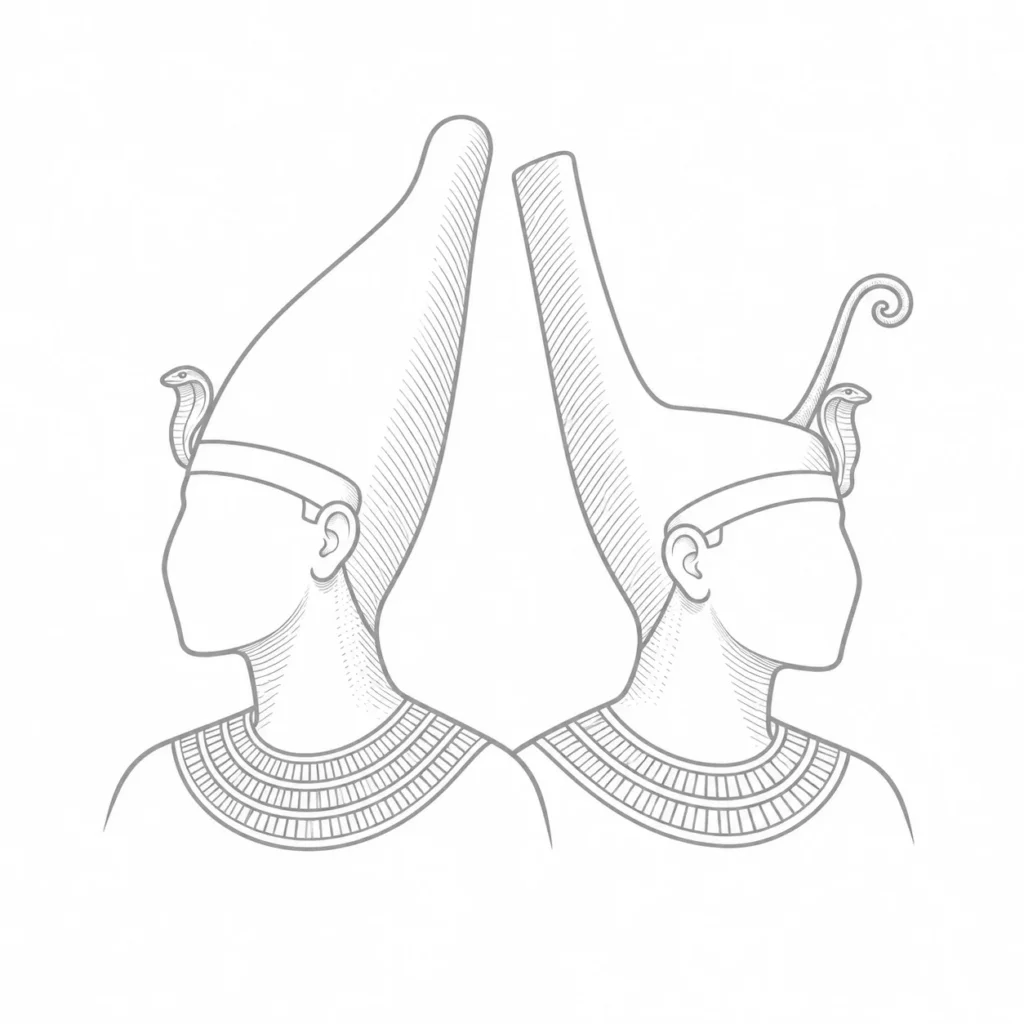
The only king of a dynasty
Amyrtaeus is the only ruler of the 28th Dynasty. A native of Sais, in the western Delta, he put an end to the first Persian domination of Egypt, established since the conquest by Cambyses in 525 BC. Manetho (in French) gives him a reign of six years. He left no known monument, and his name has not yet been found written in hieroglyphs. He is nevertheless a key figure in Egyptian history: it was he who opened the last period of independence of the country under Egyptian kings, before the return of the Persians and then the conquest by Alexander.
A family of Saite rebels
Sais had been the capital of the 26th Dynasty, the last great Egyptian dynasty before the Persian conquest. The town remained a centre of resistance. In the middle of the 5th century BC, an earlier Amyrtaeus of Sais had already risen with the Libyan prince Inaros against Persian rule. The king of the 28th Dynasty was probably his grandson. This family continuity suggests that the revolt was not an improvised uprising, but the culmination of an opposition sustained over several generations in the western Delta.
The revolt against Persia
Amyrtaeus seems to have led actions against the Persians from the last years of the reign of Darius II. On the death of that king, in 404 BC, he took the title of king. Circumstances were in his favour: the Persian empire was soon torn by the war between Artaxerxes II and his brother Cyrus the Younger, which prevented an army from being sent to Egypt. According to some Greek sources, Amyrtaeus also sought the support of Sparta. For nearly two generations, the Persians would fail to retake the country.
The Elephantine papyri
The most precise documents about his reign come not from northern Egypt, but from Elephantine (in French), on the southern frontier. A Judaean community, settled there as a garrison in the service of the Persians, left many papyri in Aramaic. Some deeds are dated by the regnal years of Amyrtaeus, including a contract of year 5, around 400 BC. These dates show that his authority was recognised as far as the First Cataract. They also show that the inhabitants of Elephantine continued their business under the new Egyptian king.
The Demotic Chronicle
A later Egyptian text, the Demotic Chronicle, written in the Ptolemaic Period, also refers to Amyrtaeus. In a prophetic and allusive form, it presents him as the first ruler to come after ‘the foreigners who are the Medes’, that is, the Persians. The Chronicle judges kings by their faithfulness to divine law, and its account must be read as a religious interpretation of history. It nevertheless confirms the place of Amyrtaeus in Egyptian memory as the liberator of the country.
A brutal end
The reign of Amyrtaeus ended around 399 BC. A new claimant, Nepherites, from Mendes in the eastern Delta, took power and founded the 29th Dynasty. According to the interpretation of an Aramaic document from Elephantine, Amyrtaeus was defeated and then executed at Memphis. The details remain uncertain. This brutal change illustrates the fragility of independent Egypt in the 4th century: rivalries between the towns of the Delta, such as Sais, Mendes and later Sebennytos, weighed as heavily as the Persian threat.
What this reign reveals
Amyrtaeus remains a king almost without images or monuments. His importance lies in what he made possible: six decades of independence, during which the 29th and 30th Dynasties would once again build temples and restore the cults. His record rests on external or late sources: Aramaic papyri, Greek authors, the Demotic Chronicle and the lists of Manetho. It shows that the history of a reign can be written from the margins of the country, and that the absence of monuments does not mean an absence of influence.
Main sources
- Manetho, fragment 72 (28th Dynasty), translated by W. G. Waddell (Loeb, 1940)
- Jona Lendering, Amyrtaeus, Livius.org
- Crowns drawn from the statue of Senusret I and the relief of Ahmose, Metropolitan Museum of Art.
Reference works
- Ian Shaw (ed.), The Oxford History of Ancient Egypt, Oxford, Oxford University Press, 2000, chronology pp. 479–483
- Aidan Dodson and Dyan Hilton, The Complete Royal Families of Ancient Egypt, London, Thames & Hudson, 2004