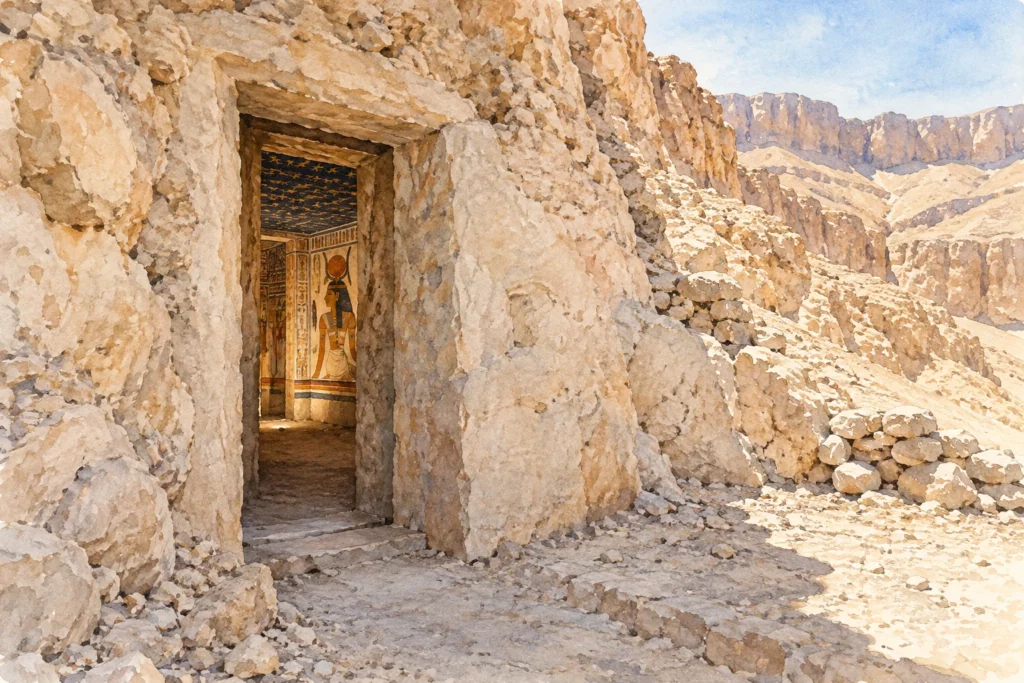
The Valley of the Queens is a funerary sector of the Theban west bank. Its modern name evokes the royal wives, but the place also concerns other members of the ruling family and, at first, officials. The two articles available present the valley as a whole and the tomb of Nefertari.
In brief
The valley is part of the property ‘Ancient Thebes with its Necropolis’, inscribed on the World Heritage List by UNESCO in 1979. According to the Getty Conservation Institute, the main valley counts ninety-one tombs. It served first as a burial place for officials, then for wives, daughters and sons of kings, between about 1550 and 1080 BC. It should therefore not be confused with the Valley of the Kings, even though both belong to the same necropolis.
What you discover
The tombs are cut into the limestone of the Theban mountain. Many have suffered: the Getty notes rock collapses, paintings damaged by flash floods, bat colonies and the pressure of mass tourism. From 2006 to 2011, the institute worked with the Egyptian authorities on a conservation and management plan for the site, with flood-protection measures, the consolidation of tombs and the training of fourteen Egyptian staff.
The valley also has a long history after the New Kingdom. Its tombs were extensively reused in the Third Intermediate Period, then in the Roman and Coptic periods, and many still bear the traces of fires.
What to look at
The tomb of Nefertari, the principal wife of Ramses II (Ramesses II), is the most famous in the valley. Discovered in 1904 by the Italian mission of Ernesto Schiaparelli, it preserves paintings of rare quality, some 3,200 years old. By the 1980s, at least a fifth of these paintings had been lost. From 1986 to 1992, the Getty and the Egyptian Antiquities Organisation consolidated and cleaned them, without repainting, in order to preserve their authenticity.
Its history
The fame of this tomb does not sum up all the burials of the sector. The tombs of the princes and princesses, those of the first officials and the late reoccupations together tell the story of a valley that never ceased to be visited. Even today, the tomb of Nefertari opens only with restrictions: in 2024, it was closed to study the humidity and the visiting conditions that would limit its wear.
How to explore the articles
The article on the royal necropolis situates the sector, the categories of the dead and the main phases of its use. The article on the tomb of Nefertari details its paintings and their conservation. To place the valley within the west bank, beside the Valley of the Kings and the mortuary temples, return to the article on the Theban necropolis.
Sources
UNESCO, Ancient Thebes with its Necropolis: https://whc.unesco.org/en/list/87
Egyptian ministry, tomb of Nefertari: https://egymonuments.gov.eg/events/the-anniversary-of-the-discovery-of-queen-nefertari-s-tomb/
Getty Conservation Institute, Valley of the Queens: https://www.getty.edu/projects/valley-of-queens/
Getty Conservation Institute, Tomb of Nefertari (1986–1992): https://www.getty.edu/conservation/our_projects/field_projects/nefertari/