In brief
On the west bank at Thebes, the Valley of the Queens was a burial place first for officials, then for wives, daughters and sons of kings, from the 18th to the 20th Dynasty, that is, from about 1550 to 1080 BC according to the Getty Conservation Institute. Its modern name therefore does not tell its whole story. The first burials are discreet; the decorated tombs of the following dynasties show another stage in the use of the valley.
What you discover
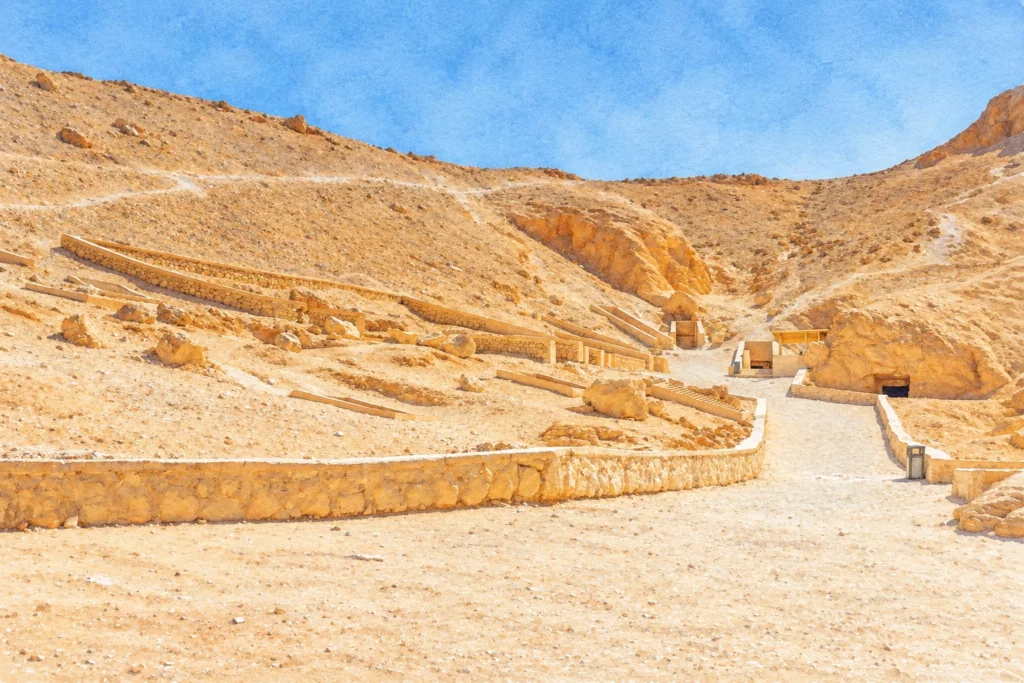
The oldest tombs are simple vertical shafts, without inscriptions. Later come tombs with several chambers, an entrance ramp and rich painted decoration. The tomb of Nefertari, wife of Ramses II (Ramesses II), is the most famous, but it does not represent all the tombs. UNESCO also mentions Tuya, mother of Ramses II, among the queens of the valley. The paths of the craftsmen of Deir el-Medina, the remains of their huts and the traces of a Coptic occupation are reminders that the valley belonged to a wider landscape and was used at different periods.
What to look at
Comparing two types of tomb is the best tool for observation. On one side, a bare shaft and chamber that name no one; on the other, a Ramesside tomb with painted walls, like that of Nefertari, where the decoration accompanies the dead into the afterlife. The contrast gives the measure of the change: the anonymity of the first occupants, recovered only through objects, against the names and images that the 19th Dynasty had inscribed. The entrance ramp and the multiplication of rooms are the signs to look for.
Its history
The growing place of the royal family changed the architecture and decoration of the tombs. Many were later looted or reused. The Italian archaeologist Ernesto Schiaparelli, active in the valley at the beginning of the 20th century, discovered many tombs there, including that of Nefertari in 1904. Between 1986 and 1992, the Getty Conservation Institute and the Egyptian authorities studied and consolidated its paintings; a wider programme then examined the conservation of the whole valley.
Why this place matters
The valley belongs to ‘Ancient Thebes with its Necropolis’, inscribed by UNESCO in 1979. It shows that royal funerary practices were not unchanging. The simple tombs, the painted chambers and the later uses tell a longer story than that of Nefertari alone. Floods and the fragility of the decoration now require protection that also concerns the less visible tombs.
Sources
Consulted on 30 September 2026: Significance of the Valley, Getty Conservation Institute; Ancient Thebes with its Necropolis, UNESCO.