In a storeroom of the Egyptian Museum in Turin, a small box holds two mummified knees. Ernesto Schiaparelli picked them up in 1904 in the looted tomb of Nefertari. For a century, nobody knew whom they belonged to. In 2016, an international team dated, X-rayed and compared them: they are very probably those of the queen. They are all that remains of her.
Identification and location
The tomb of Nefertari, numbered QV66, lies in the Valley of the Queens, on the west bank at Thebes. Nefertari was the great royal wife of Ramses II (Ramesses II), the first and most honoured. At Abu Simbel, he dedicated a whole temple to her, next to his own, where her statues are the same size as those of the king. That is rare.
She also had a political role. A letter she sent to the Hittite queen Puduhepa, at the time of the peace between the two empires, was found at Hattusa, written in cuneiform. It contains wishes for good health and the announcement of gifts.
Architecture and decoration
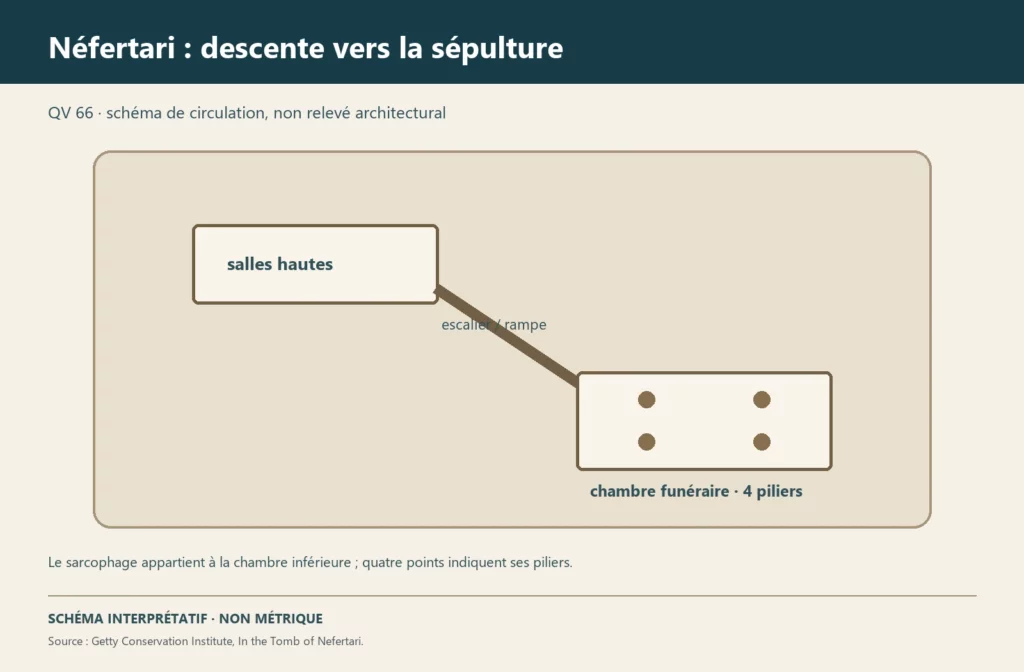
The tomb descends in two stages. First an antechamber and side rooms, then a staircase that plunges towards the burial chamber, supported by four pillars. The decoration is painted on a plaster coating modelled in low relief, which gives the figures an almost sculpted presence.
We follow the queen on her journey. She plays senet, alone at the board, a game whose stake is her passage into the afterlife. She is led by Isis and welcomed by Osiris, Hathor, Ra-Horakhty and Thoth. Her white linen dress is so fine that the body can be seen through it. Formulas from the Book of the Dead accompany the descent, and the ceiling is a dark blue sky scattered with yellow stars.
The colours strike first. The white background, the ochres, the green, the Egyptian blue. Then the faces: the queen has pink cheeks, which is unusual in Egyptian painting.
Discovery
Schiaparelli entered the tomb in 1904. It had been looted in Antiquity. He found fragments of the lid of the granite sarcophagus, sandals, funerary figurines, a box knob bearing the name of King Ay, and the human remains that were identified so late. Everything went to Turin.
Conservation
From the time of the discovery, it was noticed that flakes of plaster were coming away. Salts, from the rock and from humidity, crystallise beneath the paint and lift it. For decades, the tomb was closed.
From 1986 to 1992, the Getty Conservation Institute and the Egyptian Antiquities Organisation carried out a conservation campaign there. The conservators fixed the plaster, cleaned the surfaces and chose not to repaint what was missing. The gaps remain visible. What can be seen is the ancient painting, and nothing else.
State of preservation and research questions
The tomb reopened to the public in the 1990s, with a limited number of visitors and a fixed visiting time. Every breath brings humidity, every group raises the temperature.
The archives of the Getty project, photographs, surveys, pigment analyses, are now accessible to researchers. They will serve to measure, in twenty or fifty years, what the tomb will have lost or kept.
Sources
Main sources (consulted on 28 September 2026): Getty Conservation Institute, Tomb of Nefertari project; Getty, archives of the Nefertari project; UNESCO, Ancient Thebes with its Necropolis; John K. McDonald, House of Eternity: The Tomb of Nefertari, Los Angeles, Getty Conservation Institute, 1996.