Identification and location
The Valley of the Queens is a group of small valleys on the Theban west bank, within the necropolis of ancient Thebes. Its modern name suggests a necropolis reserved for royal wives; the burials nevertheless show a broader history, from the 18th to the 20th Dynasty. The Getty Conservation Institute distinguishes the first burials of people close to the court from the later tombs of wives, daughters and sons of kings. This development makes it impossible to date or attribute a tomb on the basis of the name of the valley alone.
General presentation
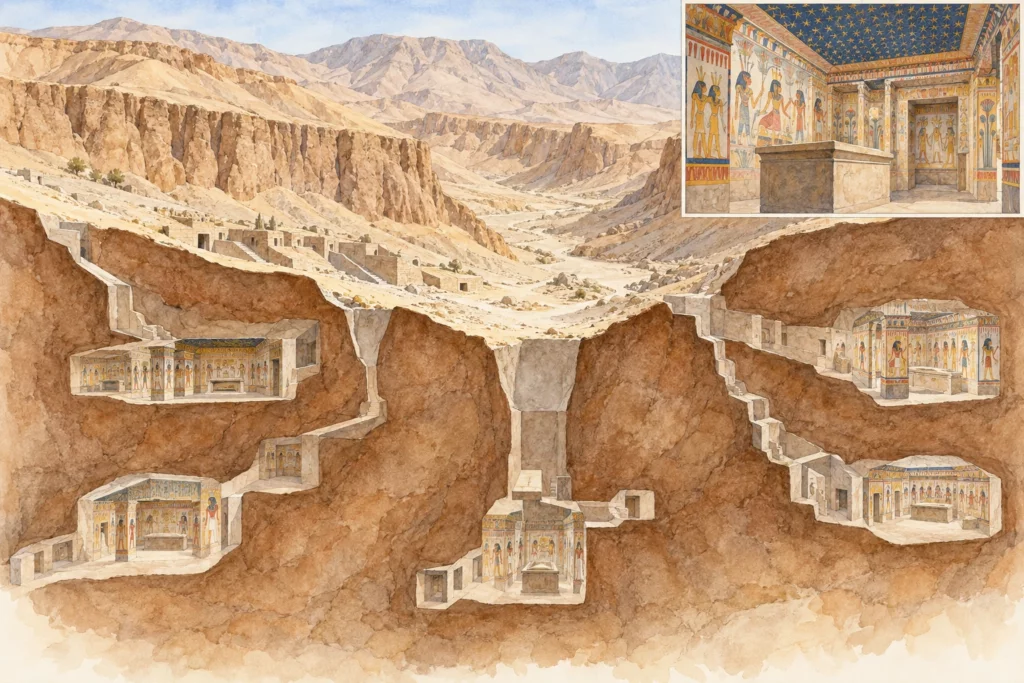
The valley is not a single monument but a funerary landscape made up of entrances, shafts, rock-cut chambers and traces of later occupation. The tombs of the 18th Dynasty are often anonymous, without inscription or decoration, with a vertical shaft and a chamber. From the 19th Dynasty, royal patronage asserted itself, and routes with several chambers, reached by a sloping passage, sometimes received developed painted decoration. The tomb of Nefertari, wife of Ramses II, illustrates this Ramesside phase; it does not provide the standard plan for the whole necropolis.
Monuments and remains
The funerary spaces change according to their period and their intended occupant. A shaft and a sparsely decorated chamber do not convey the same information as a tomb whose walls bear texts and figures of the journey into the afterlife. The identity of the first people buried depends on the objects and archaeological contexts preserved, since many tombs name no one. The paths used by the craftsmen of Deir el-Medina link the valley to the rest of the Theban mountain; the sanctuary of Ptah and Meretseger, as well as the remains of huts, bear witness to their presence. The traces of a Coptic monastery and the reuse of tombs belong to other moments in the history of the place.
Chronology and building phases
The funerary use of the valley extends mainly from the 18th to the 20th Dynasty. This long period should not be treated as a continuous building site: each tomb results from its own cutting and, sometimes, its own transformations. The early shaft monuments precede the rise of the decorated royal tombs of the 19th and 20th Dynasties. Reuse during the Third Intermediate Period, then in the Roman and Coptic periods, altered some spaces. The paintings visible today, mainly in the Ramesside tombs, therefore describe neither the state of all the early burials nor the whole of the successive uses of the valley.
History and functions
The valley complements the Valley of the Kings without being a mere annexe of it. The changes in the choice of the people buried there shed light on the place of the members of the royal family, especially women, in the funerary practices of the New Kingdom. The images and texts of the decorated tombs accompany the passage of the dead into the afterlife; their programme must nevertheless be studied tomb by tomb. The later reoccupations show that the cut chambers remained accessible and useful after the end of their original function. Objects displaced by looting or early excavations make any attribution based on an isolated find delicate.
Excavations and the history of research
Ernesto Schiaparelli explored the valley at the beginning of the 20th century and discovered the tomb of Nefertari in 1904. The importance of its paintings long drew attention to this single monument, whereas the less spectacular tombs are essential to the chronology of the whole. Between 1986 and 1992, the Getty Conservation Institute and the Egyptian authorities studied and consolidated the paintings of Nefertari. Another programme, carried out from 2006 to 2011, assessed the risks for the whole site and prepared measures for protecting the tombs, managing visitors and drainage. This work distinguishes early archaeological observation from recent conservation interventions.
State of preservation and research questions
Flash floods have brought water and sediment into several tombs; rock instability, salts, reuse, bats and visitor numbers have also affected the painted surfaces. The Getty reports that protection and conservation works were planned, but that their implementation was partly interrupted after 2011. For the tomb of Nefertari, the intervention of 1986 to 1992 favoured cleaning and consolidation of the paintings rather than an imaginary restoration of lost parts. Restored decoration must therefore be read with its material history. The main questions concern the identification of the anonymous tombs, the succession of uses and the way to protect the whole necropolis, including its less visited remains.
Sources
Main sources: Getty Conservation Institute, ‘Significance of the Valley’ and ‘Valley of the Queens’; Getty Conservation Institute, ‘Tomb of Nefertari’. Pages consulted on 28 September 2026: https://www.getty.edu/projects/valley-of-queens/significance-of-the-valley/; https://www.getty.edu/projects/valley-of-queens/; https://www.getty.edu/projects/tomb-nefertari/.