Identification and location
KV62 lies in the Valley of the Kings, on the west bank of ancient Thebes. The number is that of the modern inventory of the tombs of the valley. Howard Carter uncovered the entrance in November 1922. The fame of the discovery lies in the mass of funerary equipment left in place, whereas the size of the rock-cut tomb and the extent of its decoration are modest by the standard of the neighbouring royal burials.
General presentation
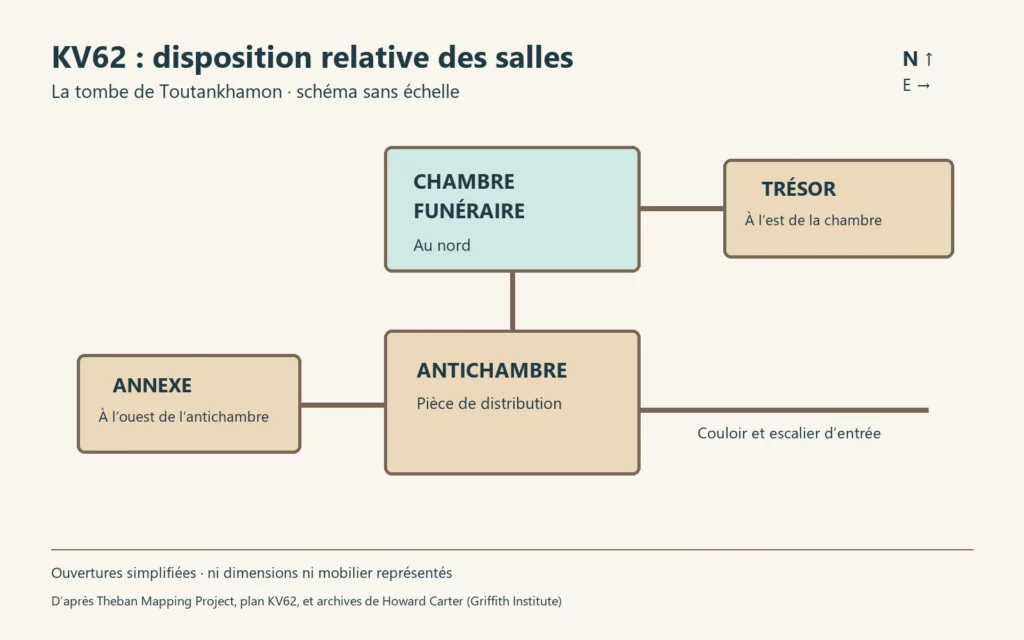
The plan comprises an access staircase, a corridor, an Antechamber, an Annexe opening off it, a Burial Chamber north of the Antechamber and the Treasury adjoining the Burial Chamber to the east. This layout can be read in the surveys of the Theban Mapping Project and in Carter’s archives kept by the Griffith Institute. The four painted walls belong to the Burial Chamber; showing the other rooms covered with the same decoration would mislead visitors.
Monuments and remains
The great gilded wooden shrines surrounded the sarcophagus in the Burial Chamber. Elsewhere, the objects formed tightly packed groups, with chariots, beds, chests, clothing, weapons and vessels. The Egyptian ministry mentions about 5,000 artefacts; the number does not by itself say how they were distributed between the rooms. The excavation cards and photographs are essential for recovering their position and distinguishing the original deposit, ancient displacements and the excavators’ operations. The richness of the funerary equipment does not mean that the tomb was discovered absolutely intact.
Chronology and building phases
Tutankhamun’s early death helps to explain the limited layout, without being enough to establish for whom KV62 had first been cut. The Egyptian ministry mentions the hypotheses that other tombs, such as KV23 or KV57, may have been intended for the king: they remain hypotheses. The Theban Mapping Project survey notes the start of a doorway abandoned when the Burial Chamber was cut north of the Antechamber. It also documents the blocking wall between these two rooms, removed by Carter’s team during the excavation.
History and functions
The funerary equipment combines the necessities of the royal afterlife with objects of daily life and court prestige. The painted images show the dead king with deities and funerary scenes; the ministry stresses that only one scene of the Amduat appears there. Objects moved since 1922 to places of conservation or display should not be presented as still arranged in the tomb. To understand the ancient deposit, one must go back to Carter’s records rather than to a present-day museum display.
Excavations and the history of research
Carter and his team devoted several seasons to recording, photographing and clearing the rooms. The Griffith Institute makes available plans, object records and photographic archives that make it possible to link an object to its context. From 2009 to 2019, the Getty Conservation Institute and the Egyptian authorities studied the condition of the wall paintings and the effects of visitor numbers. Their work also covered the routes, barriers, lighting, ventilation and public information.
State of preservation and research questions
The decoration of the Burial Chamber shows brown spots already noted during the excavation; their origin has not been fully established, according to the Getty. Dust, the internal climate and visitor numbers call for continuous management. The railings, glazing and visitor fittings are modern. The photograph in the discovery article shows the present entrance; it does not represent the entrance as it appeared in 1922. The accompanying diagram shows only the attested relationships between the rooms, without scale or the positions of the objects.
Sources
Main sources (consulted on 28 September 2026): https://egymonuments.gov.eg/monuments/tomb-of-tutankhamun/; https://www.getty.edu/projects/conservation-management-tomb-tutankhamen/; https://tutankhamun.griffith.ox.ac.uk/rooms; https://thebanmappingproject.com/sites/default/files/plans/KV62_1.pdf.