Identification and location
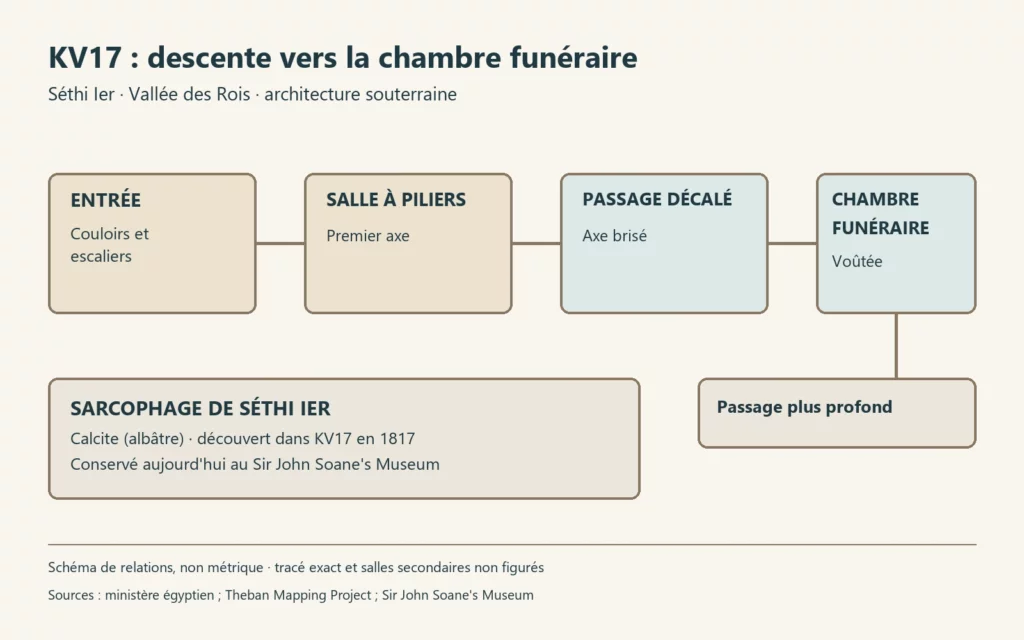
KV17 is the royal rock-cut tomb of Seti I in the Valley of the Kings, on the west bank at Thebes. The number belongs to the modern inventory of the tombs. The monument descends into the rock and is distinct from the temples at Qurna and Abydos, which had other functions. A survey by the Theban Mapping Project is needed to measure the spaces or locate a scene precisely; the accompanying diagram is not intended for that.
General presentation
The plan follows a bent axis. A first sequence of corridors and descending passages ends in a pillared hall; a new, offset access descends to the burial chamber. The ministry also mentions a room on the original axis that has sometimes been interpreted as a decoy, but this function remains hypothetical. The burial chamber has a vaulted ceiling, an innovation in the series of tombs in the valley. A passage leaves the floor of this chamber and descends deeper; its ritual interpretation is a proposal, not something directly observable.
Monuments and remains
The Litany of Ra, the Amduat, the Book of Gates and the Book of the Heavenly Cow are among the compositions inscribed or painted. The ceiling of the burial chamber depicts an astronomical sky. These groups are not topographical maps of the valley; they articulate the night journey of the sun, the divine powers and the regeneration of the king. The sarcophagus discovered in the tomb is carved from translucent calcite, traditionally called Egyptian alabaster. The Soane Museum now holds this object and specifies that the Book of Gates is carved on its faces.
Chronology and building phases
Seti I, the second king of the 19th Dynasty, had KV17 laid out for his burial. The Egyptian ministry presents it as the first fully decorated tomb in the Valley of the Kings. That does not mean that every surface received an identical finish. After the opening of 1817 by Belzoni, casts, copies and removals altered some places. The modern steps and supports noted in the Theban Mapping Project survey must be distinguished from the ancient architecture. The removal of the sarcophagus from Egypt belongs to the modern history of the monument, not to its pharaonic layout.
History and functions
The progression towards the burial chamber was both material and symbolic. The royal texts accompanied the dead king through the stages of the afterlife and shaped the image of a daily rebirth. The position of a composition on a wall or ceiling therefore matters as much as its title. The vaulted chamber brought together the royal body, its sarcophagus and a depicted sky. The present location of the sarcophagus in London makes it necessary to distinguish the visitor route from the historical arrangement of the burial.
Excavations and the history of research
Belzoni documented the tomb at the beginning of the 19th century; copies and reconstructions were shown in London from 1821. These early documents bear witness to surfaces damaged since, but their accuracy must be assessed case by case. The Theban Mapping Project has published measured plans and sections, with markers of the modern alterations. The Factum Foundation and the Theban Necropolis Preservation Initiative have carried out a high-resolution digital recording with the Egyptian authorities. These data support conservation and make facsimiles possible without contact with the original walls.
State of preservation and research questions
The decoration has suffered from removals, contact, early interventions and the constraints of a deep tomb open to visitors. Comparing Belzoni’s records, historical photographs and recent captures helps to measure the losses. Conservation work should not be confused with the original decoration. The illustration in the discovery article evokes an entrance in the valley without documenting the exact entrance of KV17. The new plate shows only the main relationships between rooms and recalls the material and the present location of the sarcophagus.
Sources
Main sources (consulted on 28 September 2026): https://egymonuments.gov.eg/monuments/tomb-of-sety-i-kv17/; https://thebanmappingproject.com/sites/default/files/plans/KV17_1.pdf; https://www.soane.org/sarcophagus-seti-i; https://collections.soane.org/object-m470; https://factumfoundation.org/our-projects/digitisation/the-theban-necropolis-preservation-initiative/the-tomb-of-seti-i/.