Identification and location
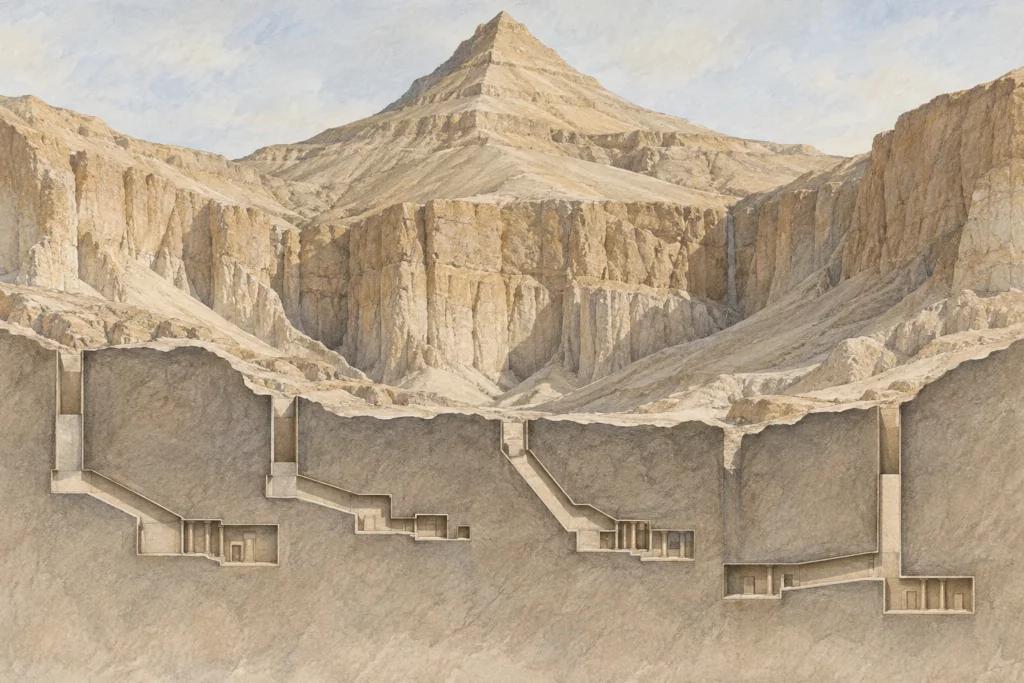
The Valley of the Kings forms a group of dry valleys in the Theban mountain, on the west bank of the Nile opposite Luxor. The eastern valley holds most of the tombs; the western valley preserves a smaller group. The Egyptian ministry links the royal burials to the 18th, 19th and 20th Dynasties and presents Thutmose I as the first New Kingdom ruler whose burial in the valley is confirmed. The precise question is that of the tomb in which his body was first placed, since several interventions affected the burials of the family.
The first tombs and their architecture
KV38 lies in a southern branch of the valley. According to the study published by the Oriental Institute, its sequence of spaces is relatively short: entrance, sloping corridor, intermediate chamber and burial chamber with a small annexe. A quartzite sarcophagus inscribed for Thutmose I was found there. This architecture should not serve as a single model for all the tombs of the early 18th Dynasty: routes and enlargements vary from one monument to another.
KV20 is linked to Hatshepsut and her father. Its underground development is more extensive and its building history more complex. The relationship between KV20 and KV38 has given rise to several reconstructions: depending on the author, the tomb commissioned by the official Ineni for Thutmose I would rather correspond to one or the other. The sarcophagus and the objects found in a tomb prove a funerary association, but are not always enough to date the first cutting of all its spaces.
Chronology and history of the burials
In the inscription of his tomb, Ineni states that he directed the work on the royal tomb out of sight. This testimony is essential for understanding the organisation of the work under Thutmose I, but it gives no modern tomb number. The hypothesis of a transfer of the king between KV20 and KV38 depends on the combined reading of the plans, the inscriptions, the sarcophagi and the objects associated with Hatshepsut and Thutmose III. Three possible events must therefore be distinguished: the cutting of a space, its fitting out for an occupant and its actual use or reuse.
The first royal tombs fit into a wider funerary landscape. The temples of the royal cult occupy other locations on the west bank; the burials of relatives of the royal family and of high dignitaries show that the valley was not reserved exclusively for the pharaohs. The separation between the tomb in the mountain and the public places of cult does not erase the ritual links between them.
The fragments of the Book of the Amduat
The Book of the Amduat describes the night journey of the sun god through the afterlife. In the setting of the royal tombs, this text and its images accompany the regeneration of the dead ruler. The fragments from KV38 are particularly important for studying the first forms of this tradition in the New Kingdom. The project directed by Khaled Abdel Ghany has documented limestone slabs kept in the Egyptian Museum in Cairo as well as plaster fragments from the burial chamber.
The team reported in particular plaster fragments discovered in 2016, then other elements collected during work in 2023. It compared their palaeography and iconography with later versions, notably that of the tomb of Thutmose III, KV34. A new fragment of a slab of the second hour, found in KV38, has been joined to the group discovered by Victor Loret at the end of the 19th century. These results strengthen the attribution of an early copy of the Amduat to KV38. The project’s conclusion on the single origin of the group should be read as a research result, not as the definitive solution to the whole chronology of KV20 and KV38.
Excavations, conservation and the limits of the investigation
Victor Loret explored KV38 at the end of the 19th century; Howard Carter studied KV20 at the beginning of the 20th. Since then, the investigation no longer depends solely on the visible architecture. The provenance of the blocks, traces of inscription, the state of the plaster and the joining of fragments can change an old attribution. In KV38, quartzite fragments bearing the throne name of Thutmose I have been reported beneath debris in the burial chamber; their possible relationship with a sarcophagus is still being examined.
Rainwater has entered the tombs and altered the painted or plastered surfaces. The Amduat slabs also suffered deposits and salts before their treatment in the museum. Cleaning and rejoining make some signs legible again, but an image isolated from its context does not on its own restore the original order of the scenes. Looting, ancient displacements and successive excavations explain why the present absence of an object does not prove its absence at the time of the funeral.
What can be concluded
The Valley of the Kings was already a place of royal burial in the time of Thutmose I. KV38 is firmly associated with him by an inscribed sarcophagus and by the discoveries studied recently; KV20 also belongs to the funerary history of Hatshepsut and her father. Recent research sheds light on the dating of the Amduat, but the identification of the first royal cutting and the exact sequence of the refittings remain debated. A depiction of ‘the first tomb’ cannot therefore replace the separate examination of the plans and remains of KV20 and KV38.
Sources
Main sources (consulted on 28 September 2026): https://egymonuments.gov.eg/archaeological-sites/valley-of-the-kings/; https://arce.org/project/documentation-and-conservation-of-the-amduat-fragments-from-the-tomb-of-thutmose-i-kv-38/; https://isac.uchicago.edu/sites/oi.uchicago.edu/files/uploads/shared/docs/saoc61.pdf.