In brief
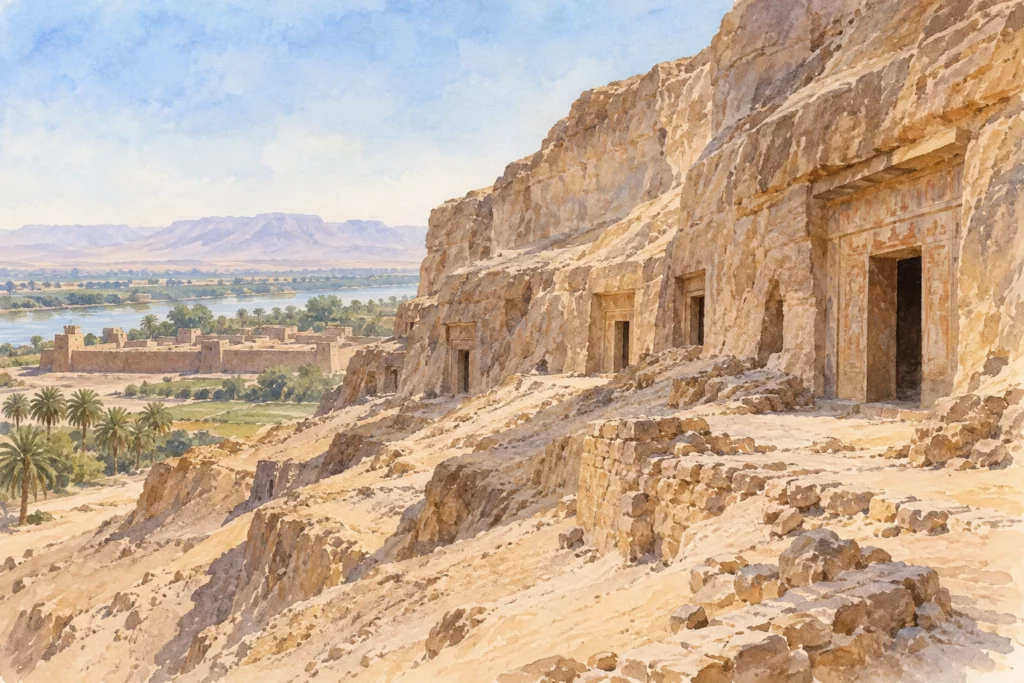
El-Kab, ancient Nekheb, lies on the east bank of the Nile, some 80 kilometres south of Luxor. Its name refers to Nekhbet, the vulture goddess who, with the cobra goddess Wadjet, protected the pharaoh. Occupation of the site goes back to the 5th millennium BC and continues into the Coptic period, but its fame rests above all on a handful of rock-cut tombs from the beginning of the New Kingdom. Their owners, notables of the town, left texts and images that are among the most direct testimonies to the birth of the 18th Dynasty.
What you discover
The first landmark is a monumental mud-brick enclosure, about ten metres high, which encloses the temples of Nekhbet and Thoth and part of the necropolis; the settlement extended over about five hectares south-west of the temples. East of the enclosure, a sandstone hill is pierced by hundreds of rock-cut tombs. A few of them, decorated in the New Kingdom, stand out: those of Paheri, Renni, Ahmose and Setau. Yet the site cannot be reduced to them. A monumental mastaba of the 3rd Dynasty crowns the hill, which also holds tombs of high priests of the end of the Old Kingdom. Further into the desert are a Ptolemaic rock-cut temple dedicated to the goddess Shesmetet, a temple of Amenhotep III dedicated to Hathor and Nekhbet and, between the two, the Vulture Rock, covered with prehistoric petroglyphs.
What to look at
In the tomb of Ahmose, son of Abana, the image gives way to the text. The east wall is almost entirely covered with thirty-one lines of hieroglyphs, which leave only a small space for the figures; its left part was largely destroyed when access to the burial chamber was opened. A life-size figure of the dead man accompanies the inscription, whose continuation, eight lines, occupies the south wall.
This first-person narrative is a soldier’s autobiography. Ahmose tells how he grew up at Nekheb, how his father Baba had already served King Seqenenra and how he succeeded him, very young, on a ship named The Bull. He then accompanied three kings, Ahmose I, Amenhotep I and Thutmose I: the siege of Avaris, the siege of Sharuhen, campaigns in Nubia and then an expedition as far as Naharin, north of Phoenicia. He lists the lands he received in his town, the severed hands brought back as proof, the prisoners received as servants and the seven awards of the gold of valour. The text was one of the first great subjects of the young discipline of Egyptology: Emmanuel de Rougé devoted a long memoir to it, published in 1853 by the Académie des inscriptions et belles-lettres, which presented it as ‘a great inscription taken from the tombs of Eileithyia’ (translated from the French).
Its history
These rock-cut tombs shed light on a precise moment: the expulsion of the Hyksos and the reconquest led by the Theban kings. But they are funerary texts, written to glorify their owners, and their account must be compared with other sources. It would also be misleading to extend the experience of these elites to all the inhabitants of the town.
Archaeological research long favoured the monuments. The Belgian excavations, begun in 1937 under the direction of Jean Capart, first explored the temples of Nekhbet and Thoth. Since 2009, the Royal Museums of Art and History in Brussels have concentrated mainly on the settlement, where they have uncovered a complete copper crucible of the 2nd Dynasty, around 2900 BC, the oldest intact example found in Egypt. The history of the ordinary town, in the shadow of the great tombs, still largely remains to be written.
Sources
Consulted on 30 September 2026: Elkab, Royal Museums of Art and History (Brussels); The autobiography of Ahmose, son of Abana, Digital Library of Inscriptions and Calligraphies, Bibliotheca Alexandrina; Emmanuel de Rougé, ‘Mémoire sur l’inscription du tombeau d’Ahmès, chef des Nautoniers’, Mémoires présentés par divers savants à l’Académie des inscriptions et belles-lettres, 1st series, vol. III, 1853, Persée (in French).