Identification and location
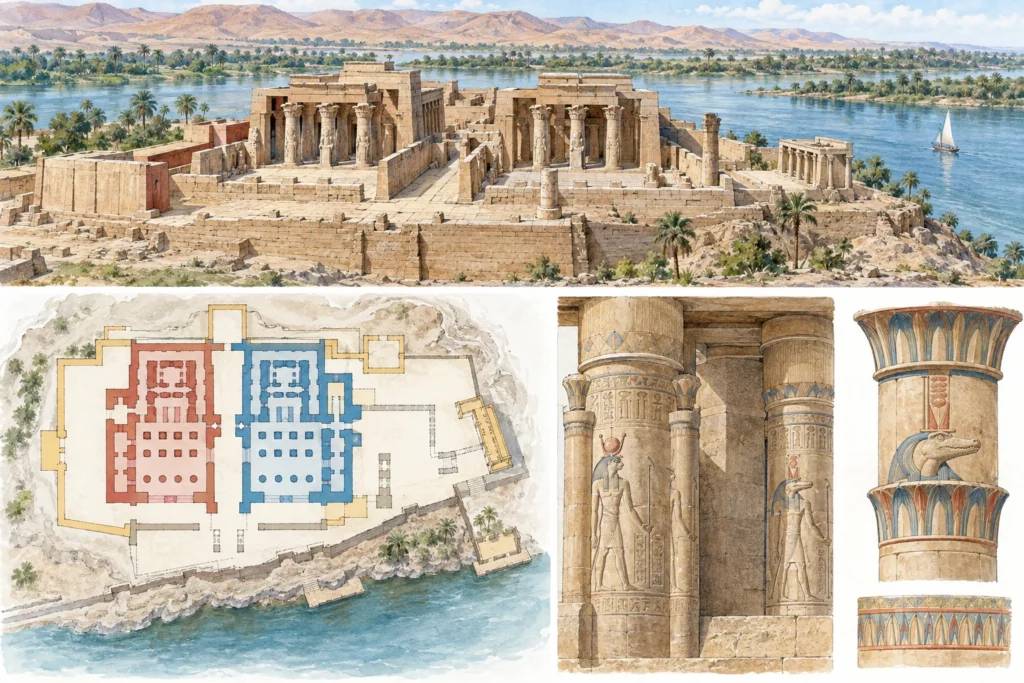
The temple of Kom Ombo stands on a promontory on the east bank of the Nile, about 45 km north of Aswan. Its distinctive feature is that it is a double temple: two parallel axes, two entrances and two sanctuaries side by side within a single building.
Architecture and decoration
The southern part is dedicated to the crocodile god Sobek (article on Sobek, in French), associated with Hathor and Khonsu; the northern part to Haroeris, Horus the Elder, associated with the goddess Tasenetnofret and their son Panebtawy. Court, hypostyle halls, vestibules and sanctuaries are doubled. The inner enclosure wall bears a famous scene showing instruments, often interpreted as surgical instruments; this reading remains debated.
The complex also includes a mammisi, a nilometer and a well. A chapel of Hathor lies within the enclosure; the crocodile mummies discovered in the region are displayed in the Crocodile Museum, opened in 2012 next to the temple.
Chronology and building phases
The present temple dates from the Ptolemaic period. According to the Egyptian ministry, the oldest royal inscriptions there bear the name of Ptolemy VI Philometor (180–145 BC), while most of the decoration was carried out under Ptolemy XII Neos Dionysos (80–51 BC). The decoration was completed in the Roman period, and the famous instruments are attributed to the 2nd century AD. The walls also preserve festival calendars. Elements of an older sanctuary are reported on the site.
History and functions
The Egyptian ministry links the construction to the Graeco-Roman period and describes the two parallel axes that cross the columned halls to the two sanctuaries, the south for Sobek and the north for Haroeris (Har-wer, the falcon god). The site is open every day, during the day and in the evening. The double cult reflects a local theology in which Sobek and Haroeris coexist. Crocodiles, the sacred animals of Sobek, were raised and mummified on the spot, which explains how the Crocodile Museum, next to the temple, can now present these mummies to the public in the immediate vicinity of the temple that was dedicated to them. The town of Ombos also controlled the routes towards Nubia and the Eastern Desert.
Excavations and the history of research
The temple was cleared at the end of the 19th century by Jacques de Morgan, who published its inscriptions. The Institut français d’archéologie orientale (IFAO, French Institute for Oriental Archaeology) is continuing the epigraphic study of the monument.
State of preservation and research questions
The position of the temple on the riverbank has exposed it to erosion; part of the pylon and of the mammisi has disappeared. Research focuses on the organisation of the double cult and on the reading of debated scenes, such as that of the instruments.
Sources
Main sources (consulted on 28 September 2026): Egyptian ministry, temple of Kom Ombo; IFAO, Kom Ombo (in French); Crocodile Museum, Egyptian Ministry of Tourism and Antiquities.