Identification and location
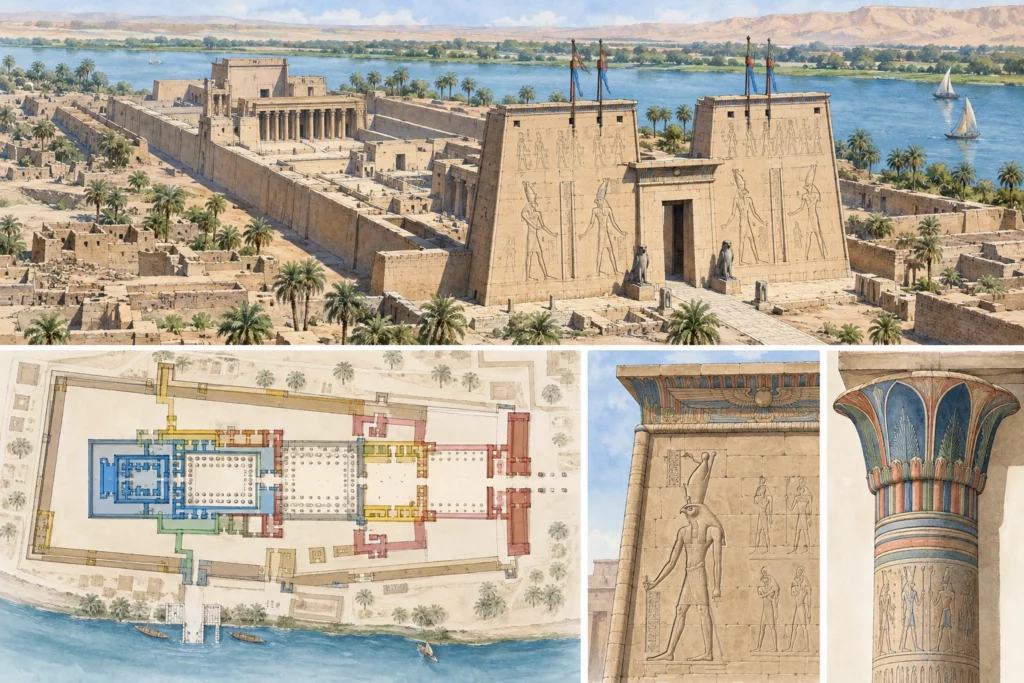
The temple of Horus at Edfu lies on the west bank of the Nile, halfway between Luxor and Aswan. It is the best-preserved Egyptian temple: pylon, court, hypostyle halls, sanctuary and enclosure wall are almost intact.
Architecture and decoration
The entrance pylon, about 36 m high, bears scenes in which the king strikes down his enemies before Horus. A colonnaded court leads to two successive hypostyle halls, then to offering rooms and the sanctuary, where a granite naos of Nectanebo II, from the earlier temple, still stands. A circulation corridor surrounds the temple between its walls and the enclosure.
The walls bear decoration and texts of exceptional density. The building inscriptions trace the history of the work. On the enclosure wall, a series of reliefs tells of the fight of Horus against Seth, shown as a hippopotamus. A nilometer made it possible to measure the flood.
Chronology and building phases
The present temple was founded in 237 BC, under Ptolemy III, on the site of an older sanctuary. The main structure was completed under Ptolemy IV, then the decoration continued; the whole was finished in 57 BC, under Ptolemy XII. The work thus lasted nearly two centuries, allowing for the troubles of the period.
History and functions
Edfu was the centre of the cult of Horus of Behdet, the falcon god. Every year, the statue of Hathor of Dendera came by river to join that of Horus for the Feast of the Beautiful Reunion. The texts of the temple also describe the ritual of the coronation of the sacred falcon and the myth of the foundation of the temple.
Excavations and the history of research
Buried in sand and partly covered by houses, the temple was cleared by Auguste Mariette in the 1860s. Its inscriptions were published by Émile Chassinat in the early 20th century, then studied and translated by the Edfu project of the Göttingen Academy.
State of preservation and research questions
The Egyptian ministry recently announced the discovery of coloured inscriptions on the roof of the temple during restoration work. Research focuses on the theology of Ptolemaic temples, for which Edfu is a source of the first order.
Sources
Main sources (consulted on 28 September 2026): Egyptian ministry, temple of Edfu; Egyptian ministry, restoration of the roof of the temple of Edfu.