In brief
Near Naqada, in Upper Egypt, several cemeteries have yielded thousands of tombs dug before the appearance of the first pharaohs. They have given their name to the Naqada period, which covers roughly the 4th millennium BC. These burials tell of the development of funerary practices and of the societies of the Nile valley. Their interest lies above all in the objects, the plans and the excavation archives: much of the ground explored is no longer visible today.
What you discover
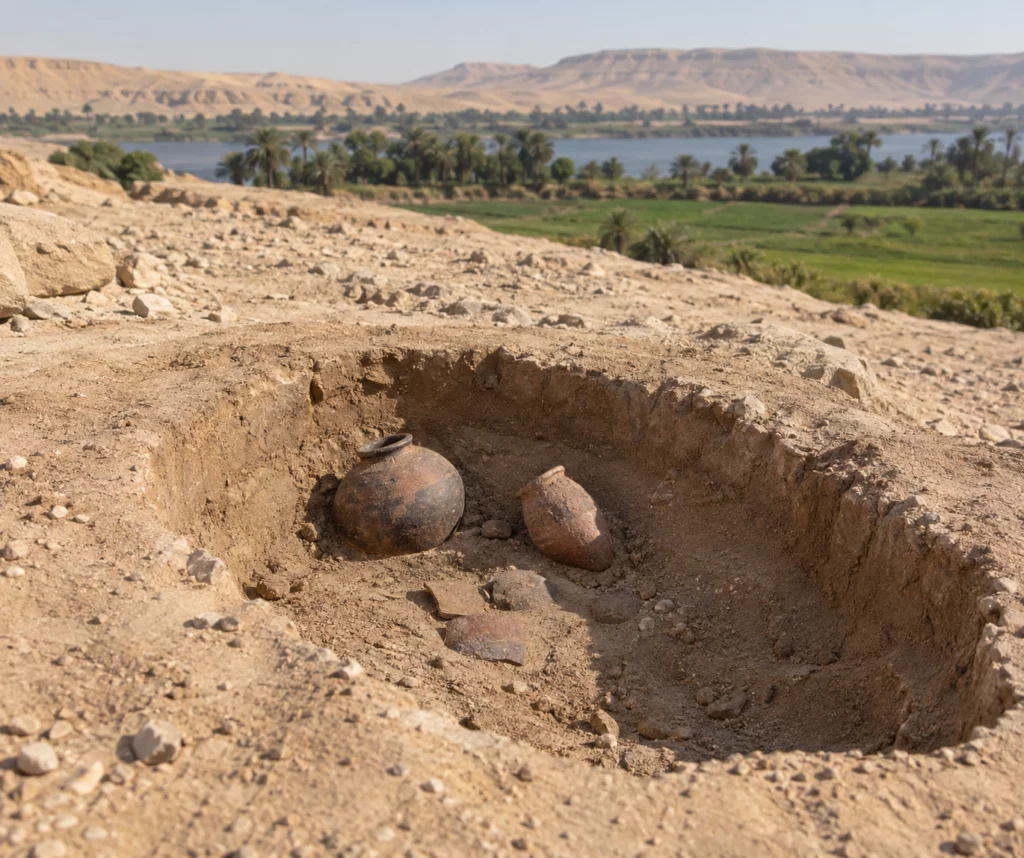
The simplest tombs were oval pits dug into the ground. Others, later, were larger and sometimes rectangular. The pottery placed beside the dead varies in form and decoration; objects of stone and other materials have also been found. The so-called Cemetery T brings together burials that are generally larger and better furnished than those of other sectors. To understand the site today, one must look above all at the objects kept in museums, the drawings of tombs and the excavation maps. They make it possible to compare the burials, without assuming that each one represented the whole society of its time.
Its history
The cemeteries were used during several phases of Egyptian prehistory, around 4000–3000 BC. In 1894–1895, the British archaeologist Flinders Petrie carried out a large excavation there, while James Quibell worked in particular at Ballas, further north. Petrie recognised the originality of the tombs but was at first mistaken about their age, attributing them to a later foreign people. Subsequent research established that they were earlier than the 1st Dynasty. Petrie then used the development of the pottery to build a relative chronology, refined since by other scholars. The excavation notebooks are still studied to recover the position and contents of the tombs.
Why this place matters
Naqada shows how archaeology can shed light on a period without abundant texts. The differences between the tombs suggest changes in funerary customs and in the distribution of resources, without revealing the exact rank of each person buried. The objects found at Naqada have also helped to date other Predynastic sites. A recent map, drawn up from Petrie’s archives, corrects some errors in the old plan. The site is thus a reminder that the first excavations opened up a history, but that their notes and collections continue to transform it.