In brief
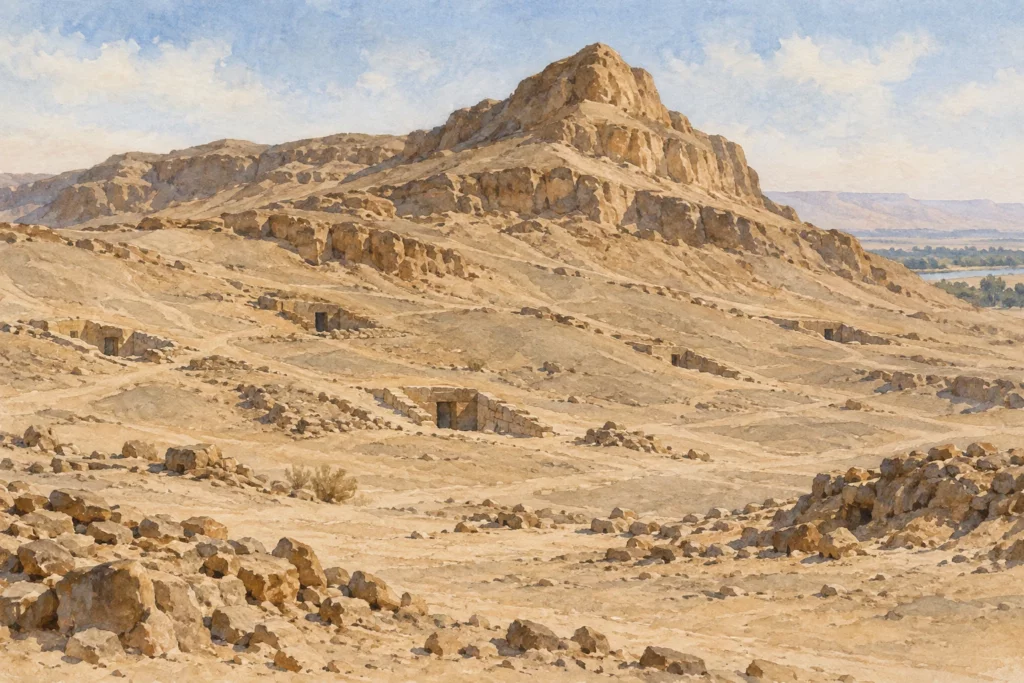
South of Abydos, at the foot of the desert cliffs, rises a natural pyramid-shaped peak that the Egyptians called the Mountain of Anubis. Beneath the desert at its base, Senusret III, who reigned c. 1880–1850 BC, had an immense underground tomb dug. About two centuries later, during the Second Intermediate Period, other kings in turn chose this area for their burial. One of them, Senebkay, was still unknown to historians before 2014.
What you discover
The place is best understood as a landscape rather than a monument. The pyramid-like mountain dominates the whole; at its foot, the royal tomb is entirely buried and barely shows on the surface. The project of Senusret III was not limited to this tomb: it included a funerary temple called Nefer-Ka, ‘Beautiful is the ka’, a religious and administrative centre, and a planned town, Wah-Sut, occupied for some two hundred years, from about 1850 to 1650 BC. The residence of the town’s mayor, a palatial building of about 45 by 75 metres, shows the importance of the community responsible for the king’s cult. The temple, the town and the tomb have been excavated and studied since 1994 by the Penn Museum mission directed by Josef Wegner.
What to look at
The tomb of Senusret III is a feat of engineering. Its corridors extend over some 180 metres and descend to 30 metres below the surface. Fourteen granite blocks, the heaviest weighing about 215 tonnes, blocked the entrance corridor. In the burial chamber, a quartzite lining concealed the position of the sarcophagus and the canopic chest. Josef Wegner sees it as the first deliberately hidden royal burial in Egyptian history, long before the tombs of the Valley of the Kings.
The tomb of Senebkay, more modest, tells another story. Discovered in early January 2014 in the area of the chapel of an older tomb, that of Sobekhotep I, the first king of the 13th Dynasty, it has a limestone chamber painted with four goddesses protecting the canopic chest. Senebkay’s craftsmen had reused, for this chest, cedar planks from the coffin of Sobekhotep. The king’s skeleton, studied in 2015, bears eighteen wounds reaching the bone: he died a violent death, aged about 35 to 40, in battle or in an ambush.
Its history
The tomb of Senusret III was discovered in 1902 by Arthur Weigall, who continued clearing it in 1903. Because the king also had a pyramid at Dahshur, it was long regarded as a cenotaph. The Penn Museum mission reopened it in 2005; in its view, the excavations carried out since 2004 provide significant archaeological evidence in favour of the king’s actual burial at Abydos.
The discovery of Senebkay gave substance to an ‘Abydos dynasty’, a regional power of about 1650–1600 BC, of which he was the first or second king. Seven other royal tombs have been excavated on the same site. The order of succession of these rulers and the extent of their authority are still debated, and the question of the real burial place of Senusret III is not closed.
Sources
Consulted on 30 September 2026: Josef Wegner, ‘Beneath the Mountain-of-Anubis’, Expedition 48/2, Penn Museum, 2006; Josef Wegner, ‘Discovering Pharaohs Sobekhotep and Senebkay’, Expedition, Penn Museum, 2014; Press release on the forensic study of Senebkay, Penn Museum, 2015.