In brief
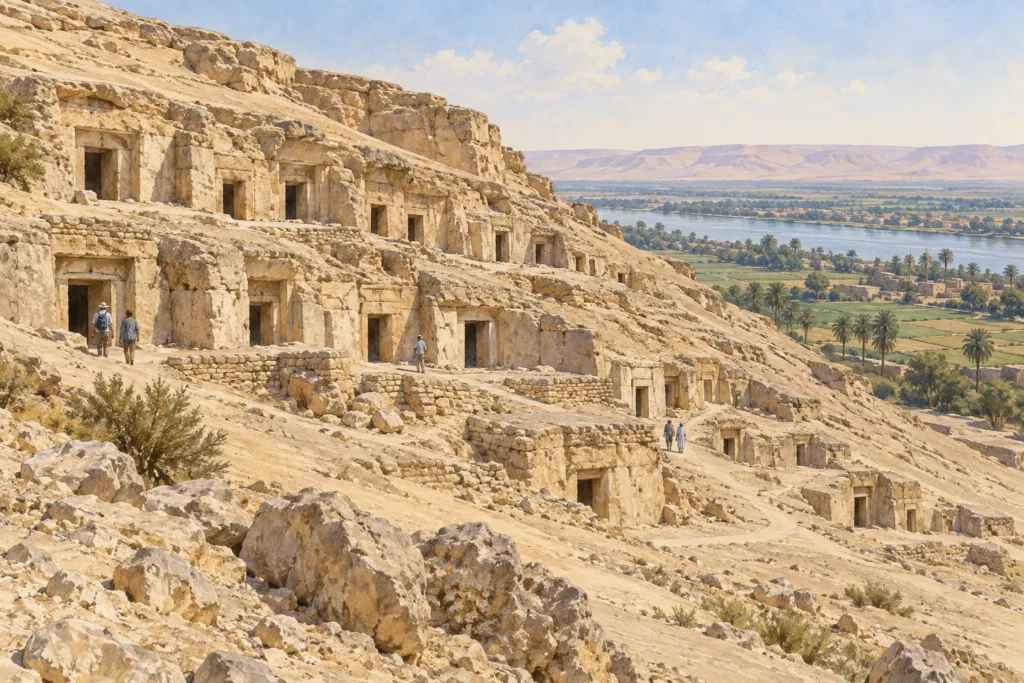
El-Hawawish is the great rock-cut necropolis of Akhmim, in the Sohag region of Upper Egypt. Unlike the royal pyramids of Saqqara, its tombs were cut into the rocky slopes for officials of the province and other inhabitants of high or middle rank. The cemetery developed from the late Old Kingdom to the First Intermediate Period; its monuments therefore do not belong to a single date or a single owner.
What you discover
The Egyptian ministry describes more than 800 tombs on the site. Some sixty preserve inscriptions or scenes, and five are particularly well preserved according to its description. In some chapels appear offerings, farming activities, hunting, dancing and images of the owner. This decoration speaks of funerary ideals and of provincial society, but it is not photographic reporting. The architecture varies: the rock-cut tombs do not all have the same plan, the same dimensions or the same status.
Its history
Akhmim was an important administrative centre of the ninth nome of Upper Egypt. Local officials were buried at El-Hawawish between the 5th and the 8th Dynasty, as the study of the tombs has shown. The research of the Australian team directed by Naguib Kanawati documented the cemetery during the 1980s and 1990s. University work continues to analyse the plans and scenes in order to understand the chronology, the functions and the representation of the owners.
Why this place matters
The necropolis makes it possible to compare the provincial elites with those of the Memphite region without assuming that they followed exactly the same customs. A decorative scheme can give information on the titles, rituals and choice of images of an official; it must be linked to an identified tomb before any biographical conclusion. The accompanying visuals offer an interpretive, non-metric view and plate. They do not reproduce a specific tomb or the exact state of an excavated sector.