Identification and location
Naqada, also transcribed Nagada, here refers to the Predynastic cemeteries on the edge of the desert near ancient Nubt, in Upper Egypt, some twenty kilometres north of Luxor. The group includes in particular the great cemetery known as N, as well as sectors B and T. It is neither a single monument nor all the discoveries made in the region: the settlement of Nubt, the temple of Seth and the dynastic tombs belong to other histories. The burials studied belong mainly to the Naqada I, II and III phases, roughly between 4000 and 3000 BC. The name of the Naqada culture comes from the site where this sequence was recognised and studied.
General presentation
The interest of the cemeteries lies in the combination of a very large number of burials, associated objects and early archives. The tombs make it possible to follow changes in the forms of the pits and in the grave goods. Pottery played a central part in the construction of the Predynastic chronology. Differences in size and equipment between tombs provide information on the diversity of practices, but social interpretation remains cautious: a rich burial does not by itself give the title, function or political identity of its occupant. The present landscape no longer conveys the extent of the excavations carried out at the end of the 19th century.
Monuments and remains
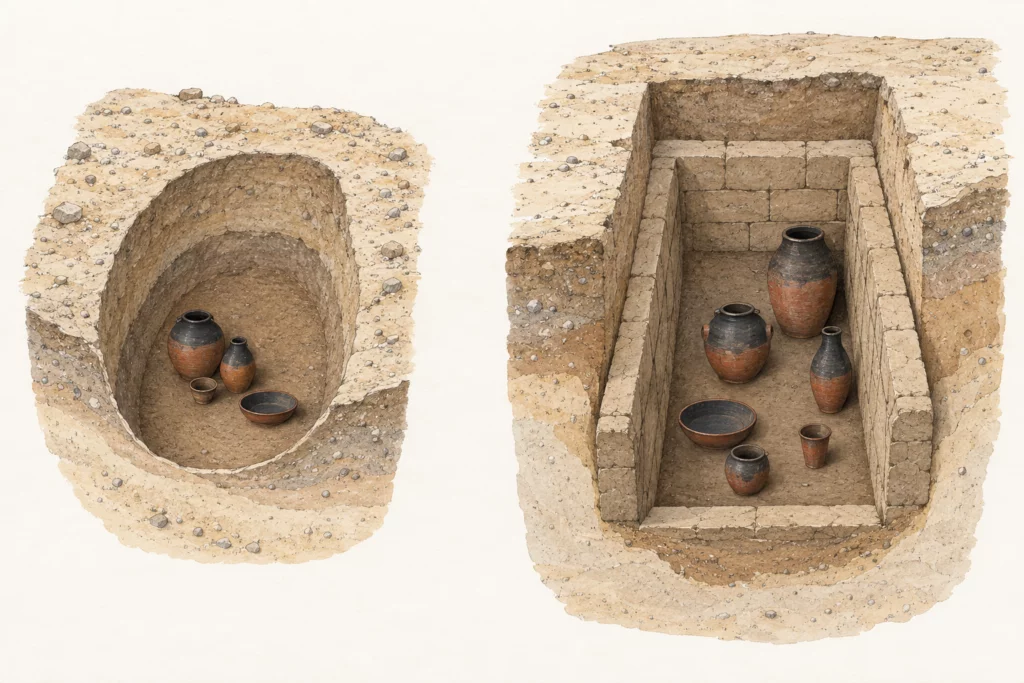
The burials of Naqada I often consist of relatively simple oval pits. During the following phases, larger pits and rectangular forms appear; some elaborate tombs have mudbrick fittings. The funerary vessels include pottery of varied fabrics, forms and decoration, whose comparison has made it possible to establish relative sequences. Cemetery T, used in particular during Naqada II and III, stands out for tombs that are larger and generally better furnished than those of other sectors. This diversity should not be reduced to two fixed ‘types’: plans, disturbances and assemblages vary from one tomb to another. The plan published by Petrie and Quibell shows more than 2,200 tombs at small scale, many of them without a legible number.
Chronology and building phases
The periodisation into Naqada I, II and III is an archaeological framework, not a succession of dynasties known from king lists. As a guide, the reference points used by UCL place Naqada I at around 4000–3500, Naqada II at around 3500–3200 and Naqada III at around 3200–3000 BC. The boundaries differ between studies and contexts. Flinders Petrie devised his ‘sequence dates’ by comparing pottery assemblages; Werner Kaiser later refined the phases. The early pits, the more elaborate tombs and the burial sectors are therefore not all contemporary. The cemeteries continued to be reused, or to sit alongside other occupations, after prehistory; each tomb must be dated by its own context, not by the name Naqada alone.
History and functions
These places served to bury the dead and to deposit, depending on the case, vessels and other objects. The deposits do not automatically explain the beliefs of the living: their precise meaning may vary and remains partly out of reach. The frequency of certain tomb forms and the uneven richness of the grave goods have fuelled discussion of social differentiation in Upper Egypt before the pharaonic state. Cemetery T has often been described as an ‘elite’ sector because of the size and the goods of several tombs; this label describes an archaeological tendency, not a certain identity for each person buried. Archives and dispersed collections now make it possible to take up these questions tomb by tomb.
Excavations and the history of research
William Matthew Flinders Petrie directed the great campaign of 1894–1895 at Naqada; James Edward Quibell worked in particular at Ballas. Their book Naqada and Ballas appeared in 1896. Petrie first attributed these tombs to a supposedly later ‘New Race’. Jacques de Morgan recognised their Predynastic antiquity, and Petrie later corrected his interpretation. The notebooks, plans and objects preserved have been re-examined, notably by Alice Stevenson. In 2024, Xavier Droux compared the excavation notebooks with the printed plan and proposed a revised digital map of sectors N, B and T. The NUBTI project, supported by the Institut français d’archéologie orientale (IFAO, French Institute of Oriental Archaeology) with the Petrie Museum, aims to bring together the descriptions of tombs, the drawings and the objects in collections in order to reassess the funerary assemblages and their chronology.
State of preservation and research questions
The preservation of the site must be distinguished from that of the objects and archives. Droux indicates that much of the burial ground has been destroyed and now lies under cultivation; the burials can therefore no longer be read as a vast cemetery open to visitors. The 1896 map has gaps and duplicated numbers; comparison with the notebooks has made it possible to relocate tombs and correct errors, without removing all uncertainty. The NUBTI project is pursuing this verification of contexts and grave goods. This research is a reminder that an object attributed to Naqada fully illuminates the cemetery only if its tomb of origin and its documentary provenance can be established. Finally, Naqada the site must be distinguished from the Naqada culture, attested well beyond this region.
Sources
Main sources: Petrie, W. M. Flinders and J. E. Quibell, Naqada and Ballas, London, 1896. https://commons.wikimedia.org/wiki/File:Naqada_and_Ballas._1895_(IA_cu31924028748261).pdf (consulted on 26 September 2026).
University College London, Digital Egypt for Universities, ‘Background Information to Naqada’ and ‘Chronology of the Naqada Period’. https://www.ucl.ac.uk/museums-static/digitalegypt/naqada/background.html; https://www.ucl.ac.uk/museums-static/digitalegypt/naqadan/chronology.html (consulted on 26 September 2026).
Stevenson, Alice, ‘The Archival Record of W. M. F. Petrie’s 1894–5 Excavations in the Predynastic Cemeteries of Naqada’, in The Many Histories of Naqada, 2020. https://discovery.ucl.ac.uk/id/eprint/10102819/ (consulted on 26 September 2026).
Droux, Xavier, ‘Revisiting Petrie’s Excavations at Naqada: Cross-matching the Available Documentary Evidence and New Digital Map’, Interdisciplinary Egyptology, 3/1, 2024, pp. 1–59. https://doi.org/10.25365/integ.2024.v3.4 (consulted on 26 September 2026).
IFAO, NUBTI project, ‘Naqada Unified Base for Tomb Information’. https://www.ifao.egnet.net/recherche/operations/op23354/ (in French) (consulted on 26 September 2026).