Identification and location
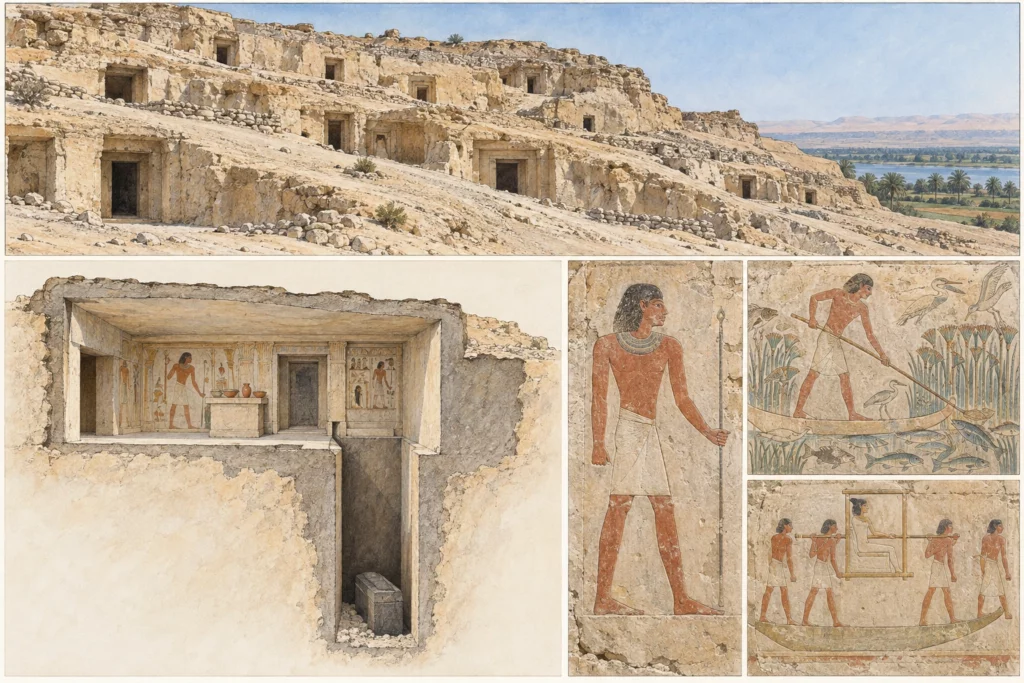
El-Hawawish occupies the rocky hills near Akhmim, capital of the ninth nome of Upper Egypt, in the present-day Sohag region. It is a vast provincial cemetery, not a royal complex. The tombs with rock-cut chapels belong mainly to the late Old Kingdom and the First Intermediate Period. The architectural study by Elizabeth Thompson places the burials of officials of high and middle rank between the 5th and 8th Dynasties, with later extensions of the cemetery. A single date for the whole site would be misleading.
General presentation
The group documents the administration of a province, the careers of its officials and the way in which they chose to appear in their tombs. Its size makes it possible to compare plans, titles and reliefs within a single territory. The Egyptian ministry records more than 800 tombs, of which about 60 preserve elements of decoration. This proportion is a reminder that a selection of a few painted chambers does not represent all the burials. Comparisons with Saqqara or Giza serve to study shared developments and local choices, without establishing a simple copy of the royal centre.
Monuments and remains
The façades and entrances are stepped up the rocky slope. Chapels cut into the mass of the rock led to the places of offering, while the burial could be placed in less accessible structures. Dimensions and fittings vary from one owner to another. The surviving scenes show the dead man standing or seated, sometimes watching activities, fishing in the marshes, travelling by boat or carried in a palanquin. These themes are studied in a Macquarie University thesis.
Chronology and building phases
The tombs of the period from the 5th to the 8th Dynasty show differences that scholars use to propose a relative chronology. Architecture alone does not, however, give an exact date: inscriptions, style and context must be compared. The Australian researchers of Macquarie University and the Australian Centre for Egyptology recorded the tombs and their inscriptions from the 1980s. The publications of Naguib Kanawati and his colleagues, followed by Thompson’s university studies, have renewed the interpretation of the cemetery. Losses of decoration and deterioration make it necessary to record the condition observed during each campaign.
History and functions
The chapels and offerings sustained the memory and cult of the dead. Images of farming, hunting or transport made an ideal world available and displayed the owner’s rank. They may contain plausible actions, but they are not a neutral inventory of his life. Titles and the size of a tomb help to study the hierarchy of officials, without establishing a mechanical equivalence between architectural measurement and real power. The decoration of a particular official must remain attached to its location, its inscription and its state of preservation.
Excavations and the history of research
The ministry’s description gives an overview of the extent, the periods and the themes preserved. Elizabeth Thompson’s architectural thesis examines whether elements of the plan make it possible to date the owners or to grasp their rank. Her research on the scenes analyses the representations of the owner and compares them with other provincial cemeteries and with the Memphite region. The series of surveys by Macquarie University, The Rock Tombs of El-Hawawish, remains a field reference for identifying individual tombs. These bodies of work should not be replaced by a general illustration when a detail is required.
State of preservation and research questions
Erosion, losses of relief and differences in preservation make the documentation uneven. The five tombs that the ministry judges very well preserved do not sum up the hundreds of others.
Sources
Main sources: Egyptian Ministry of Tourism and Antiquities, ‘El-Hawawish’, https://egymonuments.gov.eg/ar/archaeological-sites/el-hawawish/ (in Arabic); Macquarie University, E. Thompson, ‘A study of the architecture of the cemetery of El-Hawawish’, https://figshare.mq.edu.au/articles/thesis/A_study_of_the_architecture_of_the_cemetery_of_El-Hawawish_at_Akhmim_in_Upper_Egypt_in_the_Old_Kingdom/19435184; E. Thompson, ‘The depiction of the tomb owner’, https://figshare.mq.edu.au/articles/thesis/The_depiction_of_the_tomb_owner_in_the_Old_Kingdom_cemetery_of_El-Hawawish_in_Upper_Egypt_a_documentation_and_analysis_of_the_representations_of_tomb_owners_at_El-Hawawish_and_other_provincial_sites/19435046; Macquarie University, ‘The rock tombs of El-Hawawish’, https://researchers.mq.edu.au/en/publications/the-rock-tombs-of-el-hawawish-the-cemetery-of-akhmim/ (consulted on 27 September 2026).