Identification and location
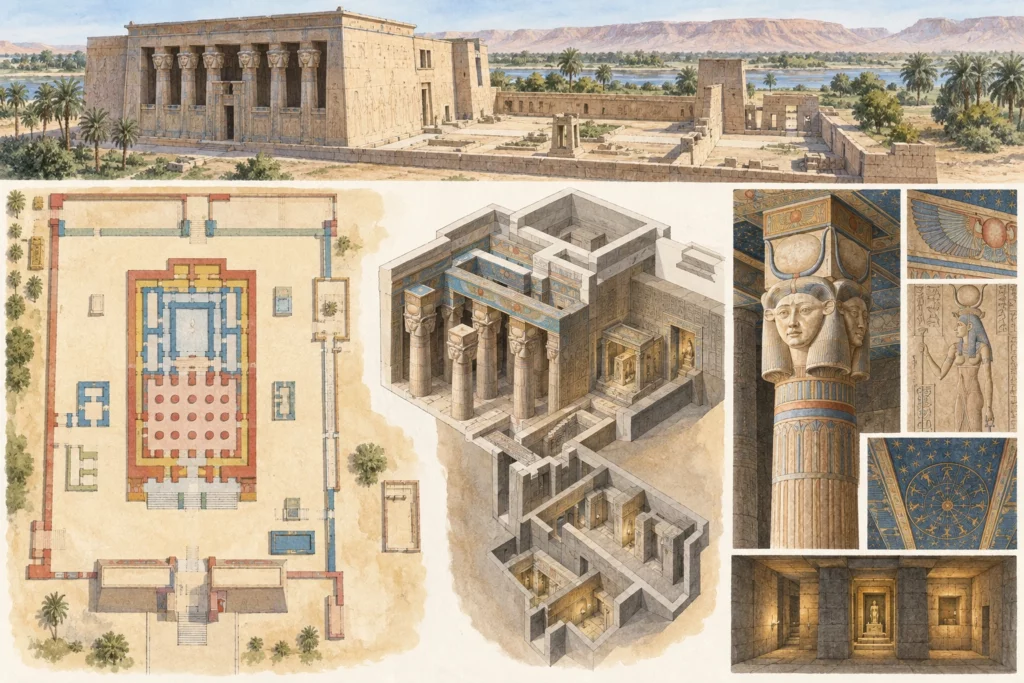
The temple of Hathor at Dendera stands on the west bank of the Nile, opposite the town of Qena. It rises in the centre of a vast mudbrick enclosure that also contains two mammisi, a sacred lake, a sanatorium and chapels. It is one of the best-preserved temples in Egypt, roof included.
Architecture and decoration
The façade opens onto a pronaos of 24 columns whose capitals bear the face of Hathor, beneath a recently cleaned astronomical ceiling; according to the Egyptian ministry, sistra frame the face of the goddess on the columns of the façade. Next come a second hypostyle hall, offering rooms and the sanctuary. Crypts built into the thickness of the walls held the cult objects. Staircases lead to the roof, where there are chapels devoted to the resurrection of Osiris.
One of these chapels bore the famous circular zodiac of Dendera, removed in 1821 and kept since then in the Musée du Louvre; a cast replaces it on site. On the rear outer wall, a large scene shows Cleopatra VII and her son Caesarion making offerings to the gods.
Chronology and building phases
The present temple was begun in 54 BC, under Ptolemy XII, on the site of older sanctuaries, and its decoration continued under Cleopatra VII and then under the Roman emperors. The pronaos dates from the time of Tiberius. Earlier elements, going back to the Old Kingdom according to the temple’s texts, attest the antiquity of the cult of Hathor at Dendera. The Egyptian ministry states that remains earlier than the Ptolemaic temple go back as far as King Pepi I, of the Old Kingdom. The present temple is therefore only the last stage of a sacred place occupied for more than two millennia, which explains the layering of religious traditions, from the first cults of the goddess to the great cosmological compositions carved under Roman rule.
History and functions
Hathor, goddess of love, music and joy, was the principal deity of the place. Each year, her statue travelled by river to Edfu to join Horus at the festival of the ‘Beautiful Reunion’. The mammisi celebrated the divine birth of their son Ihy.
Excavations and the history of research
The temple was cleared by Auguste Mariette in the 19th century. The Institut français d’archéologie orientale (IFAO, French Institute of Oriental Archaeology) has for decades been publishing its inscriptions, which form one of the richest religious corpora of late Egypt.
State of preservation and research questions
The cleaning of the ceilings, blackened by soot, has revealed bright colours. Research focuses on the theology of Hathor, on religious astronomy and on the chronology of the phases of decoration.
Sources
Main sources (consulted on 28 September 2026): Egyptian ministry, Temple of Dendera; IFAO, Dendara (in French).