The Theban tombs of high officials are not royal tombs. Their owners, dates and decoration give access to other milieux and other forms of memory. For the moment, the catalogue contains only one detailed article in this group: tomb TT33 of Padiamenope, in the Asasif.
In brief
The west bank at Thebes has many tombs of dignitaries, cut into the slopes of the mountain around Sheikh Abd el-Qurna and the Asasif. The heading ‘tombs of the high officials’ is an editorial entry point, not a claim that TT33 sums up all these burials. The selection may be widened as other articles are documented. For UNESCO, the west bank has thousands of tombs, including those of many dignitaries. Each has its owner, its date and its decoration: reading them one by one makes it possible to grasp milieux other than the royal court, and other ways of preparing for eternity.
What you discover
TT33 belongs to Padiamenope, a lector priest of the late 25th or early 26th Dynasty, in the 7th century BC. It is an immense tomb: 22 rooms and corridors, 322 m in length, four levels descending to 21 m below the desert surface and 2,622 m² of decorated walls, according to the Institut français d’archéologie orientale (IFAO, French Institute of Oriental Archaeology). An enclosure of more than 9,500 m² surrounds it.
Its walls bring together the great religious compilations of Egypt: the Book of the Dead, the Amduat, the Book of Gates, the Book of Caverns, the Pyramid Texts and the ritual of the Opening of the Mouth. A Franco-Italian mission, directed by Silvia Einaudi and Isabelle Régen, has been studying it every winter since 2004.
What to look at
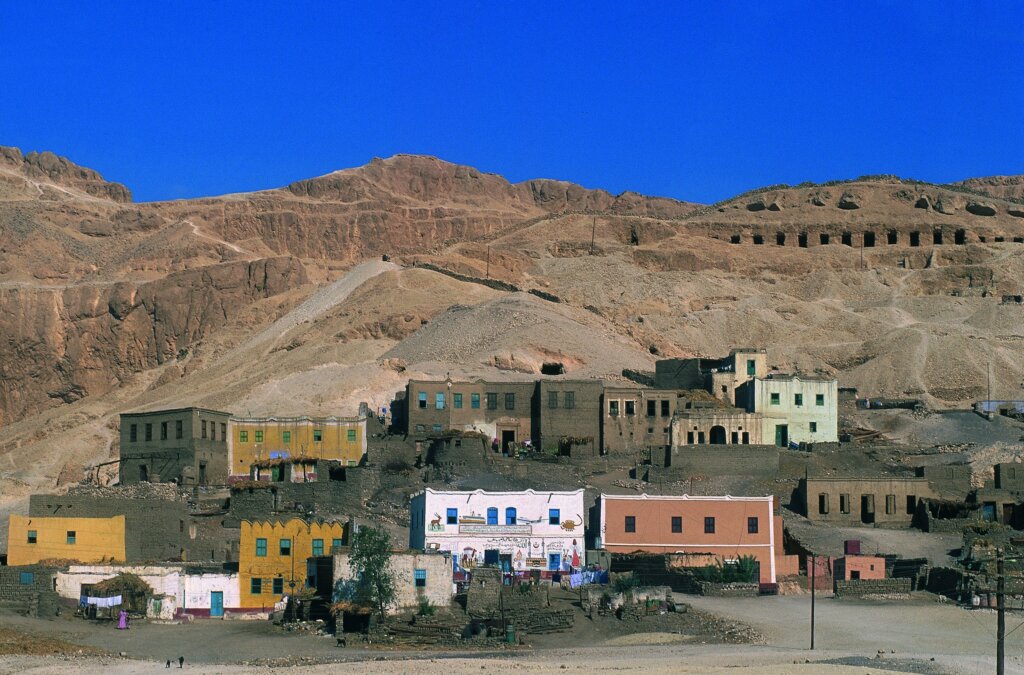
Padiamenope is also known in Europe through a block statue kept in the Louvre. The IFAO points out that it bears the first hieroglyphic text reproduced correctly in the West, and that Jean-François Champollion identified the man in 1829. The photograph shows the village of Qurna, now demolished, at the foot of the tombs of the nobles.
Its history
The chronology of TT33 separates it from the most famous tombs of the New Kingdom, built several centuries earlier. This difference is precisely what makes it useful: the Theban necropolis continued to be occupied and transformed after the period of the great royal tombs. The elites of the Late Period took up the ancient texts there, copying and reorganising them on immense walls. Since the Renaissance, Padiamenope has moreover played the role of an ambassador of Egyptian civilisation in the West, in the IFAO’s phrase: his statue, his texts and his tomb accompany the very history of the decipherment of hieroglyphs.
How to explore the articles
The TT33 article details the monument, its texts, the history of its exploration and the limits of its reconstruction. To place these tombs in their landscape, between the Valley of the Kings and the mortuary temples, return to the article on the Theban necropolis.
Sources
IFAO, TT33 epigraphic mission: https://www.ifao.egnet.net/archeologie/tt33/ (in French)
UNESCO, Ancient Thebes with its Necropolis: https://whc.unesco.org/en/list/87