Identification and location
Tomb C4 lies in Wadi C of the Theban mountain, about 2.4 kilometres west of the Valley of the Kings. A joint mission of the Egyptian Supreme Council of Antiquities and the New Kingdom Research Foundation discovered its entrance and main corridor in 2022. The Egyptian ministry announced in 2025 its attribution to King Thutmose II, a ruler of the 18th Dynasty. It belongs to a funerary sector distinct from the Valley of the Kings; geographical proximity does not justify incorporating it there.
General presentation
The entrance was discovered under deposits that had hidden the tomb. At the start of the research, its position near burials of women of the royal family had led the excavators to consider that of a king’s wife. The inscribed elements found later changed this interpretation. This history of the attribution matters: the owner’s name could not be read on a monumental façade, and the damaged state of the spaces does not allow C4 to be presented as an intact royal tomb. The official announcement distinguishes the observation of the inscribed fragments from the hypothesis of an ancient removal of the body.
Monuments and remains
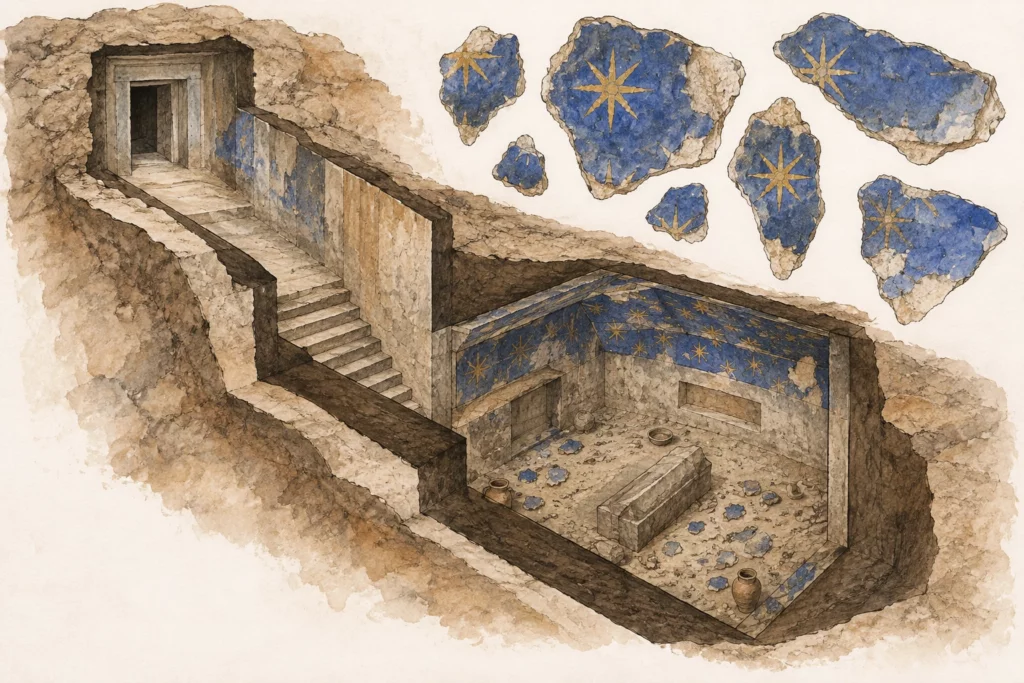
The corridor, coated with white plaster, leads to the burial chamber. The ministry describes a difference in floor level between passage and chamber, without making this detail proof of a single use. Fragments of alabaster vessels bear the name of Thutmose II as deceased king and that of Hatshepsut, his wife. Pieces of plaster preserve blue inscriptions, yellow stars and passages from the Book of the Amduat, a text linked to the night journey of the sun god. This evidence forms a body of arguments for the attribution stronger than the form of the plan alone; it does not, however, reveal the complete funerary equipment or the final location of the mummy.
Chronology and building phases
The cutting belongs to the first part of the 18th Dynasty, according to the attribution presented by the ministry in 2025. The excavators consider that floods reached the tomb shortly after the burial and damaged its decoration. They suggest that the goods and the body may have been transferred elsewhere in ancient times. This is a hypothesis resting on the state of the monument, distinct from the date of the modern discovery: entrance and corridor located in 2022, then identification announced after several campaigns of study. No single date should merge construction, flooding, possible transfer and present-day excavation.
History and functions
C4 was designed as a royal burial, with funerary decoration suited to the status of its occupant. The fragments of the Amduat are not mere ornament: they set the king’s regeneration within the night crossing of the underworld. The link with Hatshepsut appears in the inscriptions on the vessels; it does not allow the whole organisation of the funeral to be reconstructed. The severe deterioration of the monument explains the scarcity of the objects preserved, but a tomb impoverished by water does not by itself prove where its contents may have been moved.
Excavations and the history of research
The Egyptian-British mission has worked step by step since the discovery of the entrance in 2022. The attribution first considered, to a royal woman, was revised after the reading of the inscribed fragments. The ministry’s press release published in 2025 provides the main arguments available: inscriptions with names on the vessels, royal decoration and the position of the monument. The fallen plaster had to be collected and restored for parts of the painted programme to be recognised. The continued archaeological publication will make it possible to clarify the sequence of the deposits, the dimensions and the relationships between the spaces without depending solely on a press release.
State of preservation and research questions
Water and sediment have badly degraded the tomb; the entrance does not offer the monumental façade that some illustrations might suggest. The fragments of plaster and alabaster are now an essential part of the scientific file. The ministry presents the ancient transfer of the royal remains as an interpretation by the excavators, not as an already identified secondary tomb. The questions concern the exact chronology of the flood, the quantity of equipment removed, the original position of each fragment and the possible destination of the body. Any reconstruction of the plan or decoration must clearly indicate what has been recorded and what remains conjectural.
Sources
Main sources: Egyptian Ministry of Tourism and Antiquities, ‘Discovery of the Tomb of King Thutmose II’, press release consulted on 28 September 2026: https://egymonuments.gov.eg/news/discovery-of-the-tomb-of-king-thutmose-ii-the-last-lost-tomb-of-the-kings-of-the-eighteenth-dynasty-in-egypt/. The attribution and the hypothesis of an ancient transfer are presented according to this press release, pending the detailed publication of the excavations.