Identification and location
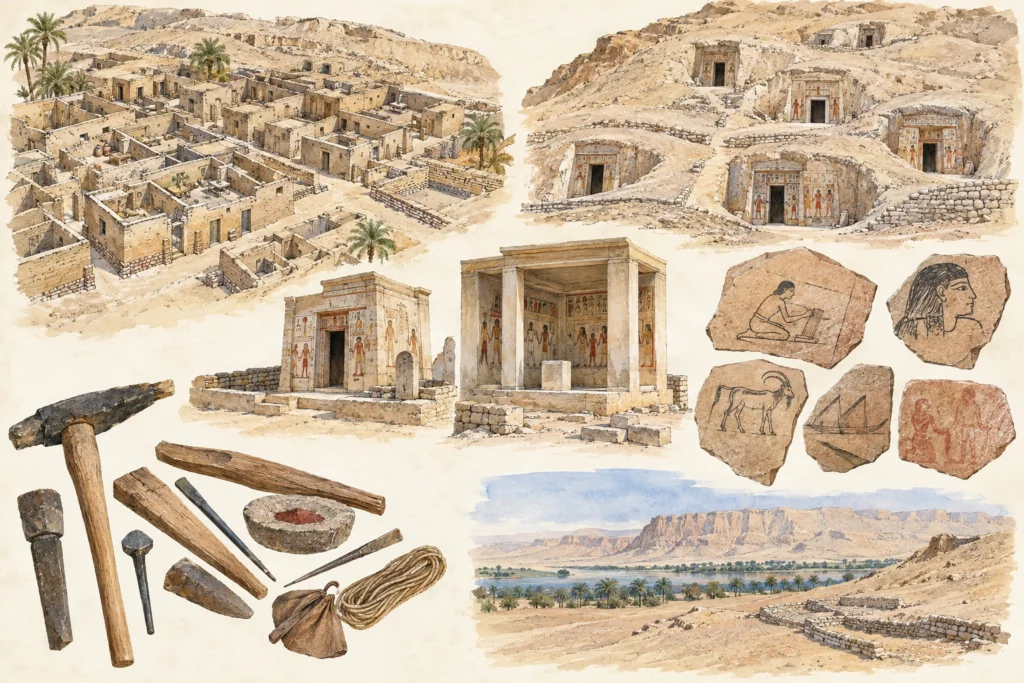
Deir el-Medina occupies a small valley on the Theban west bank, between the routes leading to the Valleys of the Kings and Queens. Its ancient inhabitants belonged to the community responsible for cutting and decorating the royal tombs of the New Kingdom. The site combines a village, cemeteries, places of worship and work spaces. It would be misleading to see it as a mere work camp: the houses and the burials attest a community settled over several generations, with its families and its own institutions.
General presentation
The village preserves the foundations of houses packed into a bounded space. The mudbrick walls make a domestic organisation legible, but the height of the rooms, the roofs and the vanished furnishings cannot be deduced directly from the foundations. Cemeteries frame the dwellings; the Institut français d’archéologie orientale (IFAO, French Institute of Oriental Archaeology) points out that only the western one is still visible, the eastern one having been filled with excavation spoil. The decorated chapels and tombs belong to particular people and families. Village and necropolis must therefore be studied together, without assuming that a neighbouring house necessarily corresponds to its funerary occupant.
Monuments and remains
The craftsmen included in particular stonecutters, draughtsmen, sculptors, painters, carpenters and scribes. Their private tombs do not reproduce identically the programmes commissioned for the kings. The tomb of Sennedjem, TT1, is among the best-known monuments of the necropolis and was explored from the very first research. The ostraca, limestone flakes or potsherds bearing texts and drawings, form another major corpus. They include administrative documents, exercises, literary texts and images. Their abundance makes it possible to study work and local life; it nevertheless reflects writing practices and the chances of preservation, not the whole population in equal measure.
Chronology and building phases
The community developed in the New Kingdom as the construction of the royal tombs mobilised specialised teams. The dwellings and tombs were transformed over the generations; a room, a painting or an ostracon must be dated from its own context. The richly decorated tombs known are mostly Ramesside, which does not allow the village to be given the same appearance throughout its occupation. More rudimentary shelters, near the work sites and on the mountain, spared the teams from returning to the village every day. This difference between place of residence and places of work helps us to understand how movement through the necropolis was organised.
History and functions
The village also housed the workers’ families. The written texts shed light on distributions, absences, exchanges, conflicts and religious practices; they must be compared with the houses and the objects rather than read as a complete account of daily life. The places of worship and the tombs show that these craftsmen prepared their own funerary future while working on that of the rulers. Deir el-Medina is exceptionally well documented, but it does not on its own represent all the Egyptian communities of the New Kingdom: its resources, its closeness to the court and its production of writings gave it a particular position.
Excavations and the history of research
The IFAO has been studying the site since 1917. Bernard Bruyère carried out methodical excavations from 1922 to 1951 in the village, the necropolises, the chapels and the Great Shaft; his diaries and reports preserve the provenance of many objects. The IFAO archives also bring together photographs of the tombs and their walls, some taken as early as the 1920s. These documents make it possible to follow the condition of the paintings and to put back in place fragments now separated from their find spot. Current research complements the early excavations with the study of corpora of texts, tools, stelae and objects of domestic life.
State of preservation and research questions
The mudbrick walls remain exposed to erosion; the paintings and plasters of the tombs are also deteriorating. Objects dispersed among collections must be linked to the excavation notebooks and photographs before being interpreted as a group. A reconstruction that raises the walls uniformly or furnishes the houses at random gives an appearance of certainty that the remains do not allow. The questions still open concern the transformations of the village, the identification of families, the distribution of trades and the precise relationship between written archives and excavated spaces. The preserved contexts and the early archives are both necessary to answer them.
Sources
Main sources: Institut français d’archéologie orientale, ‘Deir el-Médina’, ‘Archives Deir el-Médina’ and ‘Archives de Bernard Bruyère’; Metropolitan Museum of Art, Catharine H. Roehrig, ‘An Artisan’s Tomb in New Kingdom Egypt’ (2004). Pages consulted on 28 September 2026: https://www.ifao.egnet.net/bibliotheque/catalogues/archeologie/deir-el-medina/ (in French); https://www.ifao.egnet.net/archives-scientifiques/ressourcesenligne/archives-focus/archives-deir-el-medina/ (in French); https://www.ifao.egnet.net/bases/archives/bruyere/about; https://www.metmuseum.org/de/essays/an-artisans-tomb-in-new-kingdom-egypt.