Identification and location
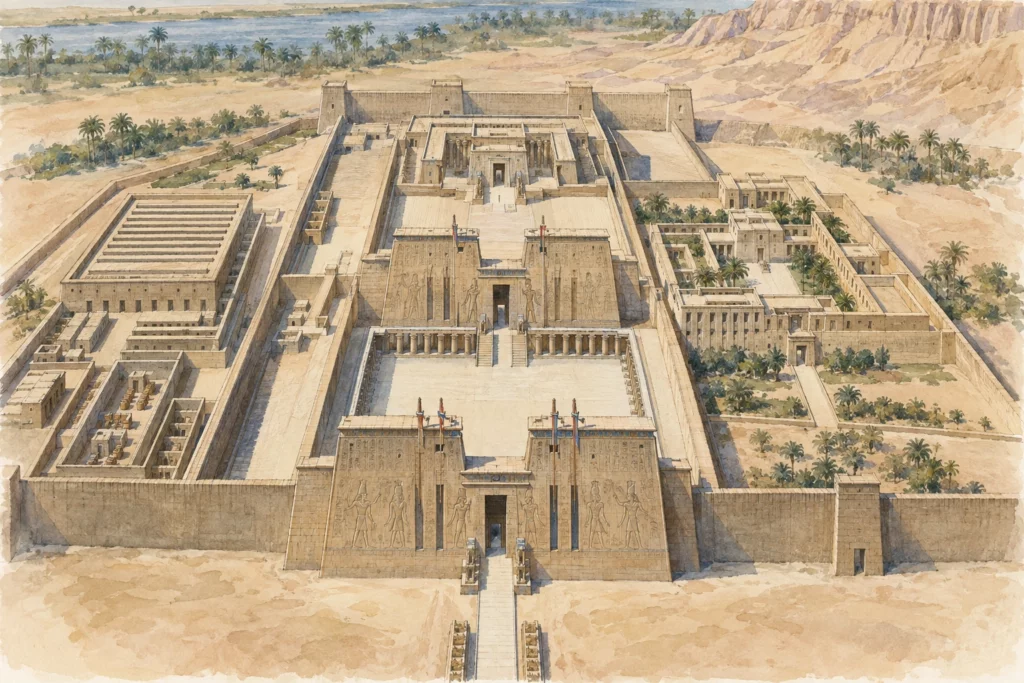
Medinet Habu, on the west bank at Thebes, houses the temple of ‘millions of years’ of Ramses III (Ramesses III), one of the best preserved in the necropolis. A vast enclosure also brings together an older 18th Dynasty temple, chapels of the Divine Adoratrices of Amun and the remains of a royal palace.
Architecture and decoration
One enters through a fortified gateway inspired by Syrian fortresses, the migdol, decorated with scenes from the king’s life. The First Pylon and the first court, lined on one side with pillars bearing Osiride statues, communicated with the palace by a ‘window of appearances’. A second court, hypostyle halls and cult rooms follow.
The outer walls bear the great military scenes of the reign, including the battle against the ‘Sea Peoples’, on land and at sea, in the king’s year 8. These reliefs are a major source for the upheavals of the end of the Bronze Age in the eastern Mediterranean.
Chronology and building phases
The small temple of Amun was built under Hatshepsut and Thutmose III, then enlarged in later periods. The great temple dates from the reign of Ramses III (c. 1184–1153 BC). In the 25th and 26th Dynasties, funerary chapels of the Divine Adoratrices were built within the enclosure.
History and functions
Medinet Habu was an administrative as much as a religious centre. It was in the reign of Ramses III that the workmen of Deir el-Medina stopped work to demand their rations, in what is often described as the first known strike. Later, the enclosure housed the Coptic town of Djeme.
Excavations and the history of research
Since 1924, the Epigraphic Survey of the Oriental Institute of Chicago has been recording the reliefs and inscriptions of the site, published in the Medinet Habu series. These facsimiles remain the basis of any study of the temple.
State of preservation and research questions
The colours are partly preserved in the second court. Research focuses on the historical reading of the military reliefs, which combine real events and the conventions of royal ideology.
Sources
Main sources (consulted on 28 September 2026): Egyptian ministry, temple of Medinet Habu; UNESCO, Ancient Thebes with its Necropolis.