In brief
At Qurna, on the west bank at Thebes, Seti I had a temple of ‘millions of years’ built, intended for the royal cult and for Amun-Ra. This monument is distinct from his tomb, KV17, cut into the Valley of the Kings, and from his great temple at Abydos. The German Archaeological Institute (DAI) excavated there from 1969 to 2001 and is now preparing the publication of the results.
What you discover
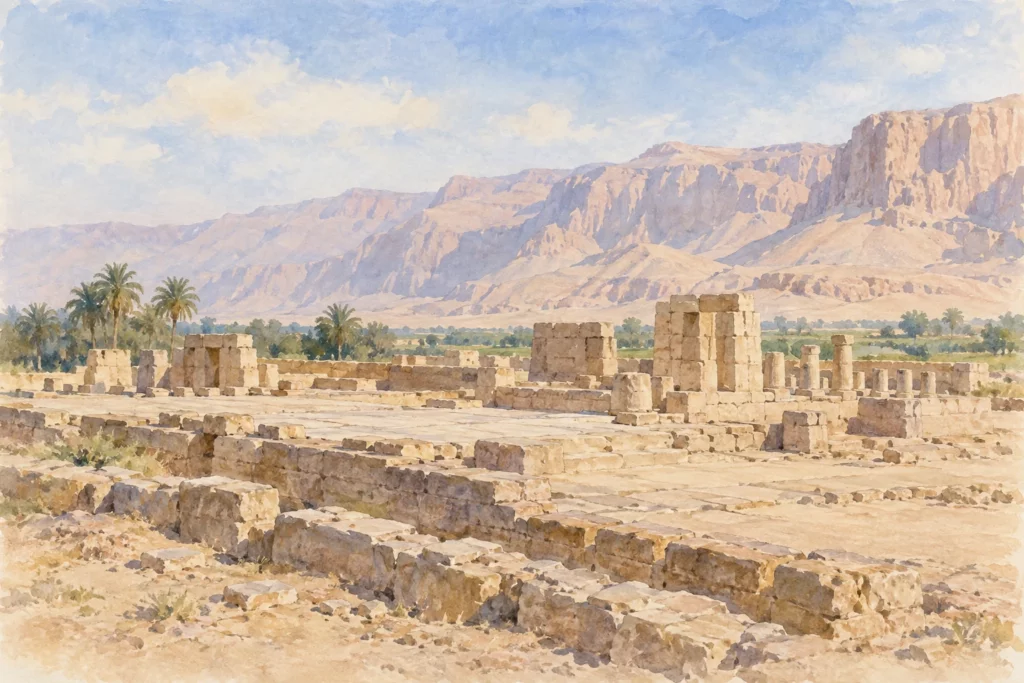
Visitors approach a ruined temple on the edge of the cultivated land of the west bank, at the foot of the Theban massif. The monument dates from the time when the kings, following the example of the 18th Dynasty, separated the tomb, hidden in the mountain, from the temple, built on the edge of the desert, facing the Nile and the temples of the east bank. This type of temple housed the king’s cult and the resting place of the barque of Amun during the processions of the west bank, in particular the Beautiful Festival of the Valley, according to Guy Lecuyot. The elevations are now fragmentary, and it is the study of the remains and the archives that makes it possible to reconstruct the whole.
Its history
Seti I reigned c. 1294–1279 BC, according to the chronology of the Egyptian ministry. Guy Lecuyot, a CNRS researcher, notes that Seti I had already used at Qurna innovations (a stone pylon, a colossus, a hypostyle hall) found afterwards at the Ramesseum. His son Ramses II (Ramesses II) built the Ramesseum on the same foundations as a small temple of his father, and respect for this plan explains, according to the same author, the irregular shape of his temple. Excavations were carried out at Qurna from 1969 to 2001 under the direction of Rainer Stadelmann, with reports published in the Mitteilungen des Deutschen Archäologischen Instituts, Abteilung Kairo (MDAIK) between 1972 and 1982.
What to look at
The best detail is the very position of the temple: between it and the Ramesseum, further south, stretch cultivated fields, on the edge of which several royal monuments were aligned parallel to the Nile. Lecuyot specifies that the temple of Seti I marks the northern limit of this alignment, while the small temple of Medinet Habu marks its southern limit.
Why this place matters
Qurna is an essential link in the history of the temple of millions of years. It shows how a king of the 19th Dynasty combined, on the west bank, a cult of Amun and a royal cult, away from his burial hidden in the mountain. The temple is also one of the components of the property ‘Ancient Thebes with its Necropolis’, inscribed by UNESCO in 1979. The current DAI programme, directed by Kathrin Gabler and Dietrich Raue in collaboration with the University of Mainz, concerns the processing and publication of the excavation data, as well as the digitisation of the archives. Much therefore remains to be published.
Sources
Consulted on 30 September 2026: The Temple of Seti I at Qurna, Deutsches Archäologisches Institut; Ancient Thebes with its Necropolis, UNESCO World Heritage Centre; Guy Lecuyot (CNRS), The Ramesseum (Egypt), Recent Archaeological Research.